

It was a typical weekend and I decided to go explore the city. I checked on google and this place showed up. The architecture looked so unique and beautiful that I decided to go visit.
As I love to visit the places alone I would say,
“Don’t be scared to walk alone. Don’t be scared to like it.”
https://youtube.com/watch?v=-Y1_j2MzU0A%3Fautoplay%3D0%26mute%3D0%26controls%3D1%26origin%3Dhttps%253A%252F%252Fganeshapawar.wixsite.com%26playsinline%3D1%26showinfo%3D0%26rel%3D0%26iv_load_policy%3D3%26modestbranding%3D1%26enablejsapi%3D1%26widgetid%3D1%26forigin%3Dhttps%253A%252F%252Fganeshapawar.wixsite.com%252Fhistoryonroads%252Fpost%252Fshinde-chhatri-memorial-of-mahadji-shinde-commander-in-chief-of-the-maratha-army%26aoriginsup%3D1%26gporigin%3Dhttps%253A%252F%252Fganeshapawar.wixsite.com%252Fhistoryonroads%252Fblog%26vf%3D1
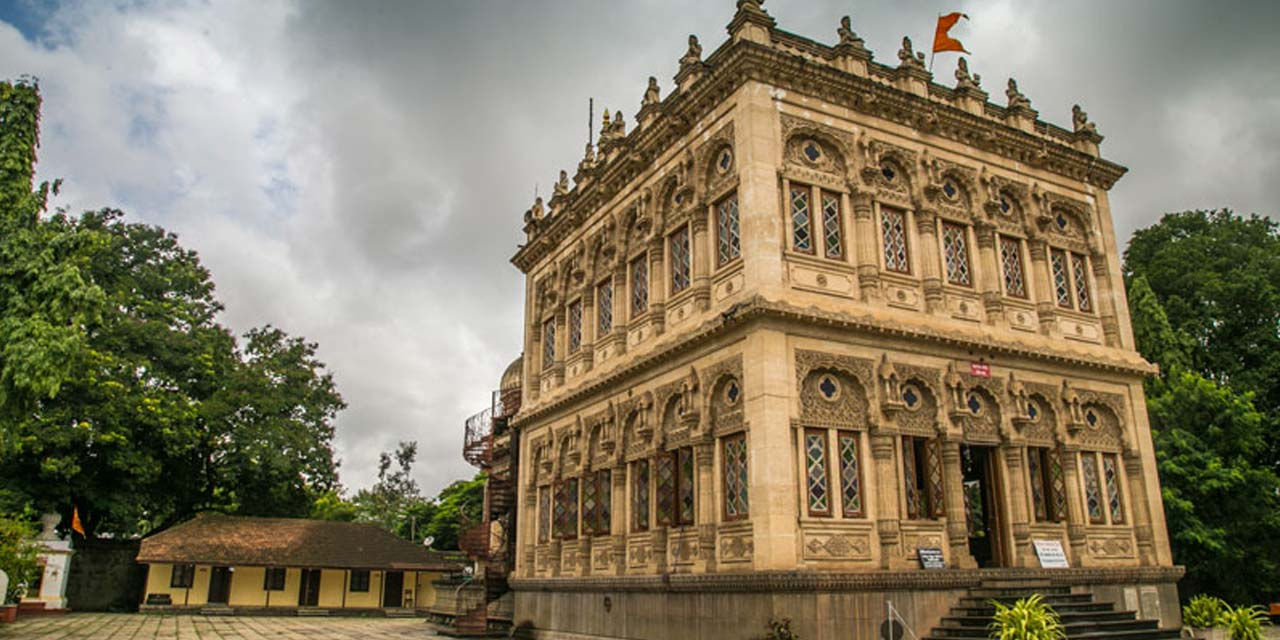
Shinde Chhatri is located in Wanowrie– on your way from Kondhwa to Hadapsar. This is a memorial built in the honor of Mahadji Shinde- a military leader during the reign of the Peshwas. Chhatri means an umbrella- the memorial shelters his ashes and so is called Shinde Chhatri. The complex houses a Shiva Temple, which is right behind the memorial, a Vitthala Temple, a small Hanuman Temple, and Mahadji Shinde Samadhi.
History
MAHADJI SHINDE CHHATRI MEMORIAL
Mahadji Shinde Chhatri was commander-in-chief of the Maratha army during the 1700s. A temple of Lord Shiva was built by Mahadji Shinde in a small complex at Wanwadi in Pune at the time of his active life.
In 1794, the complex of the memorial only had a temple, dedicated to Lord Shiva, which was built by Mahadji Shinde himself. He died the same year and his last rites were performed on the premises. The memorial to Mahadji was commissioned by one of his descendants.
In 1910, a samadhi (memorial) was constructed outside the sanctum of the Shiva temple, in memory of Mahadji Shinde, exactly where he was cremated. Maharaja Madho Rao Scindia of Gwalior (1876 – 1925) commissioned the building of the complex, along with the memorial of Mahadji Shinde. The Architects of the monument were the firm of Shapurjee N. Chandabhoy of Bombay.
The Scindia of Gwalior is the descendants of Daulat Rao Sindhia, the adopted son of Mahadji Shinde. It is maintained by Shinde Devasthan Trust, Gwalior.
In 1965, Madhavrao Shinde of the ‘Scindia Dynasty’, who ruled the erstwhile state of Gwalior, constructed a memorial outside the main sanctum of the temple along with the memorial hall.
Architectural Style
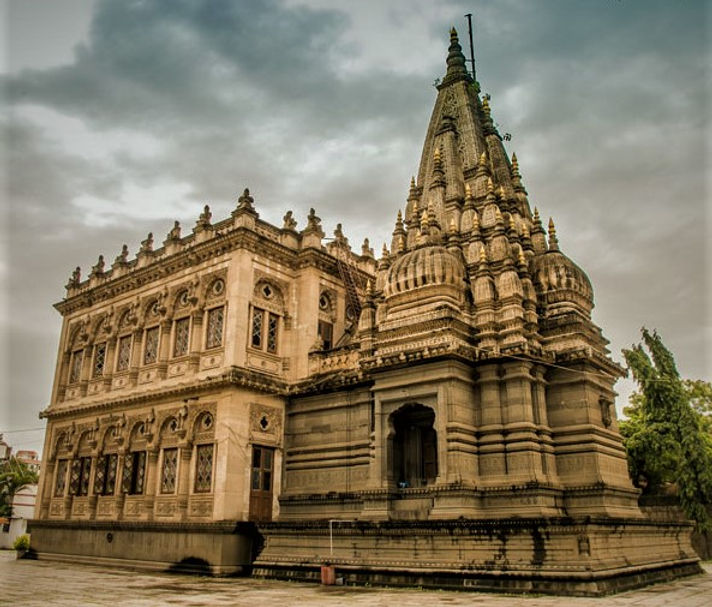
The architectural style used here is Anglo-Rajasthani but it also has traces of Indo-Islamic architecture in its floral motifs and friezes. The structure is on a stone plinth with yellow sandstone used for its walls. The play of stained glass and the multifoil arches just add another layer to its unique architecture.
The Shiva Temple reminds you of a typical Rajasthani temple with its pointed roof or vimana– depicting the shape of hands joined together in prayer. The entire vimana is elaborately carved in Rajasthani floral motifs. The stone structure also has friezes breaking the monotony and giving the structure some depth.
The Gomukh- cow’s mouth is a spout through which the milk/water offered during rituals is carried outside from the garbhagriha (sanctum sanctorum). I don’t like how they’ve put a pipe right through the cow’s mouth, imagine her discomfort! This could’ve been done more efficiently.
The square-shaped building reflects the Anglo-Rajasthani style of architecture – a fine blend of two different cultures.
Six sculptures are seen at the top seated in a meditative state (as you can see in the cover image), a total of 24 well-crafted figures facing four directions.
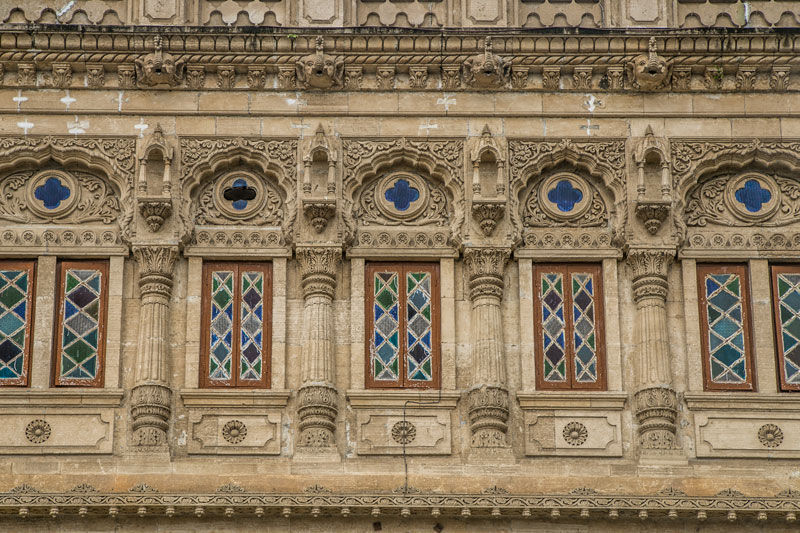
The exterior exhibits windows with colored glasses, columns, and arches with intricate designs of flowers, shapes, elephant faces, and molds carved on a yellow stone; whereas the inner sanctum is made of black stone.
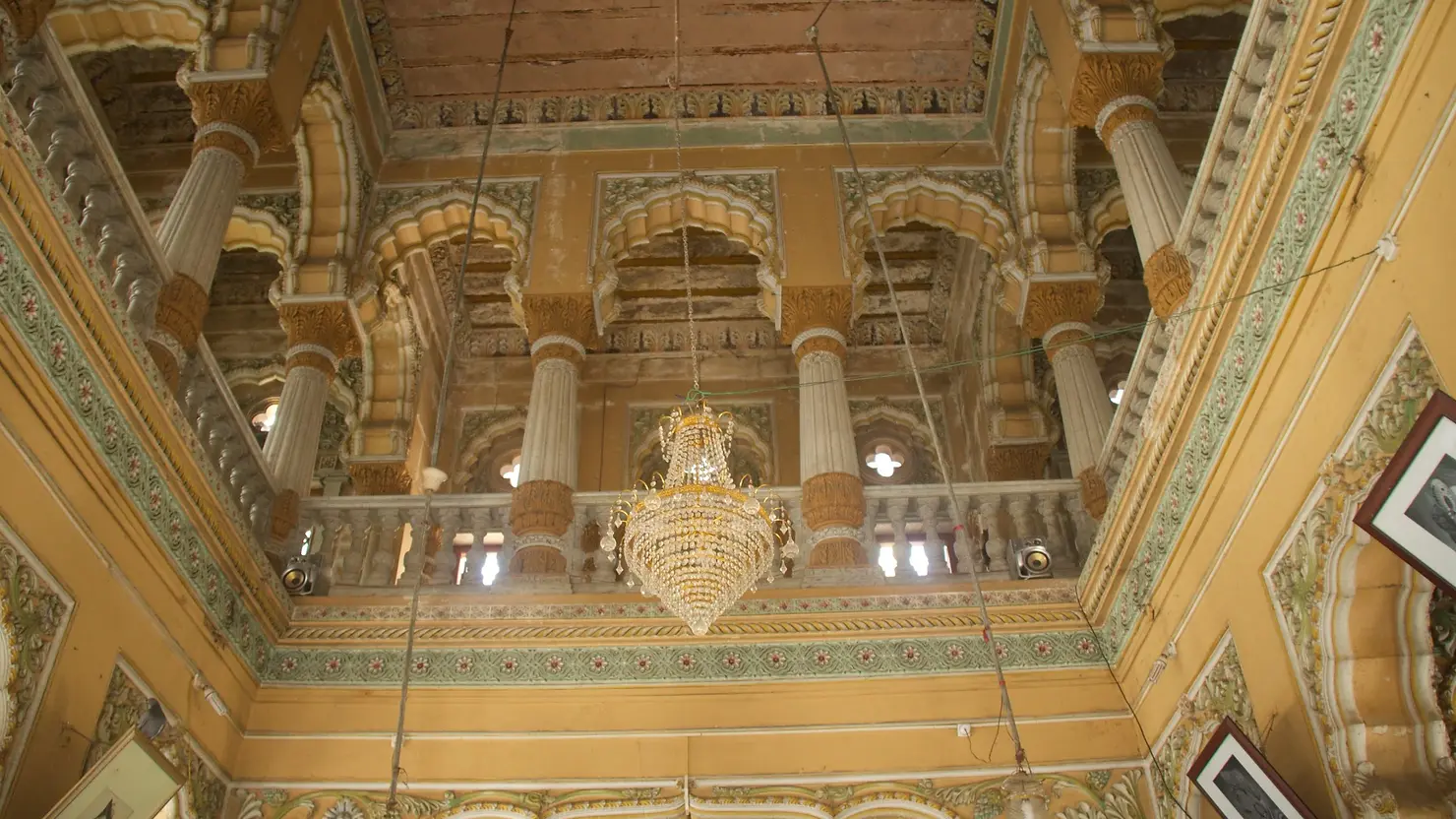
The interior has a photo gallery hall with carved pillars supporting the upper floor and white marble flooring with geometric prints. The hall is adorned with lamps, photographs, and paintings of members of the Shinde family. A unique combination of beige and brown color paint gives the interior an elegant look.
Shinde Chhatri memorial is well-lit from the inside, with a natural inflow of light and cross-ventilation; a visible feature in many of the old buildings and religious structures. It somewhat suggests, mankind’s limited dependency on artificial sources of light and fresh air in the earlier period. Or to take an alternate view, a problem resolved through architecture design and precision artisan-ship.
The guardians of the Shinde Chhatri memorial have revival plans to bring back the structure to its original look, but I doubt if any progress would have been made by now due to various pandemic-led restrictions and labor crises. I was lucky to be able to enter the memorial and take some photographs. However, this wasn’t the case with a few other places that I visited in Pune as they were closed for renovation.
I was lucky that day because fortunately the insides were open and we could take some photos!
It is safe to say that this place is unique and one of a kind in Pune. If you are interested in architecture detailing and exploring heritage sites, then this is the place to go. The amalgamation of different elements has somehow worked well and doesn’t feel botched. So if you live in Pune then do give a visit to this place!
“Architecture should speak of its time and place, but yearn for timelessness” – Frank Gehry