

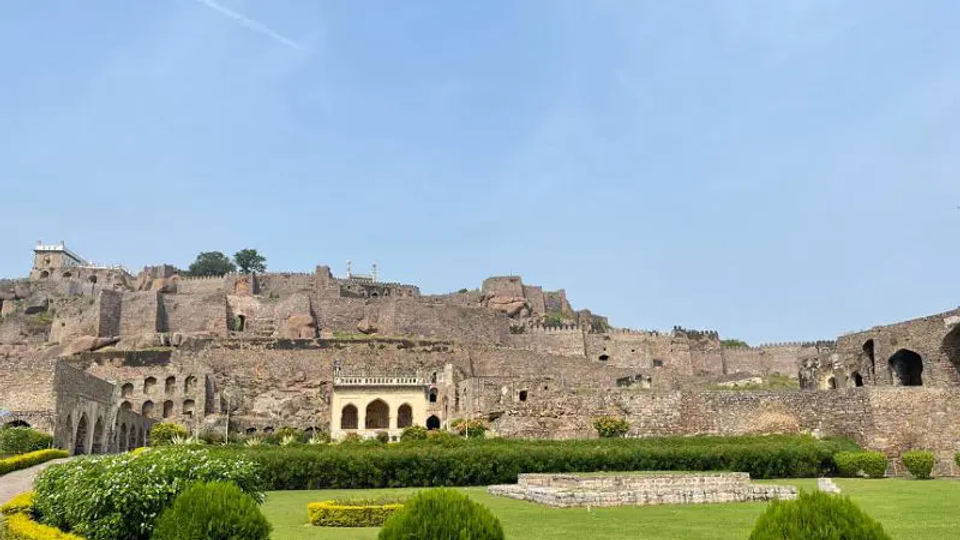
The Great Golconda Fort is a fortress and the initial capital of the Qutb Shahi Empire in Hyderabad.
The Golconda Fort entails four forts spread over an 11-kilometer with mighty eight entrances. Golconda fort is also well-known for its diamond mines, which yielded fabled gems like the Koh-i-Noor, Blue Hope, as well as Daria-e-Noor.
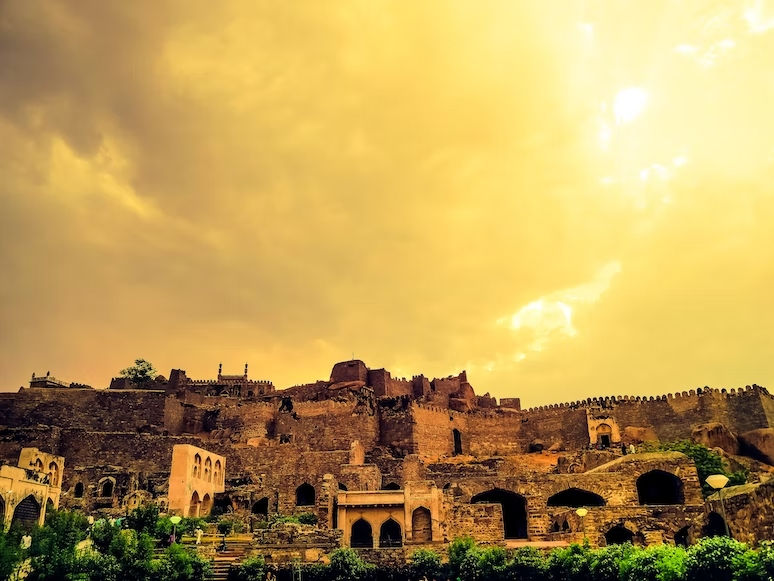
Located in the western part of Hyderabad city Golconda Fort is about 9 km from Hussain Sagar Lake. The outer fort inhabits an area of three square kilometers, which means 4.8 kilometers in length.
The Mighty Fort and Its History
The fort was formerly known as Mankal and was built in 1143, under the reign of Rajah of Warangal.
Later on, the fort was fortified between the 14th and 17th centuries by the Bahmani Sultans & Qutub Shahi dynasty. It was the principal capital of the Qutub Shahi kings. This amazing fort contains ruins of amazing palaces, and mosques along with the hilltop pavilion, which rises high and gives a bird’s eye view of other structures nearby.
Golconda fort is unquestionably one of the most glorious fort complexes in the Indian subcontinent. The story of it goes back to the early 13th century when it was ruled by the Kakatiya and by Qutub Shahi kings in the later period by the 16th and 17th centuries. The fort is built on a granite stone hill.
Golconda consists of semicircular bastions, 8 entryways, and 4 drawbridges, with many royal apartments and great halls, places of worship like temples, mosques, etc. inside.
The “Fateh Darwaza” – outermost enclosure.
It was originally called Golla Konda in Telugu. According to stories I heard – A shepherd boy came across an idol on this rocky hill and it has been informed to the ruling Kakatiya king, who constructed a mud fort around this holy spot.
The Kakatiya ruler Ganapatideva [1199–1262] built a hilltop outpost—later known as Golconda Fort —to defend their western region.
Rani Rudrama Devi and her successor Prataparudra strengthened the fort further.
Golconda Fort was first built by the Kakatiya dynasty as part of their western defenses along the lines of Kondapalli Fort.
After 200 years, Bahamani rulers took possession of the fort. Under the Bahmani Sultanate, Golconda slowly rose to prominence. Sultan Quli Qutb-ul-Mulk (r. 1487–1543. It remained the capital of the Qutb Shahi dynasty until 1590 when the capital was shifted to Hyderabad.
The fort finally collapses in 1687, after an 8-month long siege led to its fall at the hands of the Mughal emperor Aurangzeb
It’s a Victory gate, so called after Aurangzeb’s triumphant army marched in through this gate.
Bala Hissar Gate
It is the main entrance gate to the fort located on the eastern side.
Designs of peacocks and lions are characteristic of Hindu architecture and underlie this fort’s Hindu origins. It is whispered a secret underground passageway that starts at one of the durbar halls and leads to the palace at the bottom of the hill. It is supposed to use as an escape route for the royals but we cannot find it nowadays.
“Hatiyan Ka Jhad” – A 400 year old tree
Inside the fort, there is an African Baobab Tree which is known to residents as “Hatiyan Ka Jhad”.
Tree is more than 400 years old – gifted by Arabian traders to Sultan Muhammad Quli Qutub Shah.
The girth of this tree is 27.40 meters (89 feet). Moreover, a cave forms in between the branches of this tree.
Taali maaro miyan!
A clap at a fixed place at the entrance can be heard clearly at the ‘Bala Hissar’ pavilion, the highest point almost a kilometer away. Having purposes –
First – if an invader got in, it served as a warning.
Secondly, it also served as a way for the royals to know they had guests.
The Golconda Fort is full of architectural and acoustic marvels. Whispering at a few places of the forts can be heard distinctly in the other places.
Mahankali Temple
The Sri Jagadamba Maha temple at the top of the fort is the prime attraction to Hindu Pilgrims.
An interesting fact about Ibrahim Quli Qutub Shah is that he was very prevalent among his subjects and was called Malkabhiram by Hindus.
Various dynasties ruled Golconda Fort
Kakatiya Rulers
Bahamani Sultans
Qutb Shahi dynasty
Mughal Empire
(Naya Qila – It’s the new fort I mean an extension to the old Golconda Fort having a Hyderabad Golf Course on the premises)
Diamonds
Golconda is famous for the diamonds found in the southeast at Kollur Mine near Kollur, Guntur, Paritala, and Atkur during the Kakatiya reign. At that time as well, India had the only recognized diamond mines in the world.
Golkonda was the market city of the diamond trade and gems
Many renowned diamonds are believed to have been excavated from here
Daria-i-Noor
Noor-ul-Ain
Koh-i-Noor
Hope Diamond
Princie Diamond
Regent Diamond
Wittelsbach-Graff Diamond
Trade
During the early seventeenth century a strong cotton-weaving industry existed in Golconda. Cotton was produced for domestic use and exports.
Golconda used to produce high-quality plain or decorative cloth made of muslin and calico.
Exports of this cloth were to Persia and European countries.
Monuments are the glimpse of our past. Save History, Save monuments., Save Our Culture, Save India, Save Humanity