
“The next language to disappear may not make international headlines. There will be no breaking news, no global mourning, and no moment of silence. Yet when it vanishes, humanity will lose a piece of itself forever.”
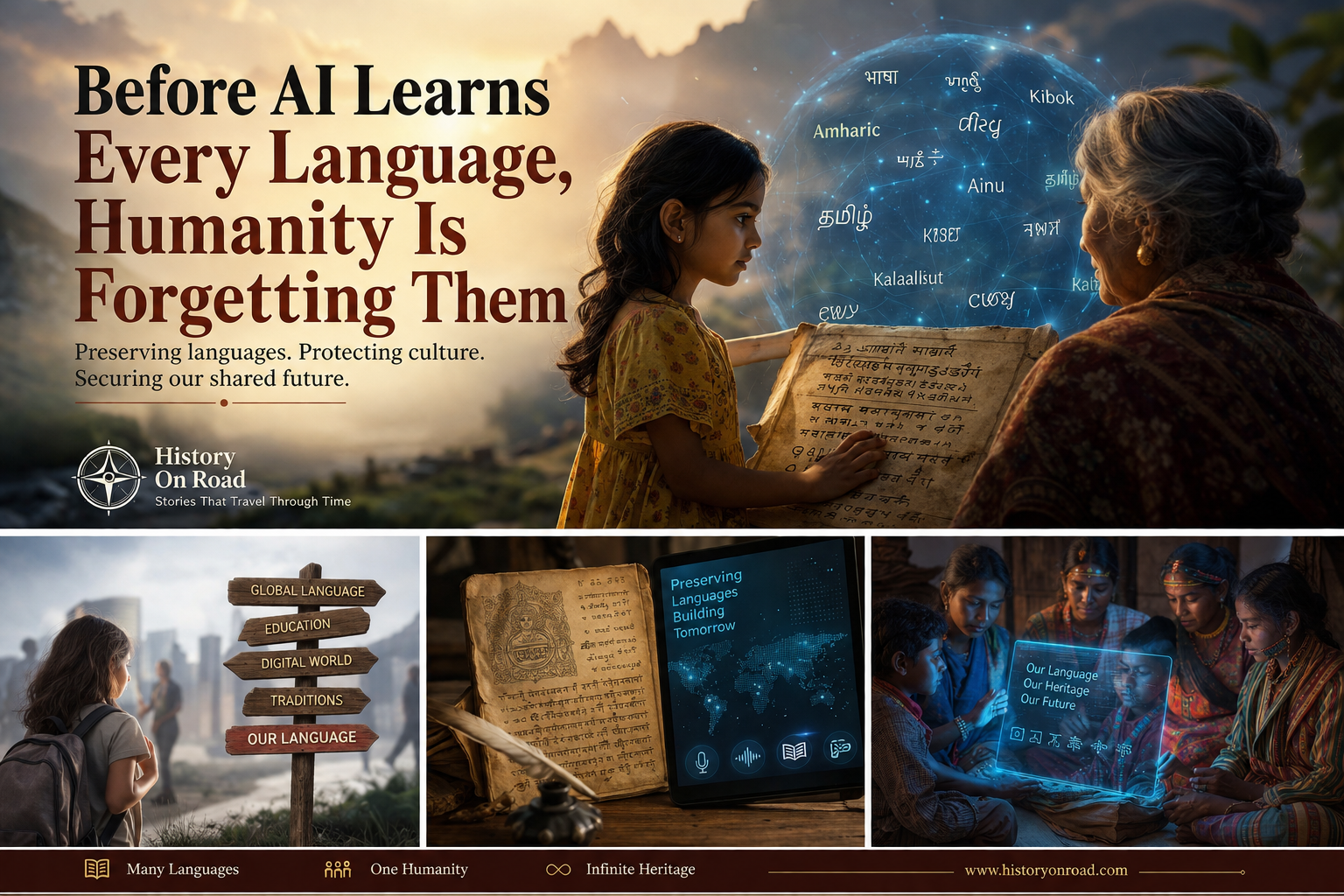
A little girl sits beside her grandmother during a village festival.
The songs are beautiful, the stories are magical, and every word feels like poetry. But there’s one problem—the little girl understands only half of what her grandmother is saying.
At school, she learns in another language.
Her phone speaks another language.
Her favorite videos, games, and social media platforms all speak another language.
Without realizing it, she belongs to the first generation in her family that cannot fully understand the language of her ancestors.
This isn’t a scene from a movie.
It is happening in thousands of communities across the world.
According to UNESCO, the world loses one language approximately every two weeks. Every disappearing language takes with it centuries of folklore, songs, traditional medicine, local wisdom, environmental knowledge, and cultural identity.
For generations, history was written in books.
But long before books existed, history lived in languages.
Today, something unexpected is trying to save them.
Artificial Intelligence.
A Race Between Memory and Machines
Artificial Intelligence has become famous for writing essays, creating images, translating conversations, and answering questions within seconds.
Yet one of its most meaningful roles isn’t replacing humans.
It’s preserving them.
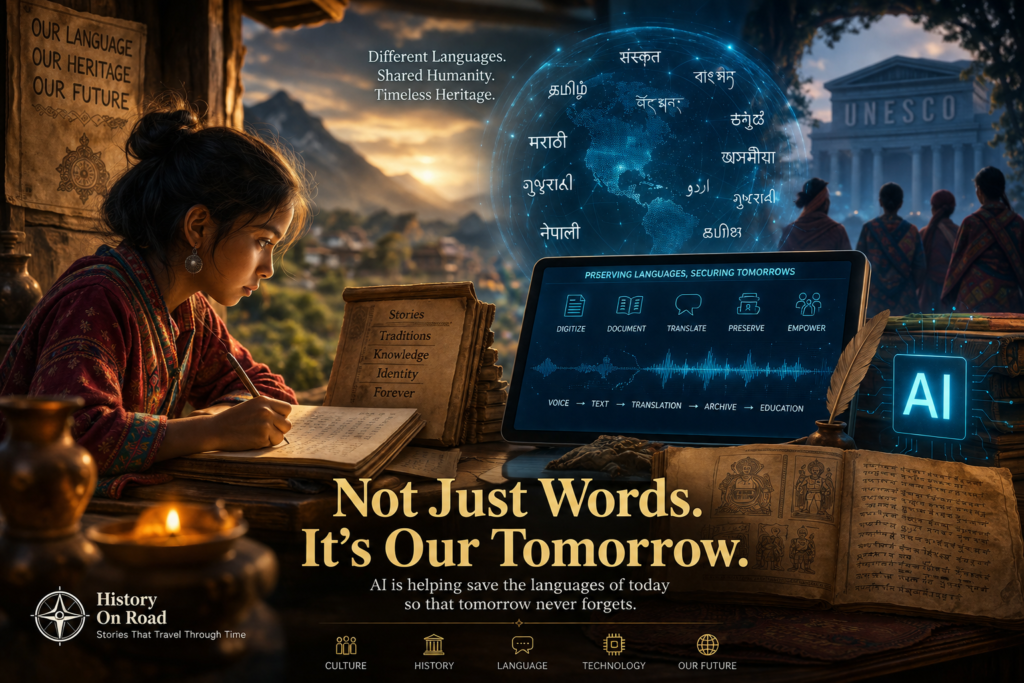
Around the world, researchers are teaching AI something most people never think about—languages that are slowly disappearing.
Not to commercialize them.
Not to modernize them.
But simply to make sure they survive.
India Is Quietly Fighting to Save Its Linguistic Heritage
While much of the world discusses AI chatbots and automation, another story has been unfolding.
India, home to one of the richest collections of languages on Earth, has intensified efforts to preserve endangered languages through the Scheme for Protection and Preservation of Endangered Languages (SPPEL).
More than 117 endangered Indian languages are being documented, while broader projects aim to preserve nearly 500 lesser-known languages.
At the same time, India’s AI-powered Bhashini initiative is helping regional and tribal languages become part of the digital world through translation, speech recognition, and language technologies.
It sends a powerful message.
Technology doesn’t always erase traditions.
Sometimes, it protects them.
Why Does Losing a Language Matter?
Imagine discovering a library where every book is unique.
Now imagine burning one book every two weeks.
Eventually, the shelves become empty.
Languages work the same way.
Every language contains stories that exist nowhere else.
Some describe medicinal plants that modern science has barely studied.
Others preserve songs sung during harvest festivals for hundreds of years.
Some explain rivers, forests, stars, and wildlife through knowledge passed from one generation to another.
When a language disappears, these memories rarely survive intact.
Translation can preserve words.
It cannot always preserve meaning.
The Digital World Was Never Built for Every Language
Open your phone.
How many keyboard options do you have?
Probably dozens.
Now imagine speaking a language that has no keyboard.
No font.
No dictionary.
No speech recognition.
No translation tool.
No online classroom.
For many Indigenous communities, this isn’t imagination—it’s reality.
If a language cannot exist online, younger generations gradually stop using it.
The digital divide becomes a cultural divide.
Then AI Entered the Conversation
For years, historians carefully preserved manuscripts inside museums.
Linguists recorded conversations with notebooks and tape recorders.
Today, AI can accomplish in weeks what once required years.
It can:
- Convert spoken language into text.
- Restore damaged historical documents.
- Translate endangered languages.
- Preserve pronunciation.
- Create digital dictionaries.
- Organize centuries of oral history into searchable archives.
Rather than replacing historians, AI is becoming one of their most powerful assistants.
UNESCO Has a Bigger Goal
UNESCO understands that preserving a language isn’t enough if people cannot use it online.
That is why it has been working to digitize Indigenous scripts and promote digital inclusion for communities whose writing systems are disappearing from modern technology.
A language that cannot be typed, searched, or shared online risks fading from everyday life.
In today’s world, digital survival is cultural survival.
More Than Culture—This Is Also About Society
Language shapes identity.
When children lose their mother tongue, they often lose a direct connection to family traditions, local history, and community memories.
Entire generations can grow up knowing where they come from but not understanding the stories that explain why those places matter.
Communities become culturally poorer even if they become economically richer.
The Hidden Economic Story
Many people see language preservation as an emotional issue.
It is also an economic one.
Traditional crafts, cultural tourism, Indigenous art, local literature, and regional storytelling all depend on communities keeping their languages alive.
As travelers increasingly seek authentic cultural experiences, preserving language becomes part of preserving livelihoods.
Technology can help local voices reach global audiences without losing their identity.
Politics Has Always Influenced Language
Throughout history, languages have flourished or faded depending on political choices.
Education policies, official recognition, public services, and media representation all determine whether a language survives.
Supporting linguistic diversity is not merely a cultural decision—it reflects how inclusive a society chooses to be.
AI can help preserve languages, but governments and communities decide whether they continue to be spoken.
Can AI Really Save a Language?
Not by itself.
A language survives when children speak it.
When families tell stories in it.
When songs are sung in it.
When festivals celebrate it.
When communities feel proud to use it.
AI cannot replace human voices.
It can only ensure those voices are never forgotten.
History On Road Perspective
History does not disappear only when monuments collapse or ancient cities are buried beneath the earth.
Sometimes history fades quietly—in a classroom where children stop speaking their mother tongue, in a smartphone that cannot recognize an Indigenous script, or in a family conversation where traditional words are replaced by more familiar ones.
The encouraging news is that the story is changing. India’s recent efforts to document endangered languages, UNESCO’s digital preservation initiatives, and AI-powered platforms such as Bhashini show that technology can become a partner in protecting culture rather than replacing it.
At History On Road, we believe every language is a living monument. Unlike stone temples or historic forts, these monuments breathe through everyday conversations, songs, and stories. Protecting them is not only about preserving the past—it is about ensuring future generations inherit the full richness of human civilization.
The next great discovery may not come from an archaeological excavation.
It may come from a forgotten language that AI helped the world remember.