
By Ganesh
The first sign of trouble was a grandmother who could not find herself.
It was a warm morning in early 2026 at the taluk office in Kaveripura, a fictional district tucked between the Western Ghats and the Karnataka coast. Seventy-eight-year-old Gowramma stood before a printed voter list, running a trembling finger down the page. She had voted in every election since she was a young bride. Her name, her late husband’s, and her neighbour’s were all missing.
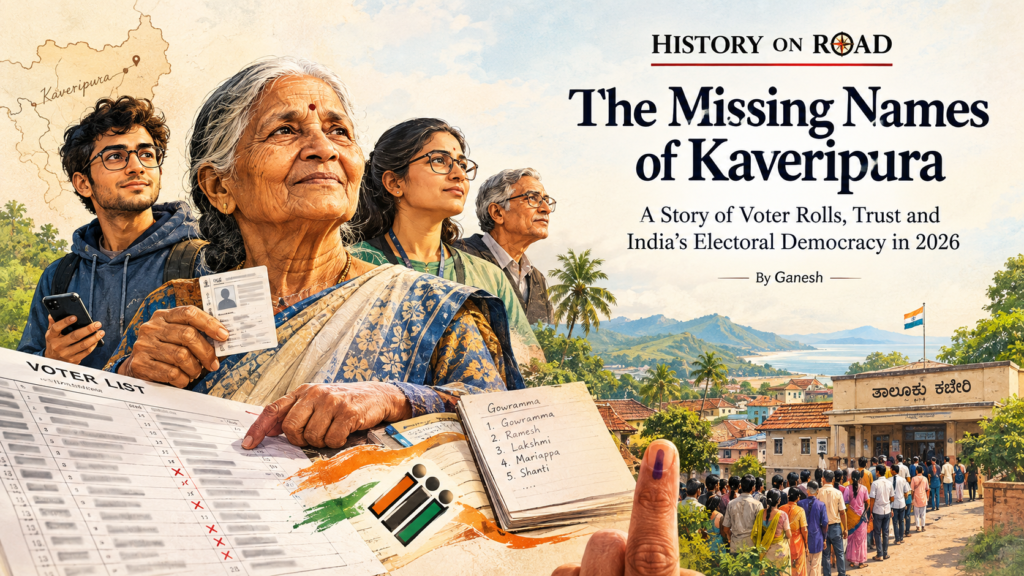
“They say I am ‘absent or shifted,'” she told the small crowd gathering around her. “I have lived in the same house for fifty years. Where would I have shifted?”
Among those who heard her was Shashi, a social worker who had spent twenty years running a village learning centre and, later, serving on the district council. People trusted Shashi for a simple reason: she never promised what she could not deliver. She wrote Gowramma’s name in a small notebook, and then she wrote down the next twelve names that came forward.
By evening, the notebook held ninety-one.
That night, Shashi called the one person she thought could give the problem some perspective: Professor Ramaswami, an international history scholar who had retired to a quiet house near Kaveripura after decades of teaching abroad. He had advised young democracies on how to build institutions, and he still answered every letter and phone call.
“Ninety-one names in one afternoon,” he said slowly. “Come to my verandah tomorrow. Bring tea, and bring the notebook.”
At dawn, Shashi arrived with a flask of filter coffee instead. Beside the professor sat a lanky young man in a faded hoodie, thumbs flying over his phone.
“This is Prashant,” said Ramaswami. “My neighbour’s grandson. He is twenty-one, and he is, I am told, ‘extremely online.'”
“I build apps,” Prashant said, looking up with a shy grin. “And I read your thread about the missing names. A lot of people my age are sharing it. Most of them are angry. Some of them don’t even know how to check if they’re registered.”
Shashi sighed. “Anger is easy, Prashant. Fixing things is slow.”
Ramaswami smiled and lowered himself into his cane chair. “Let me tell you a story about slowness,” he said.
“In 1951, when India prepared for its first general election, there were around a hundred and seventy million eligible voters. Most could not read. Many women gave their names only as ‘wife of’ or ‘mother of’ someone, and officials had to persuade them to register under their own names. People said it was impossible. Some foreign observers predicted chaos.”
“And?” asked Prashant.
“And a young republic did the unthinkable. It painted symbols on ballot boxes so voters who could not read could still choose. It trained thousands of clerks. It displayed the rolls in public, so every citizen could examine them and object. The lesson I took from that moment, and from studying elections in many countries, is simple. A democracy does not survive because its institutions are perfect. It survives because its institutions are open to inspection.”
He tapped Shashi’s notebook. “Voter lists must be cleaned. Duplicates, the departed, the truly shifted: all of this is legitimate work. But when names disappear, the burden must never fall on the citizen to prove she exists. The process must be visible, explainable and correctable. Otherwise, even a correct list will not be believed.”
Shashi nodded. “That is exactly my fear. Not that someone is cheating. That people will stop believing the system is fair, even when it is.”
Not everyone in Kaveripura wanted clarity.
Forty kilometres away in Mangalore, in an air-conditioned office overlooking the harbour, Richa leaned back in a leather chair and read a news summary with growing delight. Richa owned a transport company, two shopping complexes and a talent for finding profit in any confusion.
“Missing names, scared voters, rushed paperwork,” Richa murmured to an assistant. “People will pay for certainty.”
The plan was simple, and thoroughly improper. Richa’s staff would set up “Voter Help Desks” across the district, charging anxious families for what was actually a free service, collecting their personal documents, and quietly building a database. A database like that could later be sold to anyone who wanted to influence who got contacted, who got reminded, and who got ignored.
“A little fear is good for business,” Richa said, signing the order for a hundred banners. Check Your Vote — Fast Service — Small Fee.
Within a week, the banners had spread across the district. Frightened people queued outside the shiny new help desks, handing over copies of identity cards for a fee they could barely afford.
Prashant noticed first. He had been building a simple tool that let anyone search the public roll by name and house number, free of charge. In the app’s feedback box, a farmer had written: “I paid two hundred rupees at a stall near the bus stand. Was that necessary?”
“Shashi-akka,” Prashant said, rushing into the learning centre, “someone is making money from people’s fear.”
Shashi looked at the banners he showed her and felt her jaw tighten. “Do we know who?”
“The stalls are registered under a company called Harbourlight Services. I looked it up. It belongs to a businesswoman in Mangalore named Richa.”
Shashi was quiet for a moment. “We will not accuse anyone without proof,” she said. “That’s not how we work. But we can make sure that nobody needs to pay for what is free.”
The next three weeks were the hardest of Shashi’s life, and the most hopeful.
With Ramaswami’s advice, she wrote a polite, detailed letter to the District Election Officer, a fictional civil servant named Mr. Anand Hegde, requesting three things: a public list of every deleted name along with the reason for each deletion, a simple window for citizens to restore their names with ordinary documents, and an independent review of the process by retired officials and local volunteers.
She did not shout. She did not call anyone corrupt. She simply asked for the process to be shown.
To her surprise, Mr. Hegde agreed to meet her. He was a tired, honest man who had been handed an impossible deadline and too few staff. “I don’t want a single genuine voter removed,” he admitted. “But we were told to finish quickly. If the people want to watch the process, I welcome it. Clean work has nothing to hide.”
Meanwhile, Prashant and a team of college students turned the learning centre into a volunteer hub. They printed the public lists in Kannada, Tulu and English. They taught elders to search by house number. They stood outside Richa’s help desks, not to protest, but to hand out leaflets saying: This service is free. Come to us, or go to the taluk office. Never pay to prove you are a citizen.
Ramaswami visited on weekends, sitting among the students and telling stories of other nations: a country where voters queued for days because lists were never published, another where a simple public display of rolls restored faith overnight. “Transparency,” he told them, “is the cheapest medicine a democracy can buy.”
The turning point came on a rainy Saturday.
Hundreds gathered at the Kaveripura town hall for the first public hearing on deletions. Mr. Hegde sat on the stage with a stack of files. Volunteers read names aloud. One by one, citizens stood to say: I am here. I live there. I am not absent.
Gowramma was among the first. When her name was read, and a clerk stamped Restored, the hall applauded, loudly and warmly, as if a cricket team had won.
By evening, three hundred and forty names had been corrected. Not through lawsuits or slogans, but through paperwork, patience and public eyes.
Richa watched all of this on a video call from Mangalore, arms folded. The help-desk queues had vanished. The profits had evaporated. Worse, one of the volunteers had mentioned in a speech that anyone who had paid a fee should keep their receipt, which the district officer would examine.
That night, Richa made a decision, one of the few not driven by profit. The help desks closed. A quiet refund was announced, and the collected documents were returned and the copies destroyed in front of a local official. It was not an apology, exactly. But it was an ending.
On polling day, the line outside the Kaveripura school stretched down the road.
Shashi stood near the gate, watching Prashant help an elderly man check his name on the app for the last time. Ramaswami arrived in a borrowed jeep, leaning on his cane.
“So,” he asked, “was it worth it?”
Shashi looked at the line: farmers, students, shopkeepers, grandmothers in their best sarees. “I used to think democracy was a big word,” she said. “Parliament, governments, speeches. But it’s this. It’s whether Gowramma can walk into a room and find her own name.”
Prashant grinned. “And whether she believes the room belongs to her.”
Ramaswami chuckled. “A good election is not only a count of votes. It is a count of trust. Every citizen must be able to see how the count is done.”
At the front of the line, Gowramma stepped up, her finger pressing the button on the machine with great seriousness. A small light blinked. A beep sounded.
She turned to face the crowd and smiled, as though she had just reclaimed something that had always been hers.
The HistoryOnRoad Perspective
Every democracy tells its story twice: once on polling day, and once in the quiet months before it, when lists are prepared and names are counted. At HistoryOnRoad, we believe the second story matters just as much as the first.
India’s own electoral journey began with exactly this challenge. The Election Commission was set up on 25 January 1950, and the country’s first general election, held between late 1951 and early 1952, covered roughly 170 million eligible voters, a majority of whom could not read. The answer was not secrecy or haste. It was visible effort: symbols on ballot boxes, public display of rolls, and officials who walked from village to village to enrol citizens, including women who had been recorded only as someone’s wife or mother. Those who built the system understood that a citizen’s name on the roll is the first step of her participation in the Republic.
That is the thread this story follows. Technology has changed and the numbers have grown, but the principle that carried the first election still holds: an election earns trust when its processes are open, explainable and easy for an ordinary citizen to check and correct.
Kaveripura is imaginary, but Gowramma’s quiet pride at the ballot box belongs to every Indian voter, in every era. History does not just record elections. It reminds us how they are made believable.
Author’s note: This is a work of fiction. All characters, places and institutions are imaginary. The story reflects a timeless idea from the history of democracy: elections are trusted when their processes are open, explainable and correctable by ordinary citizens.
About the author: Ganesh is an IT professional, writer and historian who writes on history and society for HistoryOnRoad.com.
Category: Short Story | Indian History & Democracy
Hashtags: #IndianDemocracy, #ElectionsInIndia, #ShortStory, #HistoryOnRoad, #EveryVoteCounts, #IndiaStories
Which moment from India’s democratic history would you like us to walk through next? Tell us in the comments.