

“No goddess, no water, no shame: one man’s refusal to stay silent while his society danced, wasted and posed its way past everything sacred.”
Category: Social, History
At 11:40 p.m., the speakers of Shreeranga Heights Co-operative Housing Society in Kalyanvadi, Pune, were louder than the thunder that never came.
Trunal sat on his fourth-floor balcony with a cold cup of tea and a laptop he had stopped looking at an hour ago. By day he was a data scientist who found patterns in numbers. Tonight the pattern was playing out in the courtyard below, and no spreadsheet was needed.
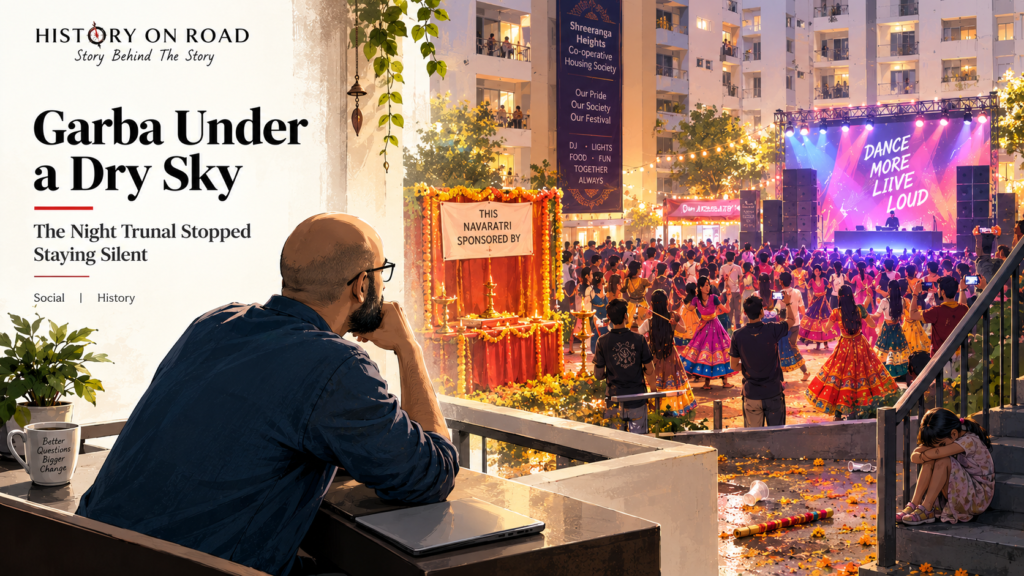
There was no sthapana of Devi Maa. No kalash, no diya, no aarti. The committee had skipped the goddess and kept the DJ. The sponsor banners were enormous, and the idol’s absence went unnoticed. Devi had not been invited to her own festival.
“Navaratri is nine nights of Shakti,” Trunal muttered. “Here it’s nine nights of sound system.”
He had lived in this society for six years. He knew who had donated to the flood relief fund and who had only donated to the garba fund. What he didn’t know was when everyone had decided that being loud was the same as being devout.
The Spectacle
The garba had started at ten, as it did every weekend, and would stretch past midnight. Phones were raised like torches. Many of the dancers moved for the camera rather than the circle, checking the angle of the reel before the rhythm of the beat. Around the edges stood a thick crowd of men who had not come to celebrate anything. They had come to watch, with the glazed stare of people who mistake a festival for a viewing gallery.
Trunal had no problem with dancing. His grandmother had danced garba in a cotton saree in a village courtyard, with a lamp in the centre and devotion in every step. That was worship that happened to move.
What he saw tonight was something else, and he refused to dress it up in polite words.
Garba had been a dance of devotion for centuries, a circle drawn around a lamp, a prayer to the mother goddess set to rhythm. Tonight, film-song item numbers blared from the speakers, and women who called themselves devotees of Shakti were thrusting, grinding and posing to lyrics that no goddess should ever have to hear. It was vulgar, it was cheap, and it was a disgrace to the heritage they claimed to be celebrating. Generations of women had carried this tradition with dignity, through famine, foreign rule and poverty, and it was being traded for a few thousand views. Nobody had forced these women. They chose the stage, the song and the camera. A heritage that survived centuries was being buried in a single decade, and the people burying it were applauding themselves.
That is not empowerment. Empowerment is the courage to keep your tradition with pride. This was the surrender of it for attention.
And the men stood at the edges with folded arms and wandering eyes, treating the evening as a free show, no better than the performance they watched. The organisers chose the playlist, the sponsors paid for the lights, and everyone called it “freedom.” Nobody got a goddess.
On the third-floor landing, a girl of five sat with her head on her knees, asleep against the cold steel railing. She was waiting for a parent who had promised “just one more round” two hours ago. It was 11:55 p.m. School started at 7:30.
Trunal didn’t blame mothers alone. He blamed a society where fathers watched from the sidelines and mothers danced in the middle, and both agreed that the child could manage. Children cannot manage. A child asleep on a staircase is not a cultural moment. It is neglect with a festive soundtrack. And what would that girl learn about womanhood, or about the goddess, from the example in front of her?
He thought of the elderly man in Wing C, who needed rest after dialysis and now lay awake with a pillow over his ears. He thought of the dogs, trembling under parked cars, and the night-shift nurse in Wing A trying to sleep before dawn. None of them had been consulted. Nobody asks the quiet people anything.
The Morning After the Night Before
At seven, Trunal went down for his walk. The courtyard looked like a battlefield that had lost to marigolds. Crushed petals were stuck to the paving, plastic cups rolled in the breeze, and a lone dandiya stick lay by the drain like a casualty.
Last week’s Dussehra had left the same mark. Bikes, cars and even a delivery van had been garlanded in orange and yellow. Pandits were hurried through five-minute poojas while phones recorded every rotation of the coconut. By the next morning, those same flowers lay on the road, ground into tar and clogging the gutters. Sacred at noon, rubbish by dawn. A flower offered to a god and then trampled by a scooter was not an offering. It was a prop.
“We worship machines with marigolds,” he thought, “and then step over the god’s flowers on our way to work.”
Then there was the water.
Bhaurao of Wing B was washing his white sedan with a hose at full force in the common driveway. It wasn’t dirty. He was washing it because he could, and because the neighbours could see him doing it. A rivulet ran down the slope and out of the gate, carrying soap, dust and a month’s worth of drinking water for someone else. Behind him, a scooter blocked the fire-exit path. Beside him, two residents were shouting about whose turn it was to park where, each one certain that the common area was privately theirs.
“Bhau,” said Trunal, keeping his voice polite, “the monsoon failed us this year. The dams are far below where they should be. Maybe we can go easy on the water?”
Bhaurao did not turn off the hose. “My car, my water. I pay maintenance, Trunal. Don’t teach me.”
My car. My water. My society. My noise. My mess.
Trunal typed the five words into his phone. That sentence, he thought, is the real epidemic of this country. It was not a virus or a policy failure. It was an attitude, passed from one generation to the next like a bad inheritance.
A co-operative society is supposed to be exactly what the name says: people operating together. In Shreeranga Heights it was a co-operative in name only, a building full of individuals each fighting for a bigger share of a shared space. They quarrelled over parking and bullied the weak. The one quarrel nobody had was over the things that mattered, like water, sleep, children and kindness.
What the Data Said
That afternoon Trunal opened his laptop, but not for work. For months he had been collecting small observations: rainfall figures, reservoir levels, the cost of floral waste cleanup in his ward, and the litres of water wasted on vehicle washing in his own building. He had counted them the way he counted everything, patiently and without drama.
The numbers were not subtle. His society alone burned through thousands of litres a month on cars that were already clean. Multiply that by the thousands of societies in the city, and the picture stopped being petty and started being criminal. In a year of weak rain, every litre poured on a sedan was a litre that a village downstream would never see.
He knew Maharashtra had been here before. The drought of 1972 was no abstraction in his family’s stories. His grandfather had talked about it in a low voice, as if the memory might still be listening: queues for a single bucket, cattle dying in the fields, grown men fighting over a tanker. A generation later, that lesson had evaporated faster than water from a leaking tank. The people who now washed cars with hoses were the grandchildren of people who had once begged for buckets.
He thought about history in another sense too. Lokmanya Tilak had turned Ganeshotsav into a public festival in 1893 for a purpose bigger than ritual. It was meant to gather people, awaken them and give a divided society a common voice. Somewhere between that vision and the present, the public festival had been hijacked. Sound systems replaced speeches, sponsor banners replaced purpose, and vanity replaced unity. Tilak had used the crowd to wake people up. Today’s crowd had been used to put them to sleep.
He began to write.
“We are not a religious society anymore. We are a photographic society. We do not ask whether the goddess is present, only whether the lighting is good. We do not ask whether the river has water, only whether the car shines. We worship machines with marigolds and starve the earth to do it.”
He kept going.
“Intellectuals and decent people do not behave this way. Cruelty to the earth, noise to the sick, vulgarity in the name of the goddess, and arrogance toward the neighbour are not tradition. They are bad manners dressed in saffron.”
He read the line again. It was harsh, but he did not soften it. Softness had been tried for years, in polite requests, WhatsApp messages and gentle reminders, and it had been ignored by everyone from the chairman down to the man with the hose.
The Confrontation
On Sunday, Trunal attended the society’s general meeting. He had never spoken at one. For six years he had treated these meetings as noise to be endured, like traffic.
When the chairman, Rajesh, announced that this year’s garba would run until 1 a.m. and that the vehicle pooja would be a “grand community event,” with a bigger budget for decoration and a live reel photographer, Trunal stood up. His hands were not entirely steady.
“Sir, we have no sthapana, no aarti, and nobody has asked what Devi would want. We have children sleeping on staircases at midnight. We have an elderly resident in Wing C who needs rest after dialysis. We have item-number dancing in the name of a goddess, and a state struggling with poor rain while we waste water and flowers so that we can post a video.”
The room went quiet, then hostile.
“Who is this man to lecture us?” a voice shouted from the back.
“He’s a data scientist,” someone sneered. “He thinks he’s smarter than all of us.”
“This is our culture,” said another. “Don’t tell us how to celebrate.”
Trunal waited until the noise settled. “Culture is not what you do when everyone is watching. Culture is what you protect when it’s inconvenient. If your festival needs a sleeping child, a sick neighbour and a dry river to be enjoyable, it is not culture. It is selfishness with a playlist.”
Someone laughed nervously. Someone else muttered something about “outsiders,” though Trunal had lived there longer than half the room.
Bhaurao rose with the confidence of a man who had never been told no. “I pay my maintenance. I’ll wash my car when I want.”
“You will,” Trunal said. “And someday your grandchildren will ask where the water went. What will you tell them? That you were busy making your bumper shine?”
The silence that followed was different. It wasn’t hostile. It was the silence of people who had heard something true and resented it for being true.
“I’m not smarter than any of you,” Trunal added quietly. “I’m just not asleep.”
A few people looked down. In the third row, Anjali nodded slowly, and her husband stared at his shoes. In the corner, a retired schoolteacher clapped once and then stopped, embarrassed to be the only one. The chairman called for a vote on the garba timings, which ended in a compromise nobody liked: midnight instead of one. It wasn’t a victory, and Trunal knew it. But it was the first honest argument the society had had in years.
What the Rain Keeps Count Of
That night he finished the piece and sent it to a small history-and-society portal. He didn’t expect applause. He was writing because silence had begun to feel like participation.
He knew the story wouldn’t stop a single DJ or turn off a single hose. But every real change in history had begun as an uncomfortable sentence said aloud by someone who was tired of whispering. Tilak had not been polite either.
His final paragraph read:
“Maharashtra has always been a land of reformers, of Phule, of Savitribai, of Agarkar, of people who looked at their own society and said: this is not good enough. Those people did not ask for permission, and they did not wait for rain. If we cannot summon even a fraction of their courage to turn off a tap, lower a speaker, or let a child sleep, then we have no right to call ourselves their heirs. A society is not measured by how loudly it celebrates but by how quietly it behaves when nobody is watching. By that measure, we are failing, and the rain, the river and the children are keeping score.”
He closed the laptop. Below, the speakers had gone silent for the first time that week, thanks to a power cut that nobody had planned and nobody had prayed for. The courtyard was dark and empty, and a few stray petals lifted in the breeze.
In the silence he heard something he had not heard in months: crickets, and somewhere far off, faintly, a child breathing in her sleep in a bed where she belonged.
Maybe that was where the goddess had been all along.
This story is fiction. All characters, names and places are invented for social commentary.
Hashtags: #CivicSenseCrisis, #FestivalsWithoutFaith, #DryMaharashtra, #SocietyMirror, #ShowOffCulture, #HistoryOnRoad

Borrowed Glory in Kalikapur: The Story of a Village Election