
A Forty-Foot Warrior at the Bus Stop
The overnight bus from Pune dropped Shivam at the banyan-tree stop of Kalikapur at 5:40 a.m., along with two sacks of onions and a goat with strong opinions.
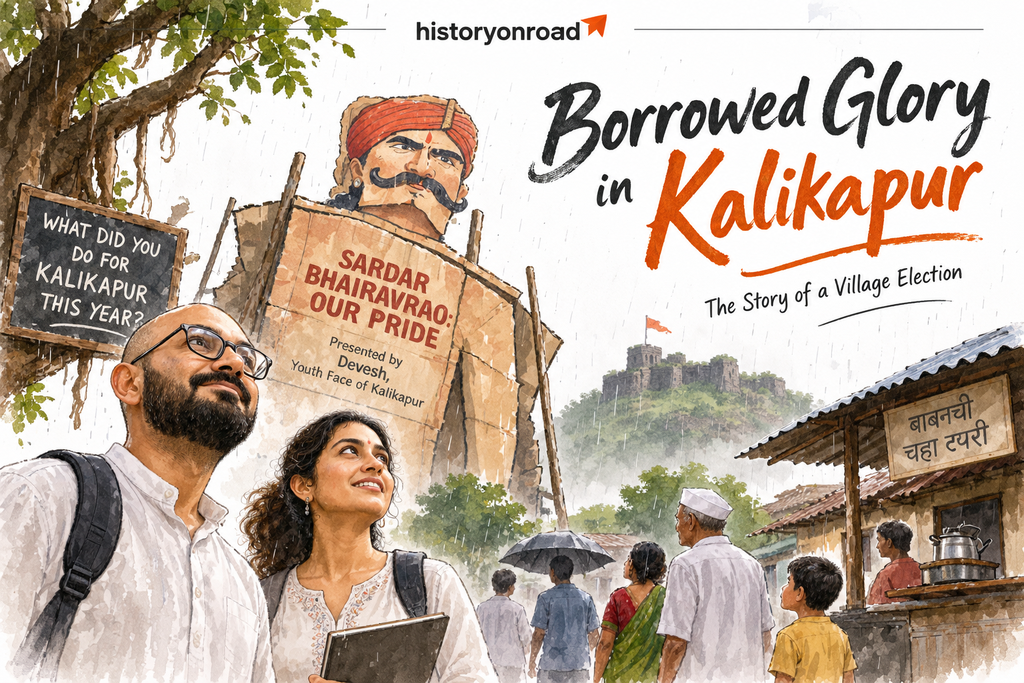
Eleven years in Bengaluru had trained Shivam to read dashboards, spot patterns and predict what strangers would click. Nothing in his career had prepared him for the sight beside the bus shelter: a cardboard man, forty feet tall.
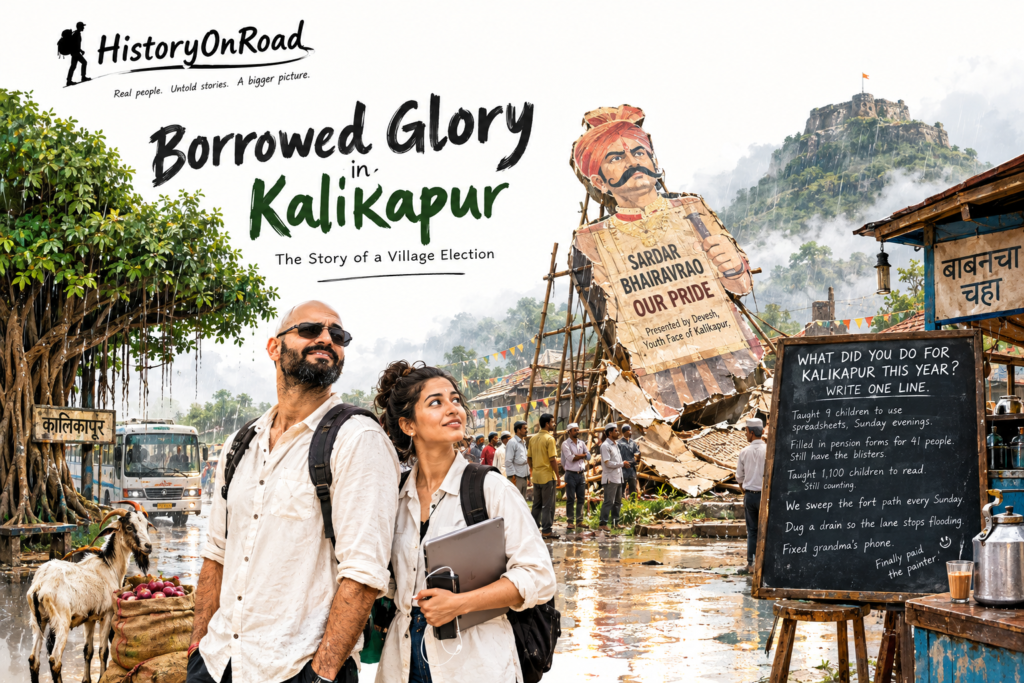
The man wore a turban, a moustache like two curved swords, and the stern look of someone who has just been handed a restaurant bill. Beneath him, in letters a child could stand inside, were the words SARDAR BHAIRAVRAO: OUR PRIDE. Below that, in print so small it seemed embarrassed, ran a second line: Presented by Devesh, Youth Face of Kalikapur.
Shivam laughed out loud. The goat gave him a look of deep disapproval.
He had come home for his mother’s knee check-up and a quiet week in the old family wada. But Kalikapur’s gram panchayat election was nine days away, and the village had caught the fever that always comes with it: fresh paint, loudspeakers at dawn, and every wall wearing somebody’s smile.
The Heir Who Never Pays the Painter
Devesh found him within the hour, because Devesh found everyone within the hour. He was thirty-two, wore sunglasses on his forehead at dawn, and treated every mirror as a form of public service.
“Shivam-bhau! Bengaluru’s big brain! One selfie, quick, the cutout is behind us!”
He was the son of Dadasaheb, the outgoing sarpanch, whose panel was standing for re-election. Devesh had never held a job or contested a vote. His talent was narrower and, in this season, more useful: he could stand beside something large and let the light bounce onto his face.
“How much did it cost?” Shivam asked, nodding at the warrior.
“One lakh twenty. Though the painter wants his last forty thousand, and I told him exposure is also payment.” Devesh grinned as if this were a joke he had not yet noticed was on him. “Bhau, you don’t understand village politics. Roofs don’t win elections. Heritage does. Sardar Bhairavrao was our ancestor. Our blood, our fort, our legacy.”
“Whose ancestor? Yours?”
“The village’s. Which means ours. Which means my father’s panel.”
Shivam admired the sentence the way an engineer admires a bridge that should not be standing. In three short steps, a dead warrior had become a campaign asset.
“The school roof leaks, you know,” Shivam said gently. “Last monsoon, the second-standard class studied under umbrellas.”
Devesh patted his shoulder, the way you pat a child who has asked why the sky is blue. “Umbrellas are cheap, bhau. Legacy is priceless.”
Then he left, to haggle with the band about their rates.
Richa Arrives with a Power Bank
Richa stepped off the next night’s bus carrying a folding whiteboard, a laptop bag and a power bank the size of a brick.
“Never trust a village without a charging point,” she announced, “or a politician without a ledger.”
She was a policy researcher, Shivam’s closest friend of ten years, and the only person who could argue with him for six hours about whether one can love a country without exaggerating it. They shared a quiet irritation at the same thing: a world where everyone seemed to be performing a better version of their life. Busy people who weren’t. Loyal people who weren’t. Proud people who had never lifted a finger for what they were proud of.
“In the city, everyone pretends to be busy,” Richa said, as they walked past the cardboard warrior. “Here, everyone pretends to be convinced.”
“Half this village knows it’s theatre,” Shivam said. “The sarpanch’s own driver told me the roof is a joke. But he’ll still clap on Friday.”
“Because clapping is free and belonging is expensive.” Richa squinted up at the giant moustache. “What do we do? Climb it with a marker pen?”
“No. That is the language they speak. If we shout, we become another poster.”
“Then?”
Shivam thought about his work. In data science, the most powerful tool is rarely a clever model. It is a simple question asked at the right moment, in the right place.
“We don’t fight the warrior,” he said. “We just put one question next to him.”
One Question in Chalk
The next morning, outside Baban’s tea stall, a blackboard appeared on two borrowed stools. Across the top, in Richa’s neat capitals:
WHAT DID YOU DO FOR KALIKAPUR THIS YEAR? WRITE ONE LINE.
Nobody touched the chalk for an hour. People circled it the way cats circle a new sofa.
Shivam went first, to break the spell. Taught nine children to use spreadsheets, Sunday evenings. He felt faintly ridiculous. It was a short line, after all.
Richa followed. Filled in pension forms for forty-one people. Still have the blisters.
Then the retired schoolmaster, Patil Sir, shuffled over with his umbrella and his cloth bag of chalk stubs. He wrote slowly, as he had written on blackboards for thirty years: Taught 1,100 children to read. Still counting.
Something changed after that. A woman from the self-help group added, We sweep the fort path every Sunday. A farmer wrote, Dug a drain so the lane stops flooding. A teenager, giggling, scrawled, Fixed grandma’s phone, and the crowd cheered as though he had cured an illness.
By noon the board was full, and a second one was needed.
Only Baban, the tea-stall owner, wrote nothing. He was sixty, soft-spoken, and in charge of the village water valve, which he opened every day at five. “I do nothing special,” he said, pouring tea. “Just the valve.”
Devesh strolled past around lunchtime, sunglasses shining, and read the board with a thin smile. “Cute. Chalk against cardboard. Let’s see who wins.”
Shivam did not answer. For the first time in days, the village had stopped asking who is great? and started asking what did I do? The difference was only a few words. It was also an entire election.
The Night the Warrior Bowed
The final rally took place on Thursday evening in the school ground, under strings of yellow bulbs and a DJ truck that could have rattled the stars. The cardboard warrior had been hauled in on a tractor and propped up behind the stage with bamboo poles and optimism.
Devesh took the microphone like a man who had waited all his life to be handed one.
“Brothers and sisters! The blood of Sardar Bhairavrao runs through this soil! Through our veins! We are the sons of lions!”
The crowd clapped, mostly out of habit. Near the front, a man with a boiled-peanut cone nodded along with the expression of someone calculating next month’s electricity bill.
A wind rose from the east, the cheeky kind that arrives at the end of the monsoon to see what everyone is up to. It tugged at the bunting. It whistled through the bamboo. It lifted one corner of the cardboard turban.
“We carry his courage! We carry his name! We stand tall because he stood tall!”
Behind Devesh, forty feet of warrior began to lean. He leaned slowly, with great dignity, like a respected elder bending to touch someone’s feet. Then he folded gently forward over the DJ truck. The speakers gave a final squeak and went dead.
There was a pause of perfect silence. Then somebody at the back snorted, and the whole ground collapsed into laughter. It was real laughter, the first honest sound of the entire campaign.
Devesh stood frozen, microphone in hand, a man upstaged by his own ancestor. Desperate to recover, he did what desperate speakers do: he asked a question without knowing the answer.
“Who here,” he cried, “is a true descendant of Bhairavrao?”
No one spoke. Then Patil Sir, in the third row, lifted his umbrella and pointed it, very gently, toward the tea stall.
“Ask Baban.”
Heads turned. Baban, sixty years old and caught holding a kettle, went pink to the ears.
“It’s nothing,” he muttered. “My grandfather’s grandfather guarded the fort well, that’s all. The old rule was simple: the water opens before sunrise, for everyone, whoever you are.” He shrugged, embarrassed. “That’s all I inherited. A rule. So I open the valve at five.”
Nobody clapped. It felt wrong to clap. The ground went quiet in a different way, the way a room does when someone has said something true.
The Morning After
At dawn, Shivam and Richa sat at the tea stall with the chalkboards stacked behind them like retired soldiers. The valve had been opened at exactly five. The pipes coughed, then sang.
A pair of polished shoes stopped beside the stools. Devesh stood there without sunglasses, which made his face look unfinished.
“Do you think my father’s panel will lose?” he asked.
“I don’t know,” Shivam said honestly. “Elections are not my field. But last night, for the first time in nine days, people asked a different question.”
“Which one?”
“Not whose ancestor. What did you do?”
Devesh stared at the board for a long moment. The sentence he had spent his life dodging was now written on a stool in plain chalk.
Then, slowly, as if lifting something heavy, he picked up a piece of chalk and wrote at the bottom, in crooked letters: Finally paid the painter.
Richa burst out laughing. Devesh looked offended, then startled, then, against all odds, he laughed too. It was small and clumsy, but it was a start, and a start is more than a cardboard hero ever managed.
The results came on Saturday. The margin was fourteen votes, and nobody in Kalikapur can agree today on who won, which tells you everything about how little it mattered. What people remember is that the chalkboard stayed outside the tea stall for months. Children added lines. Someone wrote, Mended the school roof, and for once it was true.
On his last morning, Shivam woke at 4:50, walked to the stall and watched Baban reach for the valve. The old man’s hand was steady and unremarkable. Water began to flow through the village, asking nothing from anyone.
“Kaka,” Shivam said, “do you ever feel proud of your family’s history?”
Baban thought about it while the first light touched the fort on the hill. “I feel responsible,” he said. “Pride is for people who aren’t up at five.”
On the bus back, Richa leaned her head against the window. “So what’s the moral?” she asked. “Don’t admire heroes?”
“No. Admire them loudly if you like. Just don’t let the admiration do your work for you.”
Outside, the banyan tree, the empty cardboard poles and the chalkboard grew small in the dusty glass. The question stayed behind with them, waiting for the next election, and the next, and for every one of us:
Are we celebrating greatness because it inspires us to become better, or because it lets us feel great without becoming anything?
Category: Fiction · Social Commentary
Hashtags: #HistoryOnRoad, #BorrowedGlory, #VillageElection, #IndianShortStory, #SocialCommentary, #FictionWithAMessage
A fictional story for HistoryOnRoad. All characters, places and events are imaginary.