

Category: Editorial / Opinion
Sub-categories: Nature & Ecology, Maharashtra, Environment & Society
The hill never voted. The squirrel has no lawyer. The Pej river files no petition. A new editorial from the HistoryOnRoad team on nature, restraint and why the cleverest creature on Earth owes the most. Live, and let live.
An editorial by the HistoryOnRoad team
-On Karjat’s Saidongar forest, the food web and our moral duty as Earth’s most brilliant creature: live, let live, and protect nature’s beauty.
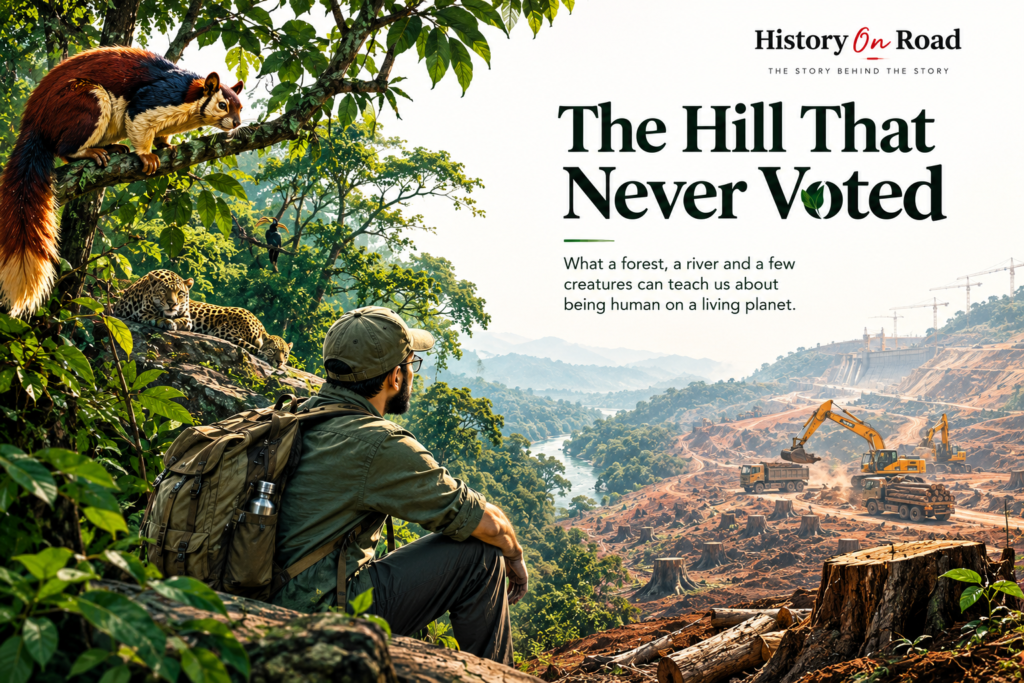
Walk into the Saidongar forest near the Pej river in Karjat, Raigad, and you will notice something no election manifesto has ever managed: nobody is shouting. The Indian giant squirrel, the Shekru, leaps between branches with its rust-coloured tail trailing behind. A leopard sleeps through the afternoon somewhere you cannot see. The soil holds the monsoon the way it has held it for centuries, slowly, without sending a bill.
Now picture 32,490 of those trees gone, across 233 hectares, to make way for a ₹13,500-crore, 3,000-megawatt pumped-storage project. The forest department’s diversion order is dated October 10, 2026. Its backers say the procedures have been followed and that the site lies outside the Bhimashankar Wildlife Sanctuary. Villagers in Dhak, Potal and Pali worry about their water, their slopes and their livelihoods. We take no side in any party’s quarrel. This editorial is about something older than every quarrel: what it means to be a human being on a living planet.
We Are Not Visitors Here
Somewhere along the way, we began to talk about nature as if it were a place we go to on weekends. We speak of “protecting the environment” the way one speaks of protecting a neighbour’s property. But the environment is not outside us. It is the thing we are made of.
Consider a single meal. The rice on your plate was a grass that drank monsoon water, which was held by a hillside, which was held by roots, which were fed by fungi and insects and the droppings of birds, which were fed in turn by fruit and seed and the shade of larger trees. Your lunch is the visible end of a chain with a thousand links, and every link is alive.
Ecologists call this a food web, and the word web is exact. Pull one strand and the whole structure trembles. The Shekru eats fruit, flowers and bark, and in moving from tree to tree she scatters seeds that become the next generation of the forest. The leopard keeps the numbers of deer and other grazers in balance, which keeps the young trees from being eaten before they can grow. Insects pollinate. Fungi stitch the soil together. Rivers carry the forest’s work to the villages and fields downstream. Nobody is the boss of this web, and nobody is unimportant.
Now ask the uncomfortable question: where do we fit? The honest answer is that we are in it. We eat from it, drink from it, breathe what it exhales, and build our houses from it. A human being is not a ruler standing above the food web. We are a very clever animal sitting in the middle of it, and the cleverness is exactly what makes our situation dangerous.
The Burden of Brilliance
The squirrel cannot build a dam. The leopard cannot draw a map. No other creature on this earth can blast a mountain, divert a river, or fell thirty thousand trees in a season. We can. That ability is the most extraordinary thing about us, and it is also the heaviest thing we carry.
In every human tradition, power is supposed to come with responsibility. We expect the strong to protect the weak, the educated to look after the unlettered, the elder to guard the young. The same moral logic must apply to our relationship with the rest of life. Because we can reshape the world, we owe it care. A creature that can destroy a forest and chooses not to is behaving with wisdom. A creature that can destroy a forest and does so for convenience is merely behaving with power.
Our own heritage says this plainly. Saint Tukaram looked at trees and creepers and called them kin. The warkaris who walk to Pandharpur each year do not walk through scenery; they walk through a living landscape their abhangs praise. The people who set aside devrai, the sacred groves, were not naive. They understood that a community which keeps a corner of the forest untouched is a community that has learned to restrain itself. That restraint, not any machine, was the real technology of survival.
Brilliance is not a licence. It is a debt.
The Arithmetic Nobody Writes Down
We are very good at counting what can be sold. Megawatts, crores, hectares, tonnes: these go on balance sheets and make sense to committees. What does not appear in the column is harder to count and far more valuable.
How do you price the way a canopy slows a violent downpour so the soil beneath it is not washed away? How do you invoice a hillside for holding monsoon water in its roots and releasing it slowly through the dry months, so that a village well still has water in May? What is the market rate for the cool air under old trees, for the birdsong that wakes a child, for the quiet that lets an old man sit and think?
We have only to look at what the Western Ghats have already been telling us. This range is recognised as one of the world’s biodiversity hotspots, home to creatures found almost nowhere else. And in recent years the hills have spoken in the only language they have. Malin in Pune district in 2014, Taliye in Raigad in 2021, and Irshalwadi, a tribal hamlet in Karjat’s own district, in 2023: each was buried when a slope gave way. Each time came the ritual of grief, condolence, a committee, and silence. We do not say a single project caused these tragedies. We say a mountain stripped and cut open for roads, quarries and construction behaves like what we have made of it, and the cost is paid in lives.
Mumbai learned a version of this lesson with its creeks, mangroves and marshes, which once absorbed the rains and now exist mostly on old maps. The Mithi river, which should have been a lung, became a drain, and in 2005 the city saw what a drain does when it is angry. Pune’s rivers carry more froth than folklore. Tigers in Vidarbha are celebrated on posters while their corridors narrow. These are not separate stories. They are one story told in different dialects: a species that forgot it was part of the web.
The Hunger That Does Not End
We want to say something about greed, and we want to say it gently, because greed is not a sin that belongs to others. It lives in all of us.
A body that is hungry eats, and then it is satisfied. This is the wisdom of every living thing. The leopard hunts, eats, and rests for days. The squirrel gathers what the season offers. No animal in the forest stockpiles a hundred lifetimes of food while its neighbours starve. Only human beings have invented a hunger that is never satisfied, a wanting that grows with every gain, a wealth that exists only to be larger than yesterday’s.
That hunger tells us a story: more is safer, more is happier, more is proof that you matter. And so we chase it, and we pay for it with our time, our sleep and our health, and then, without noticing, with the forests and rivers that were never ours to spend. A person may earn a great deal and still live in air that stings his lungs, drink water that tastes of the factory, and look out of his window at a view of other buildings. What exactly was the profit?
Money is a tool for living, and a useful one. We are not saints and we do not ask anyone to renounce it. But there is a difference between earning a living and eating the ground you stand on. A rupee earned by silencing a stream is a rupee that someone’s grandchild will repay with interest.
Beauty Is Not a Luxury
We are told that concern for nature is a luxury for the comfortable, that the poor need development and the rich can afford to be sentimental. It is worth sitting with how backwards this is. Those who suffer first and most when a forest dies are not the comfortable. They are the tribal family whose food, fuel and medicine came from that forest. They are the farmer whose stream dries up. They are the villager downhill when the rains arrive and the slope has lost its grip.
And beauty itself is not decoration. A sunrise over the Sahyadri, a firefly-lit paddy field in June, the first smell of rain on dry earth: these are not extras. They are the reasons a human life feels like a life and not merely an existence. They calm the nervous, console the grieving, and teach children to wonder. A society that cannot protect its own beauty is slowly becoming poor in a way no income figure will show.
We should be suspicious of any idea of progress that makes the world less beautiful and calls this an improvement. Real progress should leave people better fed, better housed, better educated, and living among a world still worth looking at.
What a Wise Species Would Do
None of this means a state without electricity, roads or industry. Pumped storage, for example, is a genuinely useful technology for a grid that wants more solar and wind. The question is never whether we build, but how, where and at whose cost.
A wise species would ask those questions before the first tree falls rather than after the first landslide. It would build on land that is already scarred before touching land that is still alive. It would let independent scientists survey the forest and publish the findings in a language the villagers read. It would sit with the gram sabha, listen properly, and write down what was said. It would ask whether the same need can be met some other way, and would be honest about the answer. And wherever a loss is truly unavoidable, it would replace it with care, monitored and counted in public, and not with a sapling photographed once and forgotten.
India already has the principles written down: Article 48A of the Constitution directs the State to protect forests and wildlife, and Article 51A(g) makes compassion for living creatures a duty of every citizen. Those lines were not written for ornament. They were written by people who understood that a nation’s strength is measured by what it chooses to keep.
The Eye-Opener
Here is what we want you to carry away.
You are not above the web. You are in it. Every tree is a neighbour, every river a relative, every creature a thread in the cloth you are wearing. When you pull a thread, the cloth tears somewhere you may not see for years.
You are cleverer than every other creature, and so you owe more than every other creature. The squirrel is not asking for charity. She is asking for the one thing only you can give: restraint.
You will not take your wealth with you. You will leave only what you protect: water that runs clean, soil that holds, a forest that still has a leopard in it. These are the real inheritance.
Live and Let Live
The hill never voted. The squirrel has no lawyer. The Pej river files no petition. That is exactly why those of us who can speak must not stay quiet. Silence is also a signature.
Live, and let live. Let the villager keep his water. Let the Shekru keep her branch. Let the monsoon find its roots. Let a child, many years from now, stand in Karjat, look up into a canopy, and hear a squirrel leap through the leaves above her head, and let her never know that it was ever in danger.
Ask the questions. Walk the hills. Count the trees yourself, all 32,490 of them, before someone else decides they were never counted.
Life is beautiful. Let it be.
— The HistoryOnRoad Team
Note: The figures and dates mentioned in this article are representative, taken from publicly available sources and used only for the purpose of writing and illustration. They may differ from official records, and no objection to or dispute with any authority, organisation or individual is intended.
टीप: या लेखात नमूद केलेले आकडे आणि तारखा प्रातिनिधिक असून केवळ उपलब्ध स्रोतांवर आधारित आहेत आणि लेखन व उदाहरणादाखल वापरले आहेत. ते अधिकृत नोंदींपेक्षा वेगळे असू शकतात. कोणत्याही प्राधिकरणावर, संस्थेवर किंवा व्यक्तीवर आक्षेप घेण्याचा किंवा त्यांना विरोध करण्याचा हेतू नाही.
#HistoryOnRoad #TheHillThatNeverVoted #SaveSaidongar #Karjat #Raigad #Maharashtra #WesternGhats #Sahyadri #SaveTrees #NatureEditorial #LiveAndLetLive #FoodWeb #Shekru #IndianGiantSquirrel #Ecology #ProtectNature #MaharashtraNature #SustainableDevelopment #Biodiversity #ClimateAction



Borrowed Glory in Kalikapur: The Story of a Village Election