

The year before the drought, Kalikapur had more water than it knew what to do with.
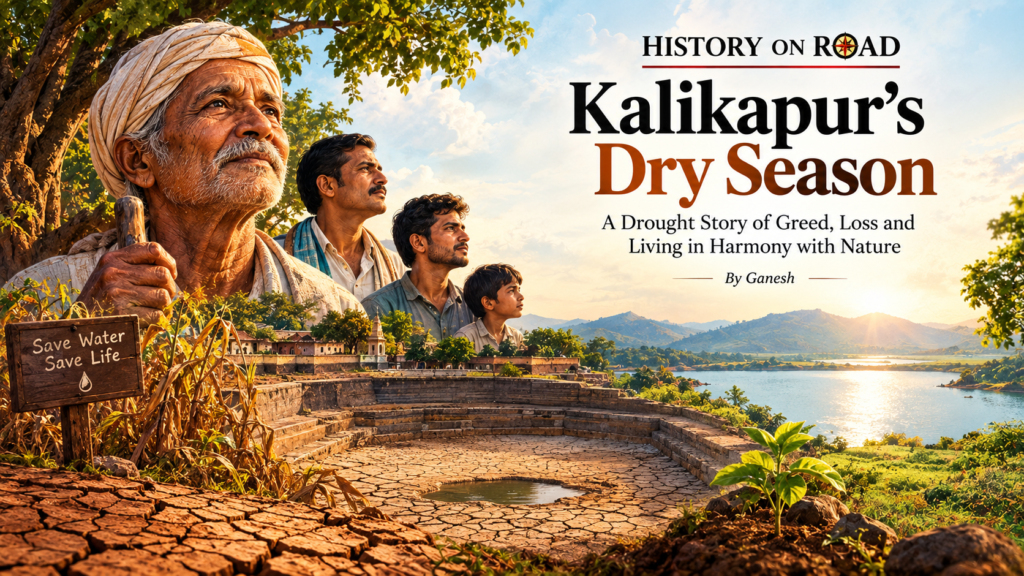
The rains had come early and stayed late. The village talav brimmed to its stone steps, the check dam on the Kali stream spilled over for months, and every well in the village sang with water. Children floated paper boats in the lanes. Old women said it had been twenty years since the earth looked so satisfied.
Chindhu stood at the edge of his two-acre field that winter, watching the green sugarcane sway, and felt like the richest man in Maharashtra.
“Water is plenty, Chindhu,” Govind had said to him that season, smiling, one arm around his shoulder. “Why plant jowar and pulses? Plant cane. Cane is money.”
Govind was the kind of man who smiled with his teeth and never with his eyes. He owned the only godown in Kalikapur, the only tractor, and a borewell rig he kept parked outside his house like a trophy. Everyone in the village owed him something.
Chindhu listened. So did half the village. They tore out their old crops and planted cane, a thirsty crop that drinks as if there is no tomorrow. They dug borewells, then deeper borewells, because Govind’s rig was always ready, at a price, of course, paid in instalments with interest.
Only Anna said anything.
Anna was the oldest man in Kalikapur. Nobody knew his exact age, not even Anna. He sat every evening under the banyan tree near the talav, leaning on a bamboo stick, his eyes cloudy but his memory sharp.
“The earth is not a bank, Chindhu,” he told him once. “You cannot keep withdrawing and never deposit.”
Chindhu laughed politely. “Anna, the dams are full. The wells are full. What is there to worry about?”
Anna looked at the water for a long time. “My father used to say a full well is not a promise. It is a gift. And a man who treats a gift like a right will one day be taught the difference.”
Chindhu forgot the words by morning.
The next monsoon was late.
The clouds gathered in June like guests who could not decide whether to enter. They rumbled over the hills, teased the village with a few fat drops, and moved on. July came, and the sky stayed pale and empty. August passed. The sugarcane, so green the year before, turned the colour of old straw.
“One bad year, that is all,” people said. “Last year’s water will carry us.”
But last year’s water had already been spent. It had gone into thirsty cane fields, into borewells that pumped day and night, into a hundred small wastes nobody had counted. The talav, which had seemed endless, shrank. First it lost its stone steps, then its edges, then its colour. By November it was a cracked brown plate, and children played cricket on what had once been the deepest part.
Chindhu’s borewell coughed one morning and gave only mud. He stood over it, listening to it gasp, and a cold fear crawled up his spine.
He went to Nana.
Nana was the sarpanch of Kalikapur, a lean, tired man with a grey moustache and the patient face of someone who had spent thirty years solving other people’s problems. His office was a single room with a tin roof, one table and a framed picture of the village from long ago, green on every side.
That morning he had a line of farmers outside his door.
“Nana, my well is dry.”
“Nana, my cattle have not drunk since yesterday.”
“Nana, what are we going to do?”
Nana raised both hands. “Sit, sit. I will tell you the truth, because you deserve it. The government will send tankers, but they will not be enough. The rains failed, and our own habits have made it worse. We had a full talav and full wells, and we treated them as if they would never end.”
A murmur ran through the room. Chindhu looked at the floor.
“We are not the first,” Nana continued. “Our elders saw hard times too. Old stories speak of years when the rains failed one after another, and people suffered for it. Today it has taken just one bad season to bring us to our knees. That should tell us something. It is not only the sky that has become less generous. It is that we have become more demanding.”
“Then what do we do, Nana?” someone cried.
“We start by being honest. And then we ask Anna.”
They found Anna under the banyan tree as always, though now the talav beside him was a dry bowl.
“I have been waiting for you,” he said, without looking up.
“Anna, tell us how our grandfathers survived,” Nana said.
Anna was quiet for so long that Chindhu wondered if he had fallen asleep. Then he spoke, slowly.
“They did not fight the land. They listened to it. When the rains were kind, they stored water in the talav and let the stream rest. They planted jowar, bajra, tur, crops that sip rather than gulp. They never took the last drop from any well, because they knew somebody else would need it tomorrow. They kept the hillside trees, because trees hold the rain the way a mother holds a child. And they dug small bunds on the slopes so the water walked slowly into the earth instead of running away.”
He tapped his stick on the cracked ground. “We forgot all of it. We became clever, and cleverness without wisdom is just another word for greed.”
“But how do we fix it now, Anna?” Chindhu whispered. “There is no water.”
“Not in the talav,” said Anna. “But there is water in the sky, in the years to come, if we learn to catch it. And there is something else you must do first.”
“What?”
“Look at who profited while you suffered.”
It did not take long to find out.
Within weeks, as wells went dry across Kalikapur, Govind’s business bloomed. He had bought three private water tankers and began selling water to the very farmers whose wells he had helped drain. A tanker that cost him almost nothing to fill from his deep borewell sold for a fortune. Families who had never begged for anything now stood in line outside his gate with empty drums and folded hands.
“Water is expensive these days, brother,” Govind told them, counting notes. “I am only a businessman. I take no pleasure in it.”
But he took plenty of pleasure in it. He bought a new motorcycle. He added a second floor to his house. And he kept the price high, because scarcity was good for business.
Chindhu stood in that line one evening, holding two plastic cans, and felt something burn inside him that was not thirst.
“Govind,” he said quietly, “you told us to plant cane. You told us water was plenty. You dug our borewells.”
Govind shrugged. “I told you what you wanted to hear, Chindhu. Nobody forced you.”
It was true, and that was the worst part. Nobody had forced them. They had been greedy too, wanting bigger harvests, quicker money, easier lives. Govind had merely held up a mirror and charged them rent for it.
The turning point came on a scorching April afternoon.
A little girl in the village, Chindhu’s niece, collapsed while carrying water from the tanker point two kilometres away. She recovered, but the sight of her small body in the dust did something to the whole village. The anger and fear that had been rattling around inside them finally had somewhere to go.
That night, Nana called a meeting under the banyan tree. Nearly every household came. Even Govind came, standing at the edge with his arms crossed, wearing the expression of a man who did not intend to lose anything.
“We have had enough of blaming the sky,” Nana said. “Anna has shown us a way. It will take years, not days. But we begin tomorrow.”
And they did.
They organised labour and dug small trenches and earthen bunds along the barren hillsides. They desilted the old talav by hand, hundreds of villagers carrying basket after basket of dried mud. They planted saplings, neem, tamarind, and banyan, along the slopes, and promised to guard them like children. They agreed that no new borewell would be dug without the village’s consent, and that water would be shared by need, not by wealth.
Govind watched in silence. When the committee asked him to open his borewell for common use and to sell water at fair rates, he tried to argue.
“This is my property!”
Anna, leaning on his stick, spoke softly. “Govind, the water under your land is not yours. It is not even ours. We are only borrowing it from those who come after us.”
The crowd turned toward him, hundreds of tired, determined faces. Govind looked around and, for the first time in his life, found he had nothing to sell that anyone would buy. His shoulders sagged. He nodded, once.
The next monsoon was not heavy, but it was kind.
The rain came softly through July. It did not rush into the stream and vanish. It fell on the bunds and trenches and slowly, patiently, sank into the thirsty earth. By September the talav held a hand-span of water. By October, a little more. Chindhu, who had planted jowar and tur on his field instead of cane, watched the small green shoots rise and wept without shame.
It was not the abundance of before. But it was honest water, earned and respected, and it tasted sweeter than any he had ever drunk.
Years later, when the saplings had grown into shade-giving trees and the wells held steady water through every summer, Chindhu would sit under the banyan beside Anna’s empty seat, his own grandchildren playing nearby.
“Tell us about the dry year, Ajoba,” they would ask.
And he would tell them, not as a tale of misfortune, but as a lesson he hoped they would never need to learn twice:
“Nature gives us everything we need, but never everything we want. The day we forget the difference is the day the water begins to leave.”
Then he would point to the full talav, glittering in the evening light, and add quietly:
“Take only what you need. Leave the rest for the sky, the soil, and the children who are not yet born.”
Hashtags: #HistoryOnRoad, #DroughtInMaharashtra, #KalikapurStory, #RespectNature, #WaterConservation, #LivingInHarmony
Category: Short Stories / Social Awareness and Environment