
Category: Tamil Literature, Culture and Heritage
The Leaf in the Attic
Kurinjipuram was preparing for its yearly poets’ evening, the Pulavar Vizha, when Athiyan arrived with a laptop bag and an uneasy conscience. It had been months since his last visit, and he had spent them answering emails at midnight and eating dinner over keyboards.
“You look better than last time,” Ganesh said at the bus stop. “Still tired, but the right kind of tired.”
“I resigned from the project, you know. The company found someone else for the valley.” Athiyan shrugged. “I thought I’d feel lost. Mostly I feel quiet.”
“Good. Quiet is where poetry lives. Come, I have something to show you.”
Ganesh led him to the village library, a single room beside the temple, where Maran sat at a table with a bundle wrapped in red cloth. Elakhiya and Rudhira stood beside him, one thrilled and the other pretending not to be.
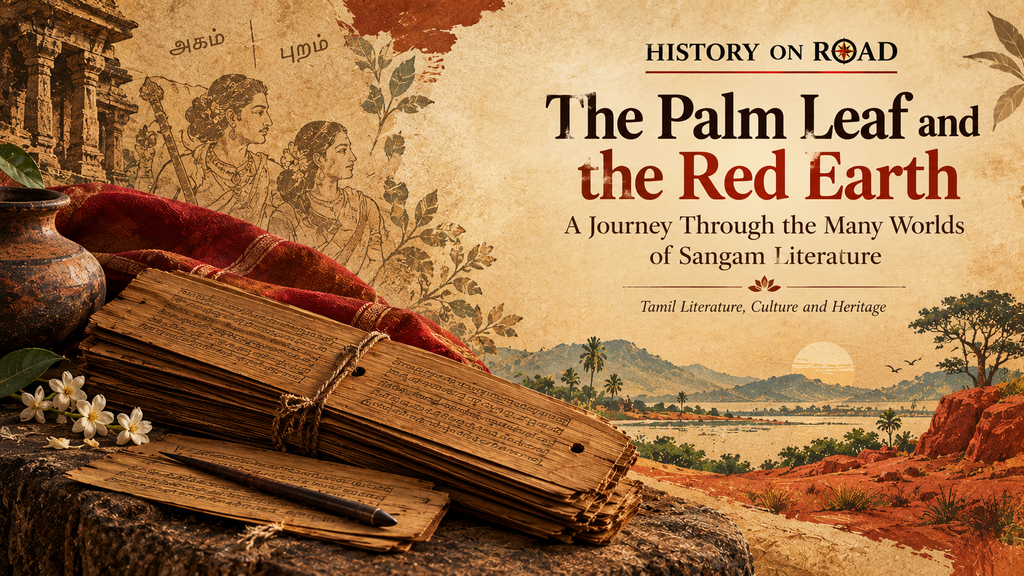
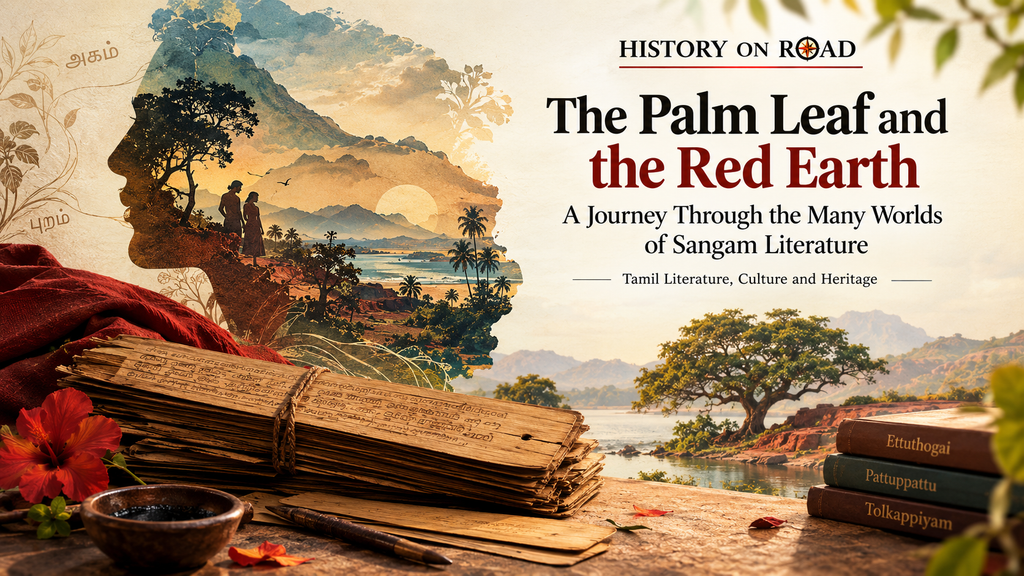
Maran unwrapped the cloth. Inside lay a stack of dark, narrow strips, each about the length of a forearm, pierced with a hole for a thread.
“Palm leaves,” Ganesh said softly. “A copy, made about a century ago by a village scribe. Someone carved each letter with a stylus, then rubbed soot and oil into the grooves so the writing would show.”
“This is Sangam literature?” Athiyan asked.
“It’s how Sangam literature survived. Roughly two thousand years ago, poets composed these verses and sang them aloud. They were memorised, then written on leaves that rot, crack and get eaten by insects in our humid climate. By the nineteenth century, much of this body of work was nearly forgotten, tied up in bundles in monasteries and family homes.”
“Then a scholar named U. V. Swaminatha Iyer spent decades travelling village to village, begging for old leaves, comparing them and editing them into printed books,” Elakhiya added. “The Ten Idylls appeared in print in 1889 and the Purananuru in 1894. Without him, and others like him, we might know these poems only by rumour.”
Rudhira lifted one leaf and held it to the window light. “So all of this nearly vanished because nobody thought it was valuable.”
“Nobody thought it was profitable,” Maran corrected. “A different thing.”
What Exactly Is It?
They settled on the library floor, and Ganesh drew a quick map in Athiyan’s notebook.
“Sangam literature is the oldest large body of classical Tamil poetry we have. Scholars generally place it somewhere between the third century BCE and the third century CE, though they debate the edges. It includes the Ettuthogai, the Eight Anthologies, and the Pattuppattu, the Ten Long Poems. Altogether, about 2,400 poems by some 470 poets. Around a hundred of those poets are anonymous. We know them only by a phrase from their verses.”
“And there’s a grammar book called the Tolkappiyam, which describes the whole system,” Elakhiya said. “It’s among the earliest Tamil works we have. It lays out how poetry should be organised, what each landscape means, and what each emotion looks like.”
“There’s also the old tradition of the three Sangams, academies of poets in Madurai,” Ganesh added. “Historians treat the details carefully, since legend and history mix there. But the idea of poets gathering to judge each other’s work is lovely, and the name stuck.”
Athiyan counted on his fingers. “That’s an enormous amount for something people nearly lost.”
“And here is the part that startles first-time readers,” Elakhiya said, leaning forward. “Every Sangam poem belongs to one of two worlds. Akam means ‘inner’. It is the world of love, longing, waiting and separation. Puram means ‘outer’. It is the world of kings, war, charity, grief, duty and the ethics of public life.”
Two Lovers With No Names
Elakhiya opened her notebook. “Let me tell you my favourite akam poem. It’s in the Kuruntokai, by a poet remembered as Sembulappeyaneerar, meaning ‘rain water falling on red earth.’ It’s a lover speaking. He says: What is my mother to yours? What is my father to yours? How did you and I ever meet? Yet our hearts have mixed, like rain falling into red earth.“
The room was quiet.
“Rain and red soil,” Rudhira said slowly. “Once they mix, you can’t separate them again.”
“Exactly. And notice what’s missing. The lovers have no names. Akam poems almost never name the people. They aren’t about this man and that woman. They’re about anyone who has ever loved. That’s why a farmer in the second century and a software engineer in 2026 can read the same line and feel it as their own.”
“Everyone’s heartbreak, anonymous,” Athiyan murmured.
“There’s a second trick,” Ganesh said. “The poets hardly say ‘I am sad.’ Instead, they describe a heron waiting by a drying pond, or the evening sea turning dim, and the reader understands. Scholars call it ullurai, an implied meaning. The landscape becomes the emotion.”
“So that’s where the five tinai come in?” Athiyan asked.
“Yes, and here’s the nature thread,” Elakhiya said. “Mountains and the kurinji flower mean the union of lovers. Forests and jasmine mean patient waiting. Farmlands mean quarrel and sulking. The seashore means anxious longing. The dry wastelands mean parting and hardship. To the poets, the land was a grammar of feeling. If you destroy the landscape, you lose the words for the emotion.”
Rudhira put the palm leaf down gently. “That’s a frightening idea. We might be deleting our own vocabulary.”
The Poets Were Everybody
Maran poured tea into steel tumblers. “Let me tell you what my generation was never taught in school, thambi. We assumed old poets were kings and Brahmins in grand halls. But Sangam poets were farmers, merchants, potters, carpenters, soldiers, even rulers. A poem might come from a pot-maker and sit beside another from a king.”
“There were women, too,” Elakhiya said, with unmistakable pride. “Around thirty are named in the collections. Avvaiyar is the best known. She wrote about love, battle and kingship with striking frankness. Another is Kakkaipadiniyar Nachchellaiyar, whose verses are full of sharp, tender observation.”
“And one poem always stays with me,” Ganesh said. “A mother in a Purananuru verse by Ponmudiyar is asked where her son has gone. She says, roughly: Giving birth to him was my duty. Making him good is his father’s duty. Forging his spear is the blacksmith’s. Giving him a sword is the king’s. And as for him, whether he fights today, he is somewhere on the battlefield. She doesn’t weep or boast. Everyone around her has a role, and nobody carries the whole burden.”
Rudhira raised an eyebrow. “That’s a society where responsibility is shared.”
“Which is another reason I love these poems,” Elakhiya said. “They don’t flatter humans. They show us arguing, grieving, getting jealous, being generous. They’re honest about life.”
Kings, Givers and the Weight of Greed
Maran set down his tumbler. This was the part he wanted to say.
“I have been in politics for thirty years,” he said. “Let me tell you what the puram poems taught me. The old poets were not court flatterers. When a king was just, they praised him. When he was greedy or unfair, they said so, sometimes to his face.”
“Is that true?” Athiyan asked.
“Let Ganesh tell it. He has the evidence.”
Ganesh grinned. “Here’s one. The poet Kovur Kizhar once told a king about to destroy a defeated enemy’s children that cruelty brings no glory. Poets in these verses regularly remind rulers that a country is made of its farmers, not its fortresses. And there was a famous chieftain named Pari, a lord of a hill region, remembered for his generosity. The old story says he gave his own chariot to a jasmine creeper that had nothing to climb. Historians treat the story as legend, but notice what the legend celebrates. A rich man who gave without calculation.”
“My favourite is Avvaiyar and the gooseberry,” Elakhiya said. “A chieftain named Athiyaman once obtained a rare fruit said to grant a long life. He didn’t eat it. He gave it to the poet Avvaiyar, saying her songs would bless more people than his reign could.”
“Athiyaman,” Rudhira said, glancing at Athiyan. “That’s your name, almost.”
“I’m told I’ve been misusing it,” he said wryly.
“There’s an even deeper verse,” Ganesh went on. “In the Purananuru, poet Kadalul Maindha Ilamperuvazhuthi describes the kind of people who keep the world alive. Even if they are offered a heavenly nectar, they won’t drink it alone. They don’t fear blame, they don’t hate, they don’t sit idle, and they work for others without expecting praise. He says it’s because of such people that the world still exists.”
Maran nodded slowly. “Think about that. A whole civilisation believing the world continues because a few people refuse to eat alone.”
“Whereas now,” Rudhira said, her voice sharper, “people refuse to share even a parking spot. Companies hide poisoned water behind legal documents. Strangers get cheated, the weak get pushed, and the one who earns the most is called the smartest. We are cleverer than any generation before us, and meaner than most.”
“Careful,” Maran said, but gently. “I won’t say it is all of us. There are still givers, plenty of them. But I agree, we have made greed respectable. The Sangam poets would call that a sickness, not a skill.”
Athiyan stared at the floor. “I helped build that machine, in a way. Faster money, always faster. Nobody asked what it was for.”
“You asked this morning,” Maran said. “That counts.”
Ports, Pepper and the Honest Weighing Scale
“Now let me balance the picture,” Ganesh said. “Please don’t imagine Sangam life as only farmers and hills. This was a trading world.”
He pulled out a photocopy of a map. “The Cholas ruled from the fertile Kaveri delta, with a great port called Poompuhar. A long poem, the Pattinappalai, describes it vividly: ships crowding the harbour, warehouses full of goods, flags flying over shops, merchants from distant places mingling in the streets. The Pandyas had Madurai, a bustling city of markets, festivals and scholars, described in the Maduraikkanchi. The Cheras controlled western ports, including Muziris, which Greek and Roman writers also mention.”
“And the poems say that foreign ships came bringing gold and went home with pepper,” Elakhiya added. “Pepper, pearls, textiles, spices, ivory. Tamil lands were connected to the Mediterranean long before ‘globalisation’ was a word.”
“So the poets lived in a connected world,” Athiyan said, brightening. “Not a village frozen in time.”
“Exactly. And what impressed me,” Ganesh said, “is how the poems describe honest trade. The Pattinappalai praises merchants who deal fairly, keep their word and don’t tilt the scale in their own favour. Wealth was welcome. Wealth without fairness was not.”
Athiyan laughed softly. “My industry could use that line on a wall. Fair scales.”
“It could use it in the code,” Rudhira said.
The Friendship Without a Face
Outside, the evening was beginning. Lamps flickered along the temple path. Villagers had begun to gather for the poets’ evening with mats, flasks and sleepy children.
Elakhiya closed her notebook, then opened it again. “One more story, because it undoes me every time. A Chola king named Kopperunchozhan once chose to end his life by fasting after a family tragedy. A poet named Pisiranthaiyar loved him dearly, though the two had never met. They only knew each other through verse and reputation. When the poet heard the news, he travelled across the land to be with him, but the king had already asked that a place be left beside him. The poet arrived, was welcomed, and stayed.”
Nobody spoke for a moment.
“Whatever the details of history and legend,” Ganesh said, “a society that remembered this story wanted to remember friendship as something deeper than convenience or advantage. Two people who valued each other for what they were, not what they owned.”
“I have four hundred contacts on my phone,” Athiyan said, almost to himself, “and I don’t think a single one would travel across a country for me.”
“You haven’t been a friend like that yet,” Maran said kindly. “That is the first step. The poets would tell you to start with one.”
The Poets’ Evening
By nightfall the whole village sat in the open ground before the temple. Children with oil lamps lined the edges. The old stone called the Rain Stone stood nearby, mossy in the dark, and somebody had hung a string of jasmine around it.
Elakhiya stood and read aloud the red earth and rain poem, first in the old Tamil, then in her own English translation. A hush fell across the crowd. After her came a schoolboy who recited a line about the hills. Then Maran, his voice cracked and humbled, spoke the old verse about eating nectar alone, and it seemed that even the crickets paused.
When it was Athiyan’s turn, he hadn’t planned to speak. Somehow he found himself on his feet.
“I came here the first time with a bag of deadlines,” he said. “I didn’t know that poems older than my language’s printing press were waiting. I thought history was dead. Now I think history is a conversation we’ve stopped joining.”
He glanced at Rudhira, then at the crowd.
“I’m not a poet. But I’m a programmer, and I’d like to build something. A free digital archive of these palm leaves, scanned and readable by any child with a phone, so the next generation never has to rescue them from attics. It’ll take me a year. I’ll do it without charging anyone.”
Applause rippled through the dark, soft at first, then louder. Maran wiped his eyes with the towel on his shoulder. Rudhira, who had come only for fresh air and free food, found she was clapping hardest of all.
What the Poets Left Us
Much later, when the crowd had gone and the lamps had burned low, the five of them sat once more on the library steps. A light rain had begun.
“I expected a nature lesson,” Athiyan said. “But Sangam turned out to be a whole civilisation. Love, war, trade, grief, friendship, justice.”
“That’s exactly why it still matters,” said Elakhiya. “The poets never separated the heart from the landscape, or the king from the farmer, or the trader from honesty. For them it was all one life.”
“And we’ve cut it into pieces,” Rudhira said. “Work here, nature there, ethics somewhere else, feelings on weekends.”
Ganesh watched the rain gather on the temple roof. “I think the real gift of Sangam literature is a question, not an answer. How should a person live among others, and among rivers and hills, so that when he goes, the world is not poorer for it?”
“Whoever answers that well,” Maran said, “will be remembered even if his name is forgotten.”
“Like the poets,” Elakhiya smiled. “Remembered by what they noticed, not what they owned.”
The rain softened. Out in the dark, the old hill stood quiet and patient. A thousand years from now, perhaps someone would find a scanned leaf on a screen and read, in a voice from long ago, about red earth and rain.
Why Sangam Literature Speaks to 2026
We live among faster phones, bigger markets and hungrier ambitions, but the old questions have not changed. How much is enough? What do we owe the stranger? Can wealth be fair? Can love stay honest? The Sangam poets answered these through birds, flowers, kings, mothers, traders and friends, and the answers still hold.
Respect for nature, fair dealing, generosity without calculation, courage that comes with compassion, and love that doesn’t need a name are not museum pieces. They are working tools for a world that has grown rich in everything except contentment.
Hashtags: #SangamLiterature, #ClassicalTamilPoetry, #TamilHeritage, #HistoryOnRoad, #AncientTamilWisdom, #LivingInHarmonyWithNature
Category: Tamil Literature, Culture and Heritage