
Category: History, Social Awareness, Moral Stories
The Chain Under the Banyan Tree
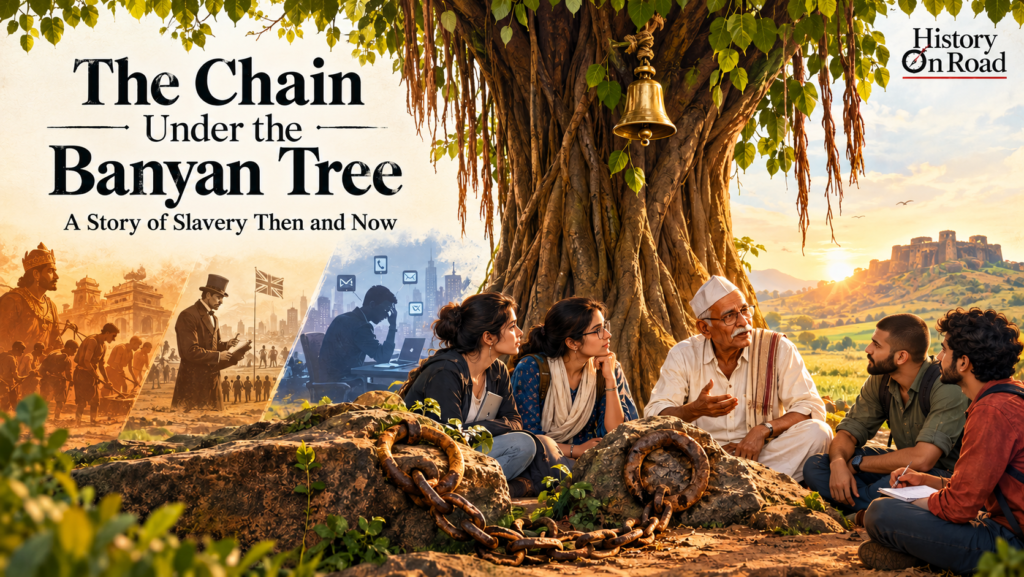
The road to Raundane is not on most maps. It leaves the highway, crosses a dry river, and climbs through jowar fields until a giant banyan tree appears, its roots hanging down like the beards of old sages. Beneath that tree sat Sonu didi, the sarpanch’s daughter, tying her dupatta against the afternoon wind.
At twenty-eight, Sonu was the only person in the village who read every old paper that came into her father’s office. People joked that she knew Raundane’s history better than the village did itself.
“They’re late,” she muttered, checking her phone.
The first to arrive was Aditi, a thirty-six-year-old software professional from Bengaluru. She stepped out of a hired car with dark circles under her eyes and a laptop bag she held like a lifeline. She had come to Raundane on a whim after her doctor said the word burnout.
“Is there network here?” were her first words.
Sonu laughed. “One bar, under the banyan tree. Freedom has its price.”
Minutes later, two students arrived on a motorbike, laughing and dusty. Umu and Nilu, from Pune, were studying history and anthropology and had come to record the oral stories of old villages for a project.
“Everyone says Raundane has the best storyteller in the district,” said Nilu. “Someone called Nana?”
“Nana,” said Sonu, smiling, “is waiting.”
The Old Man With the Iron Ring
Nana lived in a mud-and-stone house beside the old fort wall. He was eighty-two, with a white moustache and spectacles held together by thread. In his youth he had earned an Arts degree, rare for the village, and later served as a local politician for thirty years. He had never built a bungalow, never owned a car, and still walked to the fields every morning.
He did not greet them with words. He led them behind his house to a flat black stone half buried in the earth. Set into it was a rusted iron ring, thick as a man’s wrist.
“Touch it,” he said.
Aditi hesitated, then pressed her fingers to the cold metal.
“What is it?” asked Umu.
“The oldest question in our village,” said Nana. “Sit. I will tell you three stories. All are about one thing, and the thing has not died.”
Story One: The Raja’s Granary
“Long ago,” Nana began, “this land belonged to Raja Vikramdev of the Sutargad kingdom. People remember him as a lover of music and a builder of temples. But no one remembers who carved the temple stones.
“In those days, a family in debt did not just owe money. It owed its children. A farmer named Bhiku borrowed three measures of grain for his sick wife. The Raja’s steward wrote the debt in a ledger. The grain was never repaid, because the interest grew faster than the harvest. By the time Bhiku’s wife recovered, the debt had swallowed him. He, his son, and his son’s son worked the Raja’s fields and quarry, unpaid, for generations.
“That ring,” Nana said, tapping it, “held a chain at night so the workers would not run away to the forest.”
Nilu looked up from her notebook. “Was the Raja cruel?”
“That is what troubles me,” said Nana. “The Raja gave alms every festival. He fed hundreds. He believed himself kind. But kindness that sits on top of someone else’s chains is only decoration.”
Sonu spoke quietly. “My grandfather’s grandfather was one of those quarry workers. Our family has been free for only a few generations. We forget how recent it is.”
Story Two: The Collector’s Ledger
“Then the Raja’s fort fell,” Nana continued, “and a new master arrived with a different language and a different flag. The British Collector, Mr. Harlow, came to Raundane with surveyors and clerks.
“He did not use a chain on the ankle. He used a paper. Farmers were told to grow cotton for the mills of faraway England instead of jowar for their children. The tax came in coin, not grain. To find coin, they borrowed from the moneylender, who borrowed from the Collector’s friends. Again the same old trap, with a new coat of paint.”
Umu nodded. “In my research, I read that the British Empire formally abolished slavery in 1833, and India passed the Indian Slavery Act in 1843. But debt bondage and forced labour went on for decades.”
“Exactly,” said Nana, pleased. “Law can change in a year. Greed takes centuries to change. Harlow once said, in a letter my teacher showed me, that the villagers ‘worked best when they owed the most.’ Think about that sentence. The master did not want people to be well. He wanted them to be indebted.”
Aditi had been silent. Now she asked, almost to herself, “So the chain was never really iron. It was owing.”
“Now you understand the ring,” said Nana.
Story Three: The Glass Chain
The sun was dropping behind the fort wall. Sonu brought tea in steel glasses. Nana held his in both hands and looked at Aditi for a long moment.
“Beti, tell me honestly. How many hours do you work?”
Aditi laughed nervously. “Officially nine. Actually twelve, fourteen. We have calls with the US team at midnight. My phone buzzes even on Sundays. I took this trip with my laptop in my bag in case something broke.”
“And why do you work so?”
“The EMI on my flat. The car loan. The credit card. If I stop for three months, everything collapses.” She stopped. The words hung in the air.
Nilu glanced at Umu. Nobody spoke.
“Do you hear it?” Nana said gently. “A loan. A debt. A master you cannot see. The Raja used a ledger and a chain. The Collector used a ledger and a tax. Today’s master uses a screen and a target. I am not saying your company is evil, or your bank is evil. I am saying the shape is old.”
He turned to the students. “And it is not only the educated who are trapped. In brick kilns, in distant farms, in the back rooms of rich houses, there are still people who work without wages, who cannot leave, who owe a debt that never ends. And the sad part is that the people who profit often live comfortably and believe they are good people.”
Umu, the anthropologist, added quietly, “The International Labour Organization estimated about fifty million people worldwide lived in modern slavery in 2021. Forced labour, forced marriage, debt bondage. That is more than at any time in recorded history.”
“Fifty million,” Aditi whispered. “In 2026. With smartphones and satellites.”
“Yes,” said Nana. “We have gone to the moon, but we have not gone far enough from the Raja’s granary.”
The Greed of the Modern Age
“Let me tell you what I saw in thirty years of politics,” Nana said, setting down his glass.
“I saw leaders who started as servants of the people and ended as masters of them. Not all of them, and I will not name any, because the sickness is not in one party or one man. It is in a mindset. A man gets a little power, and the first thing he wants is more. Then he wants others to bow. Then he wants others to depend on him, so they will never leave. A voter kept hungry is a voter kept loyal. That is slavery of the mind.
“I saw rich men who paid their workers just enough to survive but not enough to dream. I saw shopkeepers who gave credit not out of kindness but to buy a family’s future. I saw employers who counted employees as ‘resources,’ like coal or water.”
Sonu said, “And we do the same in small ways. We scroll for hours because an app wants our time. We chase likes because strangers’ approval has become our wage. We have made ourselves slaves to attention.”
“Ah, Sonu,” said Nana, laughing. “You see why I call you the real history-keeper of this village.”
Nilu shook her head. “It’s strange. People in the past at least knew they were enslaved. Today people proudly call it hustle.”
“That,” Nana said, “is the most dangerous chain of all. The one you polish and call jewellery.”
The Ring in the Morning Light
That night Aditi did not sleep. She sat on the porch, looking at stars she had not seen in years. In Bengaluru, the sky was a dull orange ceiling. Here it was a black ocean full of lanterns.
At dawn she found Nana already seated beside the iron ring, drinking tea.
“Nana,” she said, “I think I have been selling my life in small pieces. I told myself it was ambition.”
“Ambition is a fine horse,” said the old man. “But when it stops carrying you and starts dragging you, you are no longer the rider.”
“What do I do? I can’t just quit.”
“Who said quit? I said free. Freedom is not running away. It is choosing. Reduce the loan before you buy the next shiny thing. Speak the word no sometimes. Keep one day for your own soul. And when you become the boss, and you will, be the kind of master you wished to have. Pay fairly. Respect the person who sweeps your office as much as the one who signs your cheque.”
Umu and Nilu had joined them, recording nothing, just listening.
“And the ring?” asked Nilu. “Why do you keep it?”
“So that no child of Raundane forgets,” said Nana. “A village that forgets its chains will forge new ones.”
Sonu arrived with a small brass bell. Quietly, she hung it from the iron ring. When the morning wind touched it, it rang a clear, silver note.
“Father asked me to do this,” she said. “From today, the chain that held the weak will hold a bell that celebrates the free.”
They stood together, four strangers and one old man, listening to the bell.
Aditi left that afternoon. The car was the same, but she was not. On her way back, she texted her manager one line: I will work hard, but I will no longer work endlessly. Then she turned off her phone, rolled down the window, and let the wind of Maharashtra blow through her hair.
Eye-Opener Facts
- Slavery has worn many faces: chains in royal times, debt ledgers in colonial times, and unseen pressures like debt traps, exploitation, and addiction in modern times.
- The British Empire abolished slavery in 1833. India passed the Indian Slavery Act in 1843, but bonded labour continued for long afterwards.
- India’s Constitution (Article 23) prohibits trafficking and forced labour, and the Bonded Labour System (Abolition) Act, 1976 outlawed debt bondage. Yet cases still surface.
- About 50 million people live in modern slavery worldwide, according to ILO and Walk Free estimates for 2021.
- Greed is the common root. Every era’s master told himself he was entitled, respectable, even kind.
- Digital slavery is real: endless notifications, work with no off-switch, and attention sold for profit.
The Message
Freedom is not a gift from any king, company, or government. It is born with you, as natural as breathing, and it is the most beautiful thing a human being owns. So:
- Never enslave anyone, whether through money, debt, fear, power, or emotional pressure.
- Never become a slave, whether to a master, a loan, a habit, or a screen.
- Pay fair, speak kindly, and share generously. Power is meant to protect, not to possess.
- Remember: a person who treats the weakest with dignity has already won the world.
Hashtags: #HistoryOnRoad, #SlaveryToFreedom, #BeAGoodHuman, #IndianHistory, #ModernSlavery, #FreedomIsBeautiful