

Carrying What Cannot Be Carried
History On Road often finds the story behind the story in the space between two people talking. This week, Rumi — who has spent years studying animal behaviour — and Satya, an old friend who reads everything and trusts little of it, sit by the water with their coffee going cold, talking about a dolphin named Fraggle.
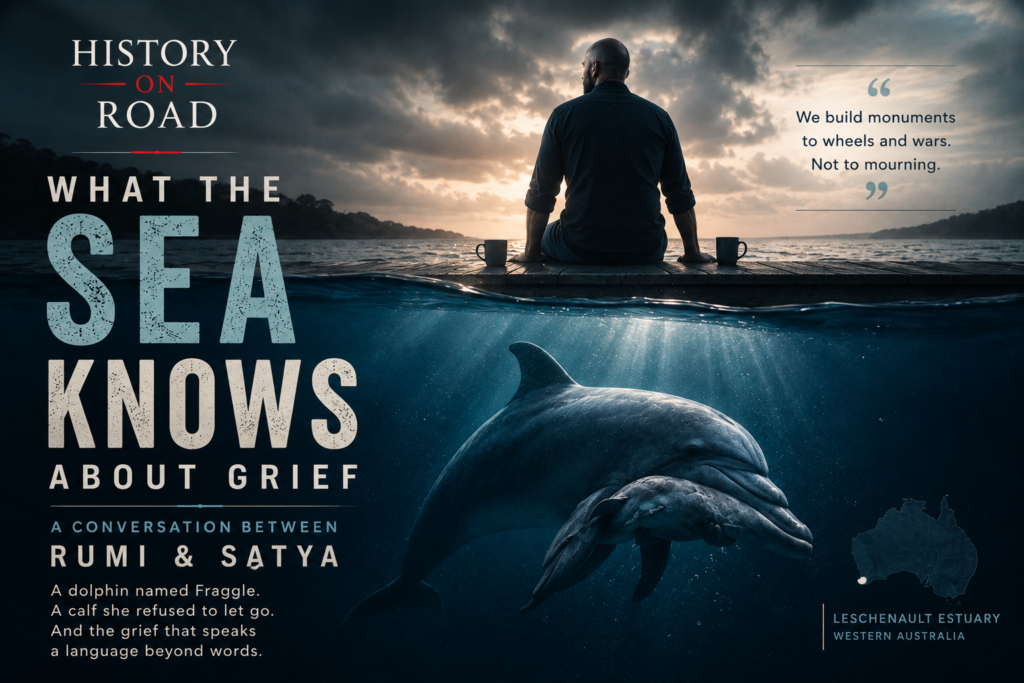
Satya: Did you see this dolphin story making the rounds? The one carrying her dead calf?
Rumi: Fraggle. Yes. It’s difficult to look away from, and harder to look at.
Satya: Tell me — is it actually grief, or are we just doing what humans always do? Seeing our own feelings in something that doesn’t have them.
Rumi: That’s the right question to ask, and researchers have been careful about it too. But look at the facts before you decide it’s projection. This is in the Leschenault Estuary in Western Australia. A conservation group called Geographe Marine Research had been watching Fraggle and her calf for two weeks after the birth — winter births are hard on dolphin calves, the cold water and air raise the risk of pneumonia. The calf’s breathing had already started to labour. Then it died.
Satya: And she wouldn’t let go of it.
Rumi: She carried it. Balanced across her back, sometimes near her rostrum, keeping it lifted near the surface, the way a calf needs to be to breathe. She kept doing it after there was no more breathing to protect. For days.
Satya: That part is what stays with me. Not that she was sad. That she kept doing the mother’s job long after the job had stopped meaning anything.
Rumi: And this wasn’t Fraggle’s first loss. Researchers say this is her fifth calf in a row that hasn’t survived.
Satya: Five.
Rumi: Five. And each time, by all accounts, some version of this same behaviour. Other dolphins came too — her pod, and some believed to have travelled in from the open ocean specifically to be near her. They swam alongside her while she carried the body. That’s not instinct in the narrow sense. That’s something closer to a wake.
Satya: You said “grief” so easily just now. Are scientists actually comfortable using that word?
Rumi: More than they used to be. This isn’t isolated to Fraggle, or even to dolphins. There’s a 2018 study in the journal Zoology that documented at least seven species, across three oceans, carrying their dead young — Risso’s dolphins, spinner dolphins, pilot whales. In 2018, an orca off the coast of Washington carried her dead calf for over two weeks, pushing it through the water, refusing to let it sink. Scientists at the time called it unprecedented. It wasn’t, really. We’d just never watched closely enough before.
Satya: It’s not only dolphins and whales either, is it? I remember reading about elephants.
Rumi: Elephants stand vigil over their dead. They’ll return to a place where a herd member died, sometimes years later, and touch the bones with their trunks — gently, the way you’d touch something you were afraid to break. Chimpanzees have been seen carrying dead infants for days, grooming them as if they were still alive. Crows gather around their dead in what researchers half-jokingly call funerals.
Satya: So it isn’t really about dolphins being special. It’s about something older than dolphins, or us.
Rumi: That’s exactly the shift I’d want people to make. There’s a line from Douglas Adams I keep coming back to — from The Hitchhiker’s Guide to the Galaxy. He wrote that man always assumed he was more intelligent than dolphins because of everything he’d built — the wheel, New York, wars. And all the dolphins had ever done was muck about in the water, having a good time. But the dolphins, he said, believed exactly the same thing about themselves — for exactly the same reasons.
Satya: (laughing, then not laughing) That’s a joke that gets less funny the longer you sit with it.
Rumi: It’s meant to. Adams is mocking the scoreboard we built for ourselves — cities, tools, conquest — and daring us to notice that the scoreboard is one we invented, and then declared ourselves the winners of. Intelligence, measured his way, is really just a list of things humans happen to be good at.
Satya: So what would the dolphin’s scoreboard measure?
Rumi: Maybe this. The ability to love something enough that its absence physically changes your behaviour for days. The instinct to gather around a grieving mother, not because it helps her calf — nothing can, at that point — but because grief, apparently, is not meant to be carried alone. That’s not a lesser form of intelligence. It might be a deeper one. We’ve just never built a monument to it.
Satya: We build monuments to wheels and wars, like the quote says. Not to mourning.
Rumi: Not usually, no. Though I’d argue this is exactly what Fraggle’s story became for a few days — a small, unintentional monument. People who will never see the Leschenault Estuary, who couldn’t find it on a map, stopped and felt something looking at drone footage of a dolphin refusing to let go.
Satya: Why do you think it landed the way it did? There are sad animal stories every week.
Rumi: Because it isn’t really a story about a dolphin. It’s a story about the specific ache of losing a child, told in a body that isn’t ours, which somehow makes it easier to look at directly. Grief in a human mother is almost too close to bear watching. Grief in a dolphin gives us just enough distance to actually see it.
Satya: So the intelligence Adams was mocking — the wheels, the wars — none of that is what makes her story land.
Rumi: No. What lands is the part of us that has nothing to do with cleverness at all. The part that recognises loss, in any body, in any species, and doesn’t need translating.
Satya: Maybe that’s the more honest scoreboard, then. Not who built the wheel. Who stayed by the water, carrying what they’d lost, refusing to swim away from it.
Rumi: By that measure, Fraggle isn’t behind us on any ladder. She’s simply doing, in her own water, what mothers everywhere have always done in theirs.
Fraggle’s pod has since moved on, researchers say, the way pods do. Somewhere in the Leschenault Estuary, she is swimming without the weight she carried for days — though whether the weight is truly gone, no one watching from the shore can say for certain. Some things, in every species, don’t leave a mark you can see. They just change how something moves through the water afterward.



Borrowed Glory in Kalikapur: The Story of a Village Election