

History On Road | Perspective
Are we just telling the story, or are we revealing the story behind the story?
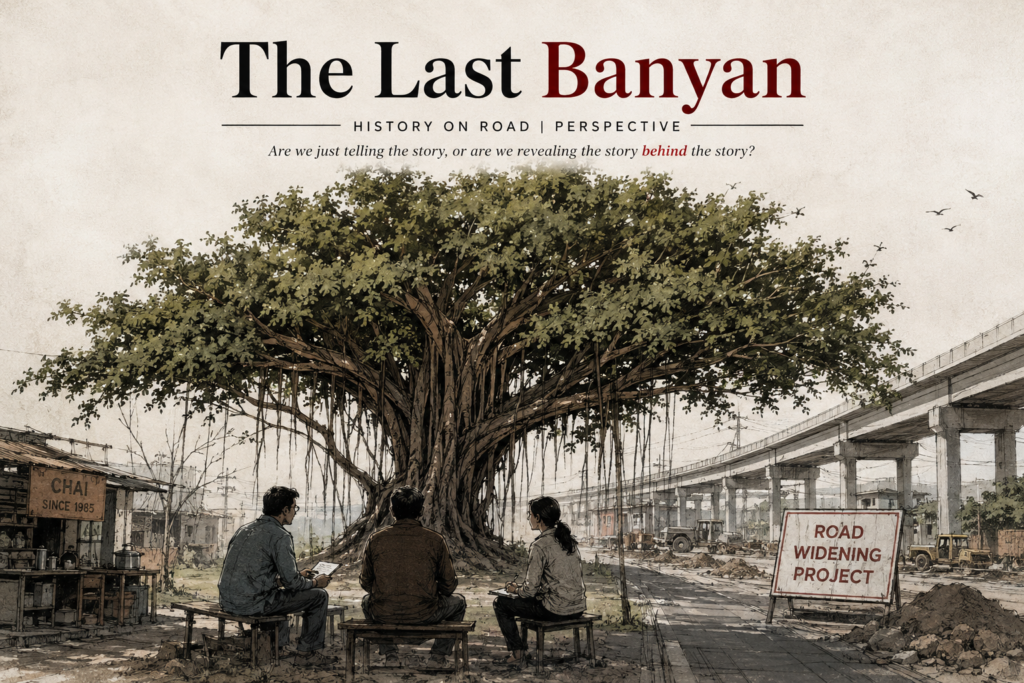
The banyan tree at the edge of Kalipur village had outlived four generations. Nobody remembered who planted it. Some said a sadhu had dropped a seed there three hundred years ago on his way to the river. Others said it simply grew, the way old things do, without asking permission from anyone.
Vivek remembered climbing it as a boy. Sujan remembered sitting under it during the power cuts, when the whole street would gather beneath its shade to escape the heat and the darkness together. Gargi remembered nothing of the sort — she had grown up in the city, and to her the tree was just a shape she’d seen once in a photograph her grandmother kept on the mantelpiece.
That was the first thing the story had to reveal: three people, one tree, three completely different relationships with the same piece of the world.
I. The Meeting
Vivek came back to Kalipur after eleven years. He was an engineer now, working for a company that built highways — the same kind of company that had, two months earlier, submitted a proposal to widen the district road running past his old village. The banyan tree stood exactly where the new lane was meant to go.
He hadn’t come back to save the tree. He’d come back to survey it for removal.
Sujan still lived in the village, running the same tea stall his father once ran under that very shade. When he saw Vivek stepping out of the survey jeep with a clipboard, he didn’t shout, didn’t accuse. He simply said, “Chai?” — the way he always had — and waited.
Gargi arrived a day later, a journalist sent by a small environmental desk to cover “one more tree being cut for one more road” — a story so common by now that most editors had stopped assigning it, except this one insisted the piece needed a face, not just a headline.
Three strangers. One shrinking patch of shade.
II. What the Story Isn’t About
It would be easy to write this as a simple parable — the greedy developer, the noble villager, the crusading reporter. Easy, and false. Because Vivek wasn’t greedy. He had a father in the hospital and a job that paid for the treatment. Sujan wasn’t purely noble. He’d once sold his neighbour’s borewell water during a drought at double the price, because his own children were hungry too. Gargi wasn’t a crusader. She needed the story to run because her freelance contract ended in three weeks and this was her last chance to be kept on staff.
Every one of them was doing something selfish. That is the part most versions of this story leave out.
Humans are often called the most selfish species on Earth — a phrase repeated so often it has become furniture in our conversations, something we walk past without noticing anymore. But selfishness alone doesn’t explain a species that also builds hospitals for strangers, that runs into burning buildings for people it has never met, that plants trees it will never sit under. The truth sitting underneath the cliché is less comfortable and more interesting: humans are not uniquely selfish. They are uniquely capable of knowing they are being selfish, and choosing anyway — or choosing not to. That knowledge is the whole difference. It’s what makes an elephant taking water from a shrinking hole a survival act, and a company draining a village aquifer for a bottling plant a moral one.
That’s the story behind the story: not “humans are bad,” but “humans are the only animal that has to decide what to be, every single time, with full knowledge of the cost.”
III. The Argument Under the Tree
On the third evening, the three of them sat together — Vivek with his clipboard, Sujan with his kettle, Gargi with her recorder.
“You’ll write that I’m the villain,” Vivek said, not quite looking at either of them. “The company. The road. Fine. But tell me — you drove here in a car. You’ll file this story on a phone charged by a plant that also cut down a forest somewhere. None of us are clean. I’m just the one standing closest to the axe today.”
Gargi didn’t argue. She wrote it down instead.
“I’m not calling you a villain,” she said. “I’m asking whether you know what you’re cutting. Not the tree — the thing the tree was doing. It was cooling this whole street. It was holding the soil where the road keeps flooding every monsoon. It gave shade to people who can’t afford air conditioning. You’re not just removing wood. You’re removing a service nobody billed anyone for, which is exactly why nobody accounts for its price until it’s gone.”
Sujan poured the tea slower than usual.
“My father used to say something,” he said. “‘The tree doesn’t ask what it gets back. That’s the only reason it’s still standing after everyone who planted it is gone.’ Maybe that’s the difference between us and it. It gives without checking the return. We’ve forgotten how.”
Nobody had a clean answer. That was the honest part.
IV. Is the Species Really Endangering Itself?
It’s become fashionable to say humanity is “going extinct,” that we are “the virus,” that the planet would be better off without us. It’s a satisfying sentence to type and a lazy one to believe, because it lets the person saying it feel separate from the problem — as if they are the exception, and everyone else is the disease.
The more accurate, less comfortable version is this: humans haven’t become a worse species. They’ve become a species operating at a scale their old instincts were never built for. A village of two hundred people sharing one tree learns fast what happens if they burn it for firewood — they freeze together the next winter, they feel the consequence immediately, and the lesson sticks. A planet of eight billion people sharing one atmosphere doesn’t feel the consequence immediately. The person who cuts the forest in one country doesn’t watch the flood it causes in another. Selfishness used to be self-correcting because the cost came home quickly. Now the cost takes fifty years and a different postal code to arrive. That’s not a moral collapse. That’s a design flaw in how far human empathy and human feedback loops can stretch — and design flaws can be fixed, if they’re named honestly instead of mourned dramatically.
That is what “History On Road” tries to do differently: not just report that a tree was cut, or that a village flooded, or that a species went quiet — but ask why the feedback loop broke, and who paid the delay.
V. What Happened to the Tree
Vivek filed his survey report late. In it, he included a paragraph his supervisors hadn’t asked for — an alternate route that curved the road eleven metres around the tree instead of through it, adding two days of construction and a modest cost overrun. It was approved, not because anyone suddenly became noble, but because Gargi’s article had already run, and the local MLA didn’t want to be photographed beside a stump before an election.
The tree still stands. Sujan still serves tea under it. Gargi got her staff position — the story did well enough. Vivek visits sometimes, though he never quite explains why.
None of them were transformed into better people by this. Vivek still builds roads that will cut down other trees in other villages he’ll never revisit. Gargi still needs stories the way a fire needs fuel. Sujan still charges the tourists who occasionally stop for tea more than he charges the neighbours. The world did not become kind. One tree, in one village, survived one road.
That is usually the real size of an ethical victory. Not a species redeemed. A tree left standing, because three flawed, self-interested people happened, for one week, to have their interests overlap with something worth saving.
VI. The Question the Story Owes You
So — is humanity degrading, or endangered, or heading toward its own extinction, as the headlines like to warn?
Probably none of those, exactly. What’s more likely is quieter and harder to headline: humanity is still exactly what it always was — a species with the unmatched ability to imagine a better way to live, sitting right beside an equally unmatched ability to ignore that imagination when it’s inconvenient. Vivek, Sujan, and Gargi didn’t prove humans are good or evil. They proved something more useful — that the line between the two runs directly through every ordinary decision, made by ordinary people, usually for reasons that have nothing to do with grand morality and everything to do with rent, deadlines, and tired feet.
That’s the story behind the story of every “tree cut for a road” article you’ll ever read. Not villains and heroes. Pressure, and what people do under it, and whether anyone was watching closely enough to ask why.
If History On Road keeps asking that question — what is the pressure behind this event, and who is quietly paying for it — every single time, then it won’t just be a publication that reports what happened on the road.
It will be the publication that tells you what the road was hiding.
History On Road — context, insight, and perspective, one story at a time.


Borrowed Glory in Kalikapur: The Story of a Village Election