

A Village Elder’s Quiet Account of a Family That Lost Its Shame, and the System That Let Them Keep It
A short story

My name is Ramappa, and I have lived in the village of Kalasapura for fifty-one years, on the same six acres my father left me, which his father left him. I say this not with pride but as a fact, the way one states the depth of a well before warning someone not to fall into it.
I am not a brave man. I want to say that plainly, before anything else, because this is a story about my cowardice as much as it is about anyone else’s cruelty.
I.
The Bhairappa family lived two fields from mine, on the northern side, where the land dips slightly toward the canal. I remember when old Bhairappa was alive — a hard man, but not a dishonest one. He argued over water-sharing schedules the way every farmer argues, with heat but with limits. Once, when a flood took part of my father’s bund, it was old Bhairappa who sent two of his labourers to help rebuild it, without being asked, and without ever mentioning it again. I do not say this to romanticize him. I say it because it makes what came after harder to understand, not easier. Sometimes decay does not arrive from outside a family. Sometimes it is bred quietly inside a house, waiting for the generation that will not resist it.
It was his son, Manjunath, and Manjunath’s wife, Kamala, who changed the family’s fortune into something else entirely. And it was their children — three of them, two daughters and a son, with a younger fourth child born some years later — who inherited that changed fortune and multiplied it, the way a small crack in a mud wall widens with every monsoon until the whole wall gives way.
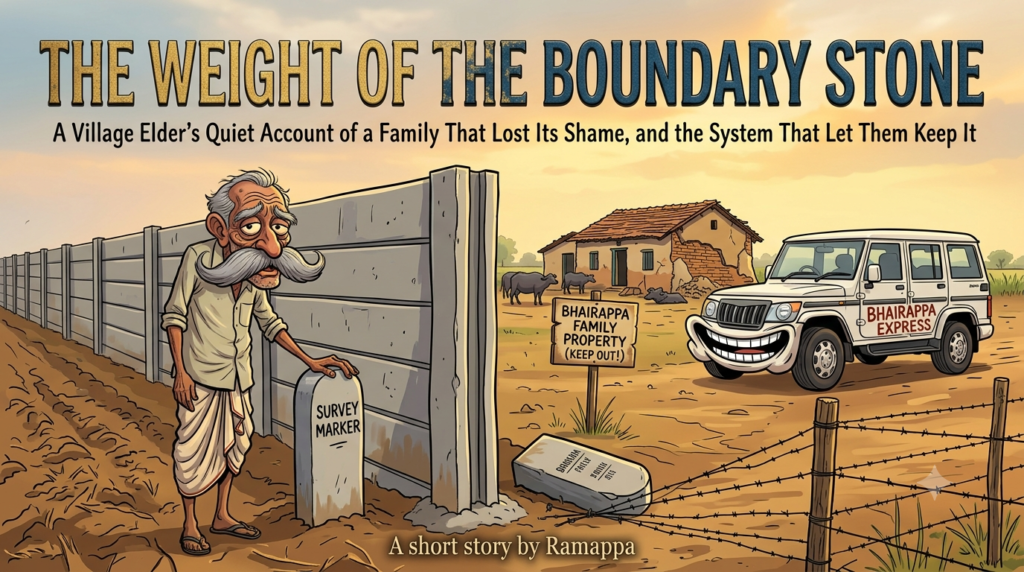
I do not know exactly when it started. Perhaps it was the season Manjunath first moved his fence a foot into the grazing path that both our families had shared since before I was born. I said nothing. My wife, Saroja, told me to say something, and I told her it was only a foot, that it was not worth the trouble of an argument with a man who raised his voice for sport. The next year it was two feet. Then it was the whole path.
By the time I understood what was happening, half the village had already built walls.
You must understand what it means for farmers to build compound walls between fields that have never needed them. It is an admission of defeat before any war has been fought. Wall-building costs money we did not have to spare, cement and labour we could have spent on seed and fertilizer. But one by one, my neighbours — Nagesh, then the Puttaswamy brothers, then even the temple trust that managed the grazing common — built their walls, not to keep anything in, but to keep the Bhairappa family out. Out of arguments. Out of court notices. Out of the particular exhaustion that comes from being accused of something you did not do, by people who seem to enjoy the accusing more than they care about the truth of it.
I did not build a wall, not for many years. I could not afford one, and some foolish part of me believed that if I simply stayed quiet, stayed correct, kept my boundary stones exactly where the old survey map said they should be, no one could touch me. I thought decency was a kind of shelter.
It was not.
II.
There is a memory I return to often, from perhaps fifteen years ago, before any of this had fully ripened. It was a wedding — not in the Bhairappa house, but in the Puttaswamy house next to mine — and Manjunath had brought his children along, as everyone brings their children to weddings in our village. I remember watching young Vikas, perhaps twelve years old then, take a second helping of sweets from the serving line without waiting his turn, pushing past two younger children to do it. Kamala, his mother, saw this. I watched her see it. And instead of correcting him, she laughed, loudly, to the women beside her, and said, “He knows what he wants, this one. He will go far.”
I did not think much of it at the time. It is only a boy at a wedding, taking sweets. But I think of that moment now the way one thinks of a single loose thread on a garment that will, years later, unravel entirely. She did not see a fault to correct. She saw a virtue to announce.
The daughters, Anitha and Deepa, grew up more or less within sight of my own fields, since our children studied at the same government school before the family could afford to send them to the private school in the taluk town. My elder son, Shivu, was in the same class as Anitha for two years. He tells me now, when I ask him, that even then, Anitha would tell teachers things that were not true — that another girl had stolen her pencil box, that a boy had pushed her, when neither had happened — and that when the teacher found this out and complained to Kamala, Kamala came to the school and shouted at the teacher instead of at her daughter, calling the teacher jealous of her child’s cleverness.
I do not tell you this to mock a woman for defending her child. Every mother defends her child; I have done it myself, badly, more than once. I tell you this because there is a difference between defending a child from an unfair world and defending a child from the truth. Kamala, I think, never learned where that line was. Or perhaps she knew it perfectly well and simply preferred the other side of it.
III.
Two years ago, Anitha came back to the village. I remember she arrived in a rented car, though I heard later it was to impress the neighbours before she needed something from them. She had left her husband in the city — some said because of a dispute over dowry that never was, others said because of a man she had met through her phone, though I never repeated that, because I do not know it to be true, and I have seen what happens in this village when things that are not known to be true get repeated anyway. Within a year there was a court case, her husband accused of cruelty, his family paying lawyers to prove otherwise. Then came the younger sister, Deepa, with two children and a similar story, a similar case, a similar rented car.
I saw Deepa once, not long after she returned, standing at the edge of her father’s field with her two children playing near the canal, and something in her face stopped me — not guilt, not defiance, but a kind of tiredness that made me wonder, for the first time, whether these young women were not merely instruments of their parents’ hunger for advantage but also, in some way, its earliest victims. A child raised to believe that truth bends to convenience does not necessarily become cruel by nature. Sometimes she becomes cruel by inheritance, the way a farmer inherits a debt he did not create but must still repay. I do not offer this as an excuse. I offer it only because a man my age has learned that villains are rarely born; more often they are built, brick by brick, inside houses just like any other, by parents who mistake indulgence for love.
By last year there were, by my counting, six cases running against or by this one family — land encroachment against three neighbours including myself, a dowry harassment case each from the two sisters, and two counter-cases filed by the sisters’ husbands’ families. I only know this because Nagesh, who is bolder than I am, once went to the taluk court to check the cause list for his own hearing and saw the Bhairappa name written five times on the board before his own.
IV.
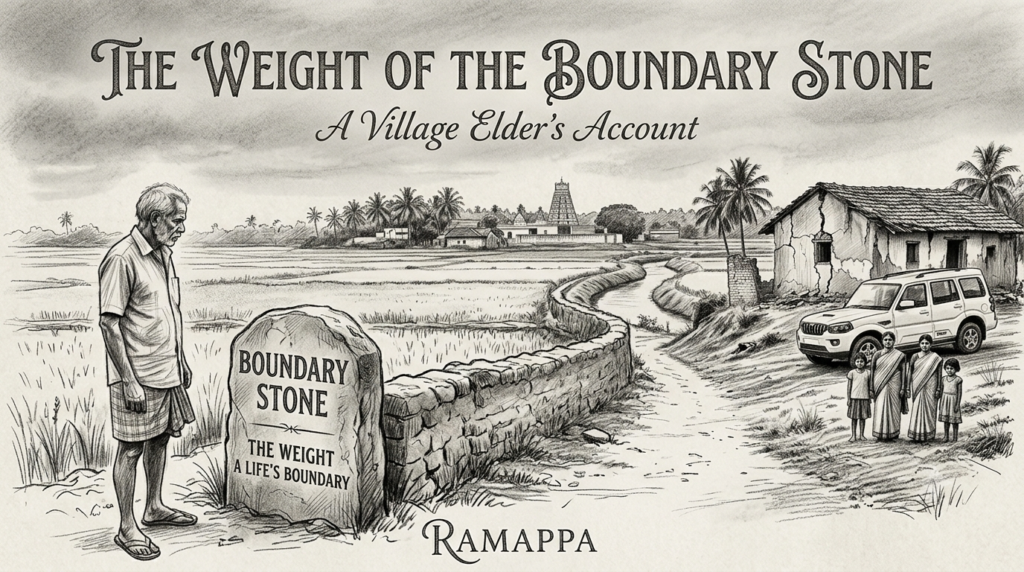
Their son, Vikas, was rarely in the village at all. He married a girl from another district against both families’ wishes, and after that he came and went like weather — gone for months trading in shares in some city, back for a few weeks with a new car, gone again. Once he brought back a white SUV, the kind used for off-road driving, though there is no off-road driving to be done in Kalasapura beyond the cattle track to the canal. He photographed himself standing beside it in the manner of the young men one sees on phone screens now, calling themselves influencers, though influencing what, I never understood. I heard from the cattle trader in the next village that the Bhairappas had sold six of their buffaloes to buy that car. Six buffaloes, which is to say, six years of a small farmer’s security, converted into a photograph.
The younger brother, Bhavesh, followed the same path as his brother, city to city, some trading business that none of us understood and that I suspect he did not fully understand either. What I noticed, and what troubled me more than the land disputes, was this: whenever the brothers returned, the parents received them like conquering heroes. There was no question asked about where the money had gone, or why a share trader needed an off-road vehicle, or why two young men who called themselves businessmen never once repaired the family’s own ancestral house, which was crumbling at its western wall even as the new car gleamed in the courtyard.
I am a simple man, and I have raised two sons of my own on this same six acres, and I know this much: children do not become what they become by accident. Manjunath and Kamala did not merely fail to correct their children. They cheered them. When the sisters made their allegations, the mother went from house to house in the early days, not to apologize to anyone, but to gather sympathy, to say her daughters were wronged women, before any court had decided any such thing. When the sons showed off their car, the father stood beside it in the photograph too, smiling, as though six buffaloes had become a new tractor instead of a toy.
I do not say the sisters’ complaints were all false. I am not in their marriages, and I do not sit in judgment over what happens inside another family’s home. That is not my claim. My claim is only this: I watched a family that had lost the trust of an entire village, whose court cases outnumbered their working farmhands, whose son bought a status symbol with the family’s animals, and I watched the parents at the centre of it offer nothing but pride. Not one word, in all these years, of “enough.” Not one moment where a mother said to her son, this is not right, or a father said to his daughters, tell me the truth before you tell the court.
V. The Meeting
There was a panchayat meeting, eight months ago, called specifically to settle the boundary disputes — not just mine, but three others besides. I attended, though attending cost me a day’s labour I could not spare during sowing season. It was held in the old cooperative hall, under the single ceiling fan that has turned slowly over every important argument in Kalasapura for thirty years. I remember the heat of that afternoon more clearly than I remember most things from the last decade — how the plastic chairs stuck faintly to the back of my shirt, how Nagesh sat beside me with his arms crossed, already certain of how it would end.
Chandrashekar, our village head, sat at the centre table with the old survey documents spread in front of him — yellowed paper, the boundary lines drawn in a surveyor’s careful hand sixty years before any of us were born. He is a patient man, Chandrashekar, and I have come to believe patience is both his greatest strength and the thing that has cost him the most.
“Manjunath,” he said, tapping the paper gently, “this line here — this is where the stone was placed in 1961, when your grandfather and Ramappa’s grandfather agreed to it together. Both families signed the register. I have brought the register too, if you want to see it.”
Manjunath did not look at the document. He sat with his arms wide on his knees, the posture of a man who has already decided the shape of the conversation before it begins. “Survey lines,” he said, and made a small sound in his throat, something between a laugh and a dismissal. “Sixty-year-old paper. You want to measure my land with a paper my grandfather could not even read? Things change, Chandrashekar anna. Rivers change their course. Fields change their shape. Are we going to argue about a foot of soil like beggars?”
“It is not a foot anymore,” I said. My voice came out smaller than I wanted it to. I felt Nagesh shift beside me, surprised, I think, that I had spoken at all. “It was a foot five years ago. Now it is the whole grazing path. My cattle have nowhere left to graze between your fence and the canal.”
Manjunath turned to look at me for the first time since the meeting began, and I will not pretend his gaze did not unsettle me, even now, even in the retelling. “Ramappa,” he said, almost gently, the way one speaks to a child who has misunderstood something simple, “we have farmed up to that fence for years. If you wanted to object, you should have objected years ago. Why now? Why after your crop has already failed on its own and you need someone to blame?”
It was not true — my crop had not failed on its own, his cattle had grazed through it two weeks before harvest, a fact three neighbours had witnessed — but I felt the room’s attention shift, felt the particular helplessness of watching a lie land more comfortably in people’s ears than the truth had, simply because it was delivered with more confidence than I could summon.
Kamala spoke next, before I could correct him, her voice pitched to carry to the women seated at the back of the hall. “This is what it has come to,” she said, shaking her head slowly, looking not at Chandrashekar but at the room itself, gathering it in. “An entire village turning against one family. Is this the Kalasapura I grew up in? We used to help each other here. Now everyone wants to measure and remeasure and drag people to court over inches of mud. Shame on all of you, honestly. Shame.”
I watched Chandrashekar’s face in that moment, and I have not been able to forget it. It was not anger. It was something closer to grief — the particular grief of a man who remembers, better than almost anyone alive, the Kalasapura Kamala was invoking, the one with heart, and who understood, before any of the rest of us fully did, that she was using that memory as a weapon against the very people trying to preserve what was left of it.
“Kamala,” he said quietly, “no one here wants a fight. We only want the boundary that was agreed sixty years ago to be respected today.”
“And whose word is more sixty years old,” Manjunath said, standing now, “the paper’s, or the people who have lived on that land every day since? You want to bring lawyers into this, bring lawyers. You want to bring police, bring police. We are not afraid of either. We have already been to court enough times to know how long these things take. Ask yourself” — and here he looked, deliberately, slowly, around the room, at Nagesh, at the Puttaswamy brothers, at me — “how many of you have ten years to spend on a boundary dispute. I have all the time in the world.”
No one answered him. That was the worst part — not that he said it, but that no one in the room, myself included, found anything to say back, because we all understood, in that silence, that he was not boasting. He was simply telling us the truth about the arithmetic of the thing: that a man with nothing left to protect can outlast, without effort, a room full of men who still have everything to lose.
The meeting ended without resolution, as these meetings always did. Chandrashekar folded the old survey papers back into their envelope with the careful, defeated motions of a man returning a photograph of someone who has already died. Nagesh muttered something under his breath as we walked out into the evening heat, and I did not ask him to repeat it, because I already knew what it would be, and I did not have the strength that evening to agree with it out loud.
Nothing was resolved that evening. Nothing has been resolved since.
VI.
I went, some weeks after that meeting, to file a complaint after Manjunath’s men grazed cattle deliberately into my standing ragi crop, destroying nearly a quarter acre two weeks before harvest — the very incident he had already, in that meeting, twisted into a story about my own failure. I sat outside the police station in the taluk town for four hours. When I was finally heard, the head constable — not an unkind man, I think, only a tired one — told me that filing the complaint would mean a counter-complaint would follow within the week, that this had happened to the last three villagers who complained, and that I should ask myself whether I had the time, the money for travel to hearings, and the patience for a case that might not conclude before my grandchildren were grown. He was not telling me to give up. He was telling me the truth. And the truth was enough to send me home without filing anything.
On the bus back to the village, I sat beside an old classmate of mine, now a clerk in the taluk revenue office, and I asked him, half in jest, whether there was truly nothing the system could do for a family like mine against a family like theirs. He laughed, not unkindly, and said something I have not been able to forget: “Ramappa, the law protects people who still have something to protect. Your good name works against you. Theirs has nothing left to lose, so nothing frightens them.” I did not understand him fully then. I understand him completely now.
VII.
That is the real horror of it, I think, more than any single stolen foot of land. It is not that the Bhairappas are especially clever, or especially powerful. It is that they have nothing left to lose, and the rest of us have everything to lose, and the machinery that is supposed to protect the second kind of person from the first kind takes so long, and costs so much, and asks so much patience, that most of us simply build a wall instead and call it peace.
I built my wall this year. I borrowed from my son to do it. He did not want to lend it to me for this purpose — he wanted me to fight, to file the case properly, to take it as far as it would go. He is young, and he still believes that persistence is rewarded in the end. I did not have the heart to tell him what the clerk told me on the bus, or what I saw in Manjunath’s face that afternoon in the cooperative hall, when he told a room full of frightened, decent men that he had all the time in the world. I only told my son that a wall built now is cheaper than a court case fought for ten years, and that I am fifty-one years old, and I do not know if I have ten years of patience left in this body.
I am not proud of the wall. A wall does not solve anything; it only marks the place where solving stopped being attempted.
Sometimes, in the evening, I sit at the edge of my field and look toward the Bhairappa house, at the new white car parked beside the crumbling western wall no one has repaired, and I think of a question I cannot answer. What is a sincere man supposed to do, in a village, in a country, where the people who have burned every bridge behind them are the very people the system finds hardest to touch — while the people who still have a name to protect, a reputation to guard, a court date they cannot afford to miss, are the ones who bend first, every time?
I think of Vikas’s white SUV, parked in a courtyard beside a wall that no one bothered to repair, and I wonder what it will look like twenty years from now, when the buffaloes that paid for it are long forgotten, and whatever it was meant to prove has proven nothing at all. I think of the two sisters, and the four children they are raising between them, and I wonder what those children will learn to call ordinary, growing up in a house where six court cases are simply the weather of daily life. I wonder if one of them, someday, will be the boy at the wedding taking a second helping without waiting his turn, and whether anyone left in that house will still know how to say no.
I do not know the answer to any of this. I only know that I have built a wall around six acres my father left me, and that somewhere past it, a family that owes the village six court cases and a lifetime of broken trust continues exactly as before, untouched, unashamed, and utterly free — while I go home each evening, sit beside my wife in the small light of our doorway, and wonder what it was, in the end, that decency ever protected.
— End —



Borrowed Glory in Kalikapur: The Story of a Village Election