

The Three Questions: A Story of Naikan in a Marathi Household
The rains had come early to Kalikapur that year, and Professor Teja Patil stood at the window of his study, watching water run down the old stone steps that led to the small river bordering the village. He had lived in this house on the outskirts of Kalikapur, a quiet grape-growing village in Nashik district, for eleven years now, ever since the university had granted him leave to write his book on the forgotten record-keepers of the Peshwa court. The book was still unfinished. He was beginning to suspect it always would be.
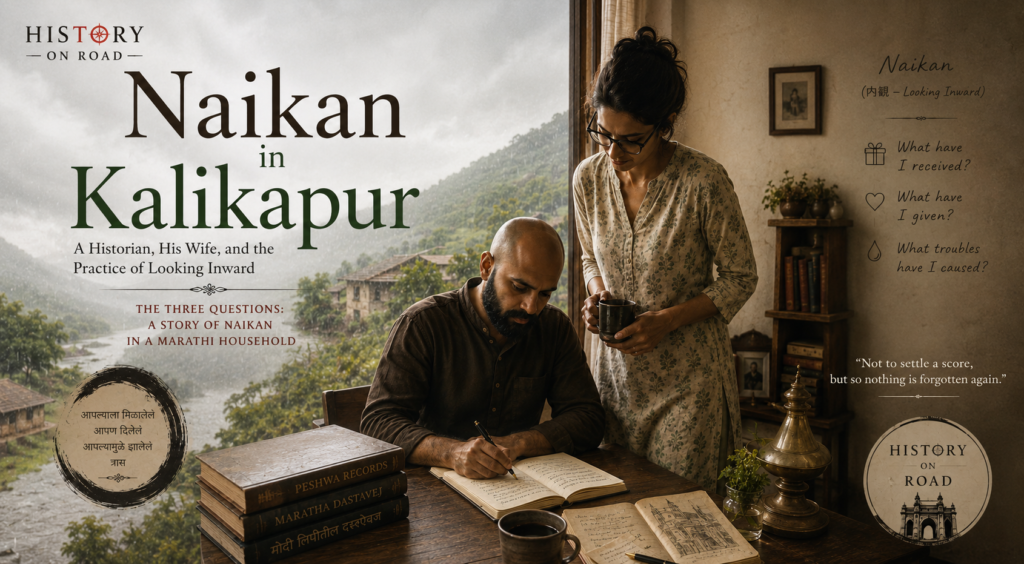
“You have that look again,” said Nomi from the doorway, a steaming cup of kadha in each hand. She was still in her cotton nightdress, her MSc in Statistics framed on the wall behind her like a relic from a different life — a life before she had left her research post in Pune to follow her husband to this quieter village.
“What look?”
“The look of a man arguing with the seventeenth century and losing.” She handed him the cup. “Your mother called. She waited forty minutes for you to call her back yesterday.”
Teja winced. “I’ll call her tonight.”
“You said that on Tuesday.” There was an edge in her voice this time, thin but unmistakable, and she left the room before he could answer it.
He sat with that edge for a while after she had gone. It was not like Nomi to let anything show. In eleven years he had built a quiet, comfortable theory of his wife: patient, undemanding, content to have followed him here. It had never occurred to him that patience might simply be a name for something she had stopped saying out loud.
The visitor arrived that afternoon, shaking rain from a black umbrella on their doorstep — a small, silver-haired woman named Kamala Tai, an old friend of Teja’s late father, who had spent decades studying in Japan and had recently returned to Maharashtra to live out her retirement among the vineyards near Kalikapur. She had written to Teja months ago, curious about his research into how ordinary Maharashtrian households recorded their debts and obligations — who lent grain to whom, who nursed whose child through fever, who forgave what.
“It is not so different from what I studied in Japan,” Kamala Tai said, settling into the cane chair, “though the Japanese gave it a name and a method. Naikan. Have you heard of it?”
Teja shook his head. Nomi, pouring tea, paused to listen.
“It means ‘looking inward,'” Kamala Tai continued. “A monk named Yoshimoto Ishin developed it out of an older, harsher Buddhist practice of self-examination, and softened it into something anyone could do — not to punish yourself, but to see clearly. You ask yourself three questions, again and again, about the people in your life. What have I received from this person? What have I given this person? And what troubles and difficulties have I caused this person?”
Teja laughed, a little uncomfortably. “That sounds like an accountant’s ledger for the soul.”
“In a way, it is.” Kamala Tai smiled. “But most of us keep the ledger backward. We remember every rupee we have lent and forget every rupee we have borrowed. Naikan simply asks you to check your arithmetic.”
Nomi set the teapot down harder than she meant to. “And what if the arithmetic has been wrong for a long time?” she asked. “What if one person has been keeping the household’s whole ledger alone, and the other has never once looked at it?”
The room went quiet. Teja looked at his wife as though seeing, for the first time in years, that she was not merely present in his life but keeping accounts of her own — accounts he had never asked to read.
Kamala Tai did not flinch. “Then,” she said gently, “it is very good that you asked the question out loud. Naikan is not meant to be done by only one person in a house. It is only half the exercise if only one side counts.”
That night, after Kamala Tai had gone home in the still-falling rain, Teja found Nomi on the veranda, staring at the water running off the eaves. He sat beside her without speaking for a while.
“I didn’t mean to embarrass you,” she said finally. “It came out before I could stop it.”
“Don’t take it back,” he said. “I think I needed to hear it said plainly, since I clearly hadn’t heard it any other way.”
She was quiet. Then: “It isn’t about the phone calls to your mother, Teja. It’s that I moved here for you eleven years ago, and I have watched you disappear into the eighteenth century almost every evening since, and I told myself it was devotion to your work. I’m not sure anymore if it was devotion or just — quiet.”
He absorbed that without defending himself, which surprised her.
Later, at his desk, he opened a blank notebook and wrote at the top: Nomi.
What have I received from her?
He thought of the eleven years. The move to Kalikapur without a single word of protest. The nights she corrected his English proofs though statistics, not history, was her subject. The mornings she woke early so he would not eat breakfast alone. The silence she gave the unfinished book, never once asking when it would end, though he knew she wondered.
What have I given her?
The pen slowed here. He had given her a house far from her colleagues, her research, the career she might have built. He had given her a husband more often present with dead courtiers than with her. The list was shorter and thinner than the first, though he had always privately believed himself devoted.
What troubles have I caused her?
He made himself write it plainly: the calls to his mother that Nomi made quietly in his place, so no one would notice he’d forgotten. The evenings she ate alone while he sat lost in someone else’s century. Eleven years of small debts, uncounted, that had finally spoken out loud on the veranda that evening.
In the next room, unable to sleep, Nomi took out an old notebook of her own — one she had used years ago for her research, now half-empty. On its first blank page, she wrote Teja’s name, and beneath it, the same three questions, because she found she could not stop turning them over either.
What have I received from him?
Slowly, unwillingly at first, she wrote: his quiet loyalty, never once wavering, even when the book failed him year after year. The way he had once given up a fellowship in Delhi without telling her, so she would not have to choose between his career and her aging mother nearby. She had learned of it by accident, three years later.
What have I given him?
A great deal, she thought — but also, she admitted, a great deal of unspoken resentment dressed up as patience, which was perhaps its own kind of withholding.
What troubles have I caused him?
She had let him believe, for eleven years, that everything was fine.
In the morning, Teja called his mother before Nomi had even made the tea. When Nomi came into the study, she found a page pinned above his desk beside the framed degree she had left behind for him: What have I received? What have I given? What have I caused?
She said nothing at first. Then she set her own notebook down beside his, open to the same three questions in her own hand.
“I think,” she said, “we have both been keeping this ledger. Just never in the same room.”
He took her hand, and for once did not reach for a book or a page or an old century to hide inside. “Then let’s read them together from now on,” he said. “Not to settle a score. Just so nothing is forgotten again.”
Outside, the rain over Kalikapur had softened to a drizzle, and the small river carried on the way it always had — indifferent to ledgers, but patient, as rivers are, with those who finally sit down together to count what has been given, and what still remains to be repaid, not in guilt, but in attention.
— End —


Borrowed Glory in Kalikapur: The Story of a Village Election