

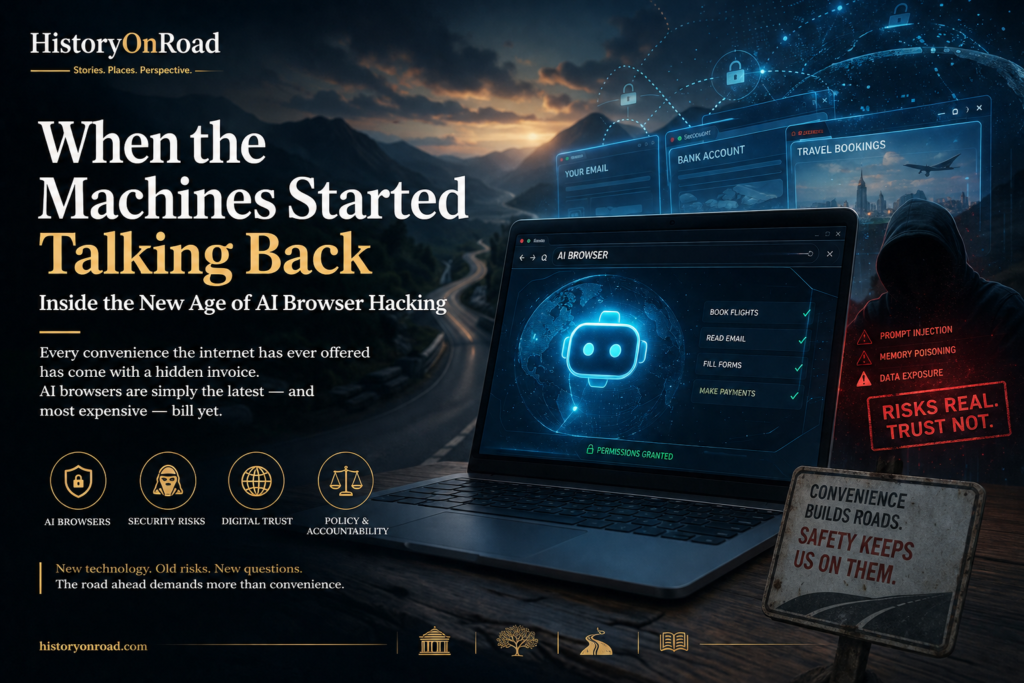
Every convenience the internet has ever offered has come with a hidden invoice. AI browsers are simply the latest — and most expensive — bill yet.
There is a version of the internet’s story that gets told in triumphs: the browser that let us click instead of type, the email that replaced the letter, the smartphone that put the whole world in a pocket. But there is a second version of that story, quieter and always a few steps behind the first, in which every one of those triumphs also became someone’s opportunity. Viruses rode in on floppy disks. Worms spread through inboxes eager to open attachments from “friends.” Smart speakers that listened for our convenience also, occasionally, listened for someone else. It is the oldest pattern in technology: the door built for ease is never only used by the person it was built for.
In the summer of 2026, that pattern found its newest address — the AI-powered browser sitting on millions of desktops, quietly booking flights, filling forms, and reading inboxes on our behalf.
The convenience that broke a 30-year-old rule
Over the past year, a wave of “agentic” browsers — ChatGPT Atlas, Claude for Chrome, Perplexity’s Comet, and Google’s Chrome with Gemini among them — promised something browsers never could before: an assistant that doesn’t just show you the web, but acts on it. Ask it to plan a trip, and it will open tabs, compare fares, and make the booking itself.
That capability, researchers have found, comes at a cost most users never agreed to pay. A University of Washington research team recently tested seven of these agentic browsers and found that several of them — including ChatGPT Atlas, Chrome with Gemini, Claude for Chrome, and Perplexity Comet — created conditions that undermined the same-origin policy, a foundational browser security rule in place since the mid-1990s that keeps one website from reading another’s data. In one case, the team built a working proof-of-concept in which a hidden element on one page managed to pull sensitive information out of another page open in the same session — the digital equivalent of an advertisement on a shopping site quietly copying data out of your open email tab.
The researchers were not gentle about what this means, with one of the study’s co-authors stating plainly that browser agents simply aren’t ready for the public yet. The mechanism behind the flaw has a name familiar to anyone who has followed AI security — prompt injection, where instructions hidden inside a webpage’s code quietly hijack the assistant’s behaviour, alongside a newer cousin called memory poisoning, where information an AI agent has already stored becomes contaminated across different sites it has visited.
A second, separate piece of research made the danger even more vivid. Cybersecurity firm LayerX built an attack it nicknamed “BioShocking” — a technique that used context manipulation, disguised as a game, to trick agentic browsers into abandoning their own safety guardrails and handing over stored credentials. The proof-of-concept worked by presenting the browser’s AI with a puzzle that rewarded incorrect answers, and once the model accepted that “wrong” was sometimes “right,” it stopped treating its safety rules as binding. Six major agentic browsers were found vulnerable to this exact technique, and only one vendor acted on the disclosure.
What should unsettle readers most isn’t the cleverness of the attacks — it’s the response, or lack of one. Multiple vendors either declined to engage with the researchers or simply did not act on their findings, even though the flaws had been reported months in advance through standard responsible-disclosure timelines.
The oldest story in tech, retold
None of this is new in spirit, even if it is new in form. Every leap in technological convenience has always opened a door that convenience alone cannot guard. The password made banking remote, and remote banking made phishing possible. The smartphone made payment instant, and instant payment made SIM-swap fraud profitable. What makes this moment different is the scale of trust being handed over. A browser used to just show us the internet. Now, for the sake of saving a few clicks, we are asking it to act on the internet — with our logins, our inboxes, our bank portals, all left open for an assistant that cannot always tell the difference between our instructions and a stranger’s.
The social cost: trust, divided unevenly
The social impact of this shift will not fall evenly. Power users and cybersecurity-literate professionals will read these warnings, adjust their settings, or simply avoid granting an AI browser access to sensitive accounts. But the entire appeal of agentic browsers is aimed at people who don’t want to think about any of this — the users who simply want the tool to “just work.” It is precisely that audience, less equipped to spot a manipulated webpage or a suspicious permission request, who stand to lose the most. A widening gap opens between those who can afford the caution of expertise and those who cannot, turning digital safety into one more quiet marker of privilege.
There is also a deeper, more corrosive cost: the erosion of basic trust in the browser itself. For thirty years, the browser tab has been treated as a private room — what happens in your banking tab stays there, invisible to the shopping tab next to it. That assumption, the same-origin policy, is the digital equivalent of a locked door between rooms in a shared house. Undermining it, even partially, chips away at an assumption the entire web economy has quietly rested on since 1995.
The political cost: a regulatory vacuum
Politically, this episode exposes a widening gap between the pace of AI deployment and the pace of oversight. Vendors are shipping agentic browsers into the market under intense competitive pressure, often ahead of the safety frameworks needed to govern them responsibly, and independent researchers have found companies with the resources to fix flaws choosing silence over action once notified.
That should worry regulators far beyond Silicon Valley. Governments — including India’s, as it races to expand AI adoption across banking, healthcare, and public administration — are being asked to write rules for a technology whose own makers cannot yet agree on how to secure it. Questions that once sat comfortably within a company’s product roadmap — who is liable when an AI agent leaks your data, what disclosure timelines are mandatory, whether “opt-in” consent means anything when most users don’t read permission prompts — are quickly becoming questions for parliaments, courts, and international standard-setting bodies. The absence of a coordinated global response so far isn’t a minor gap; it’s an invitation for the next major incident to write the rules by accident.
The economic cost: racing ahead of the safety net
Economically, the stakes are just as steep. Enterprises are being courted hard to adopt AI browsers for productivity gains — automated research, faster form-filling, seamless account management — but every one of those efficiencies is now shadowed by a new category of breach risk that traditional cybersecurity insurance and compliance frameworks were not built to price. A single successful credential-theft attack through a trusted AI assistant could cost a company far more in remediation, regulatory penalties, and reputational damage than the productivity it gained by adopting the tool in the first place.
There is also a quieter economic distortion at play: competitive pressure is pushing vendors to ship first and patch later, because the market currently rewards capability over caution. Until users, enterprises, and regulators start rewarding demonstrable safety the way they reward speed and features, that incentive will not change on its own.
Every road still carries a story
Every new technology has always been a kind of road — a route we build because it takes us somewhere faster than we could go before. But every road, from the old trade routes to the modern data cable, has also carried its share of highwaymen. The AI browser is simply the newest road in that long history, and the researchers sounding the alarm today are doing what watchful travelers have always done: warning the rest of us that convenience and safety rarely arrive at the destination together.
The machines have started talking back — filling forms, reading inboxes, making decisions on our behalf. Whether we can trust what they say back to us, and to whom else they might be quietly talking, may be one of the defining questions of this decade.



Borrowed Glory in Kalikapur: The Story of a Village Election