
“Education is the most powerful weapon which you can use to change the world.”
Nelson Mandela
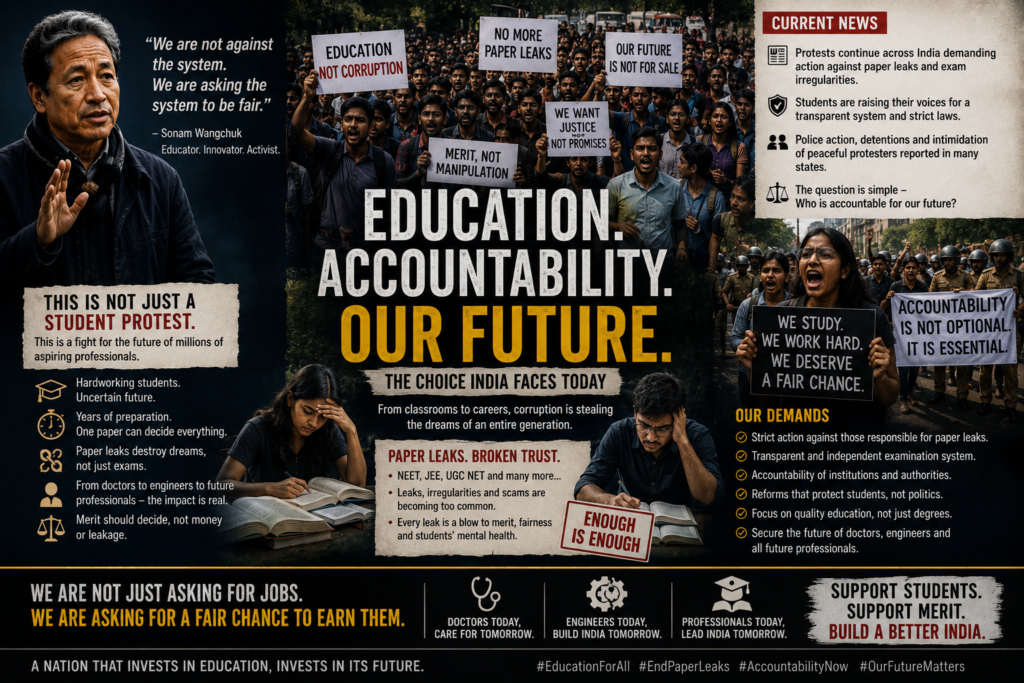
Every generation witnesses a moment that quietly asks an uncomfortable question about the society it has built. These moments do not always arrive during elections or constitutional debates. Sometimes they begin with a classroom, a teacher, a student, or a peaceful citizen who simply believes that asking questions is not an act of rebellion but an act of responsibility.
The recent events surrounding education reformer Sonam Wangchuk have become one such moment.
For many people, the images were striking. A man known more for innovation than confrontation, accompanied by students and supporters who believed that peaceful dialogue could still make a difference. Regardless of political opinions, those scenes encouraged millions to pause and reflect on something much larger than a single protest. They invited a conversation about democracy itself. Not the democracy described in textbooks, but the democracy that reveals its character when confronted with criticism, disagreement, and peaceful public participation.
History teaches us that every democracy eventually faces this examination. The question is never whether disagreements will arise. They always do. The real question is how institutions respond when citizens choose conversation instead of silence.
Perhaps this is why education has always occupied such a unique place in every civilization. It does far more than prepare students for careers. It prepares citizens to think independently. A classroom is one of the few places where young minds are encouraged to ask “Why?” before they are expected to accept “Because.”
That simple question has transformed the world countless times.
Thousands of years ago, Socrates walked through the streets of Athens asking questions that challenged accepted beliefs. His method was remarkably simple. Rather than providing answers, he encouraged people to think for themselves. It ultimately cost him his life, but it also changed philosophy forever.
Centuries later, Galileo questioned the accepted understanding of the universe. Marie Curie challenged scientific boundaries that many believed impossible to cross. Dr. B. R. Ambedkar questioned social inequalities that had existed for generations. Mahatma Gandhi questioned whether an empire could be challenged without violence. Martin Luther King Jr. questioned whether equality could remain only a promise.
None of these individuals began with power.
They began with questions.
Albert Einstein once remarked,
“The important thing is not to stop questioning.”
That sentence captures the very purpose of education. Education does not exist to produce obedience. It exists to develop curiosity, evidence based thinking, and informed judgment. Every meaningful innovation, every scientific breakthrough, every social reform, and every democratic advancement began because someone refused to stop asking questions.
This is why the relationship between education and democracy has always been inseparable. One teaches people how to think. The other gives them the freedom to express those thoughts peacefully.
When either begins to weaken, the other eventually follows.
The conversation surrounding Sonam Wangchuk is significant because it touches both these foundations at the same time. His work has long been associated with education, innovation, sustainability, and encouraging young people to solve problems creatively. For many supporters, therefore, the discussion is no longer limited to one individual. It has become symbolic of a larger concern. Can peaceful voices still expect meaningful engagement? Can disagreement exist without immediately becoming division? Can accountability strengthen governments rather than weaken them?
These questions are neither new nor unique to India.
Every democracy has wrestled with them.
The American Civil Rights Movement, South Africa’s struggle against apartheid, democratic reforms across Europe, and India’s own freedom movement all demonstrated something remarkably similar. Lasting progress rarely emerged because everyone agreed. It emerged because societies found ways to transform disagreement into dialogue.
Mahatma Gandhi understood this deeply when he observed,
“In a gentle way, you can shake the world.”
Peaceful protest is often misunderstood as a sign of instability. In reality, it can be one of democracy’s healthiest expressions. People march peacefully because they still believe someone is willing to listen. If they had completely lost faith in democratic institutions, they would not seek dialogue at all.
That distinction matters.
A peaceful protest is not merely an expression of dissatisfaction. It is also an expression of hope.
It says that citizens still believe governments can hear criticism without treating critics as enemies.
It says that dialogue remains possible.
And that hope is worth protecting.
Political philosopher John Stuart Mill warned that a person who knows only one side of an argument understands very little of the issue itself. Democracies thrive because they allow multiple perspectives to exist simultaneously. Elections determine who governs, but they do not eliminate the responsibility to continue listening once those elections are over. Winning public office grants authority. Listening earns public trust.
There is an important difference between the two.
Authority can be written into law.
Trust must be built every single day.
History rarely celebrates leaders simply because they exercised power. It remembers those who exercised restraint, welcomed criticism, admitted mistakes, and possessed the confidence to engage with opposing viewpoints. These qualities are not signs of weakness. They are often the clearest demonstrations of strength.
HistoryOnRoad Editorial
Today’s student voices are tomorrow’s history. Throughout history, students have stood for education, fairness, and accountability, reminding societies that the right to education is a cornerstone of democracy. Peaceful protests for transparent examinations, equal opportunities, and a secure future for doctors, engineers, and other professionals reflect the enduring pursuit of justice. At HistoryOnRoad, we document these moments because today’s events shape tomorrow’s history.