
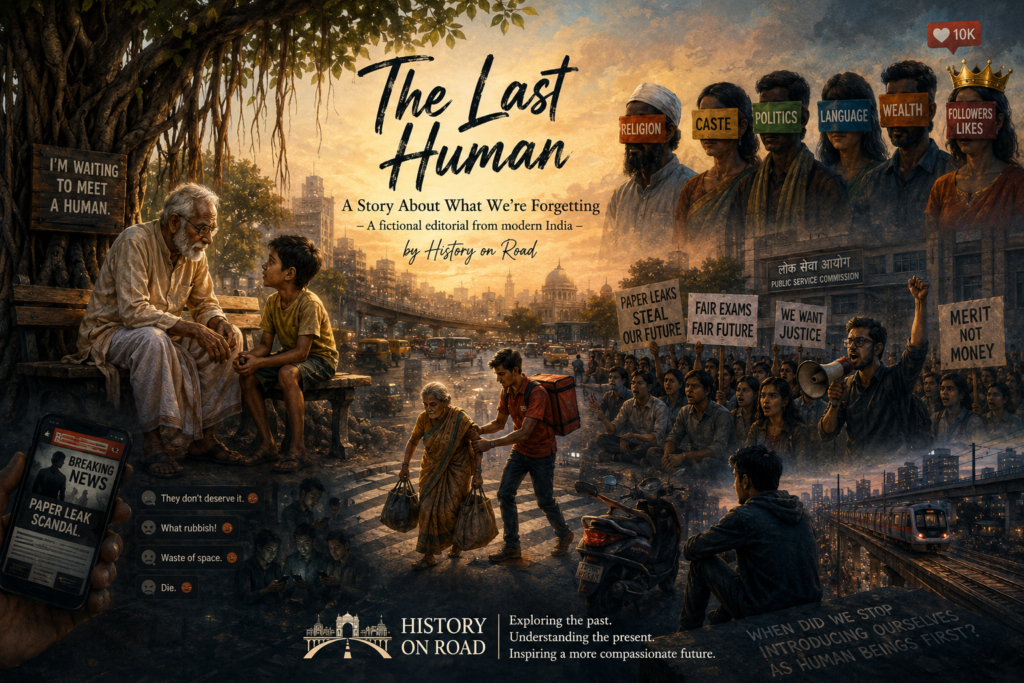
There’s an old man who sits on a weathered bench beneath a banyan tree.
The city around him never slows down. Cars honk. People rush past, eyes fixed on glowing screens. Conversations grow louder, but understanding grows quieter.
One day, a little boy stops in front of him and asks what he’s waiting for.
“I’m waiting to meet a human,” the old man says.
The boy laughs. “But there are thousands of people here.”
“I know,” the old man replies. “But I haven’t seen many humans today.”
The Labels We Wear Instead of Faces
The boy looks around, and starts to notice what the old man means. Everyone seems to be wearing an invisible badge — and it’s rarely the badge that says “human.”
- Religion worn like armor
- Caste worn like rank
- Political ideology worn like a weapon
- Language worn like a border
- Wealth worn like a scoreboard
- Followers and likes worn like a crown
Arguments break out over religion. Insults fly over politics. Strangers film accidents instead of helping. Comments online wish death on people never met in person. And somewhere in all of it, children are quietly learning that winning an argument matters more than understanding a person.
The boy asks the question that matters most: “How do you know someone is truly human?”
The Moment the Labels Disappear
The old man points to the street.
An elderly woman struggles under the weight of her bags. Hundreds of people walk past her without a glance. Then one young delivery rider stops. He parks his bike.
He doesn’t ask who she voted for. He doesn’t ask her religion. He doesn’t ask her surname.
He just helps her cross the road.
“There,” the old man whispers. “The labels disappeared. For a moment, only humanity remained.”
That’s the whole point of the story — humanity isn’t a big, dramatic gesture. It’s a small one, offered without a single question asked first.
When “Unhuman” Isn’t a Villain in a Film
We tend to imagine cruelty as something dramatic — a monster, a monster’s henchman, a monster’s plan. But the old man knew better. The unhuman nature he feared wasn’t loud. It was quiet, everyday, and normal enough that no one even noticed it anymore:
- Walking past someone who needs help, because stopping is inconvenient
- Feeling nothing when a stranger’s tragedy scrolls by on a screen
- Mistaking indifference for “minding your own business”
- Treating another person’s pain as content, not a call to act
- Being outraged for an audience, but silent when no one’s watching
Unhuman nature doesn’t announce itself. It just slowly replaces empathy with efficiency, and connection with convenience — until “normal” and “numb” start to look the same.
The Students Who Refused to Stay Silent
Years later, in a city not unlike this one, something happened that the old man would have recognized instantly.
An exam paper leaked. Again.
Thousands of students — years of preparation, family savings spent on coaching, entire futures riding on a single test — found out that the result had already been decided before they’d even opened their answer sheets. Somewhere, someone with the right contacts had bought the questions in advance.
The students did what the delivery rider did that day, in their own way. They stopped. They didn’t walk past it.
They gathered outside government offices with hand-painted placards. They sat on cold pavements through the night. They weren’t protesting a syllabus or a subject — they were protesting a system that had quietly decided some people’s futures were for sale.
- A farmer’s daughter who studied by streetlight because her village had no power after 9 p.m.
- A boy who worked at his father’s shop by day and solved question papers by night
- A girl who had already told her whole family she would “definitely clear it this time”
None of them were fighting for marks. They were fighting for the idea that effort should still mean something — that the exam hall should be the one place where the invisible badges of wealth and connections don’t get to walk in ahead of you.
The Architecture of the Problem
A leaked paper is never really about one paper. It’s a crack that reveals the whole wall behind it — a society built, layer by layer, on unequal access:
- At the top, a small number of people who can buy outcomes — admissions, contracts, verdicts, even exam questions
- In the middle, an enormous number of people who play by the rules and are told that’s simply “how it works”
- At the bottom, people for whom the rules were never really written with them in mind at all
Corruption at its worst isn’t just a bribe changing hands in a back room. It’s the slow normalization of the idea that some people’s shortcuts are just other people’s bad luck. It’s a system where the loudest, richest, or best-connected voice gets heard first — and the honest, patient, hardworking one gets told to wait its turn, indefinitely.
That’s the real unhuman nature the old man was warning the boy about all those years ago. Not cruelty with a raised fist — cruelty with a shrug. “That’s just how things are.”
Years Later, the Same Question
Time moves on. The boy grows into a man. The banyan tree is replaced by a metro station. The bench is gone.
And the world has gotten smarter:
- AI answers our questions
- Robots clean our buildings
- Cars drive themselves
But somewhere along the way, people didn’t get any kinder. Arguments got faster. Hatred went viral. Kindness became content to be posted, and compassion became a performance to be watched. People started collecting likes instead of friendships, and celebrating followers instead of neighbours.
Everyone wanted to be heard. Almost no one wanted to listen.
Sitting alone one evening, the grown man remembers the stranger under the banyan tree and asks himself the question this whole story is really about:
“When did we stop introducing ourselves as human beings first?”
What History Actually Remembers
Here’s the pattern, if you look back far enough:
- Kingdoms rose and fell
- Empires disappeared
- Borders shifted
- Languages evolved
- Currencies lost their value
But every civilization that endured had one thing stronger than its armies — humanity. No monument has ever survived because it was built on hatred. No society has ever flourished because its people forgot compassion — or because it let corruption quietly decide who gets to rise and who gets left behind.
Progress gets measured in skyscrapers. Civilization gets measured in kindness, and in how fairly a system treats the person with the least power in the room.
Maybe our biggest crisis today isn’t economic, or technological, or political — it’s the quiet disappearance of empathy, dressed up as “the way things work.”
The day we start seeing each other as labels before we see each other as people, we lose something no invention can ever build back. And the day a student stops believing that honesty and effort can win — that’s the day a society truly starts to lose itself.
A Future That Hasn’t Arrived Yet — But Could
The old man never claimed to know what comes next. He only feared one thing: that someday, museums would carefully preserve ancient swords, forgotten coins, and broken temples — and no one would remember what it actually meant to simply be human.
But that future hasn’t arrived yet. And it still doesn’t have to.
The next chapter of India’s story won’t be written only by governments, courts, or leaders. It will be written by ordinary people — students standing on cold pavements for a fair chance, a delivery rider stopping to help a stranger, and everyone choosing compassion over cruelty, truth over outrage, humanity over division.
Because history has never remembered those who shouted the loudest, or those who cut the line. It has remembered those who left the world a little kinder — and a little fairer — than they found it.
History on Road believes that history is not confined to monuments, forgotten kingdoms, or ancient manuscripts — it is written every day, in our choices, our values, and the way we treat one another. Our mission is to explore India’s past not merely to celebrate it, but to learn from it, connecting the wisdom of yesterday with the challenges of today. Because if history teaches us anything, it is this: a civilization is remembered not only for the empires it built, but for the humanity — and the fairness — it preserved. That is the journey of History on Road — discovering the past, understanding the present, and inspiring a more compassionate future.