
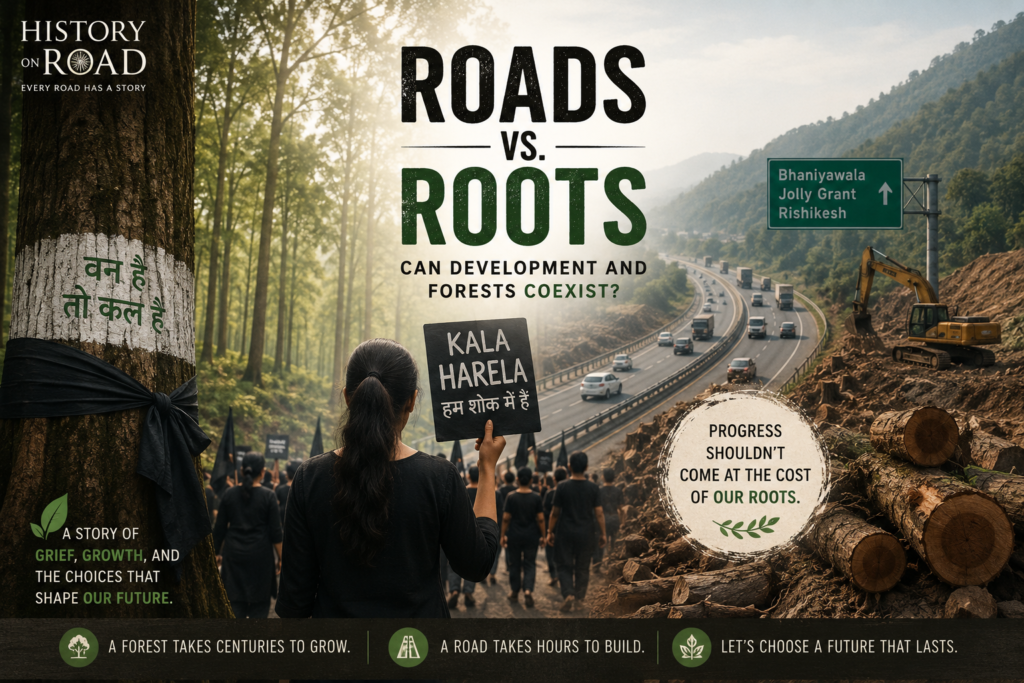
This July, something unusual happened in Uttarakhand. On the day the state was meant to celebrate Harela — its centuries-old festival of greenery, monsoon, and new sowing — a group of people showed up dressed entirely in black.
They called it Kala Harela. Black Harela. Not a celebration, but a mourning.
The reason was simple and stark: even as officials planted saplings and posted photos of pledges to protect the environment, thousands of mature trees were being marked for felling nearby — cleared to widen a highway connecting Bhaniyawala, Jolly Grant, and Rishikesh. A festival built entirely around honoring trees was unfolding in the shadow of trees coming down.
Two Reasonable Positions, One Uncomfortable Overlap
It’s tempting to reduce this to villains and heroes. It isn’t that simple.
The case for the highway isn’t unreasonable. The existing road is old, narrow, and increasingly unable to handle the traffic moving through a fast-growing region. Wider, safer roads mean fewer accidents, faster emergency access, and better connectivity for the towns and pilgrimage routes along the way. Authorities have also pointed to mitigation efforts — wildlife underpasses for elephants, an overhead crossing, and plans to transplant a portion of the trees rather than simply cutting them down.
The case against it is just as real. A tree takes a hundred years, sometimes two hundred, to grow the way these sal trees have grown — tall, rooted, load-bearing for an entire ecosystem. It takes less than an hour to cut one down. Transplantation, however well-intentioned, has a mixed record with mature trees; many don’t survive the move. And this isn’t an isolated clearing — data shared by local activists shows tens of thousands of hectares of Uttarakhand’s forest land diverted for development since the year 2000, with Dehradun absorbing nearly half of it. One road might be justifiable. A pattern is harder to wave away.
Why the Protest Looked Like a Festival
What made this protest striking wasn’t anger. It was grief expressed through ritual — the same ritual the state was using to celebrate.
People didn’t just carry signs. They marked a day of mourning the way you’d mark any other significant loss: with color, with symbolism, with their children beside them. One mother at the protest brought her toddler along, saying simply that she wanted her daughter to grow up knowing how to stand up for something. That single image says more about the stakes here than any statistic could.
Nature Doesn’t Negotiate on Our Timeline
Here’s the part that’s easy to forget in any development-versus-environment debate: a forest doesn’t operate on a five-year plan or an election cycle. It operates on decades, on root systems, on rainfall patterns built up over generations. Roads can be rebuilt, rerouted, widened again in ten years if needed. A hundred-year-old tree canopy, once gone, isn’t coming back on any human timeline that matters to the people currently living beside it.
That doesn’t mean development is the enemy. It means the trade-off deserves to be treated with the seriousness it actually has — not folded quietly into a press release beside a plantation drive photo-op.
Progress and preservation don’t have to be opposites. But when they collide, as they did this July, it’s worth pausing and asking which one we’re actually protecting for the long run.
A HistoryOnRoad Perspective
We travel to forests, hill towns, and old highways because they hold stories — the kind you can’t get from a brochure. But this story is a reminder that some of those places are being rewritten in real time, and not always in the traveler’s favor.
Every road we take to reach a destination was, at some point, cut through something that already existed — a forest, a hillside, a way of life. That’s not an argument against roads. It’s an argument for remembering what came before them. The next time we drive up to the hills for a weekend getaway, it’s worth asking what the smooth new highway replaced, and whether anyone paused to mourn it the way Uttarakhand did this Harela.
Every road carries a story. Some of them are stories of what the road cost to build.