
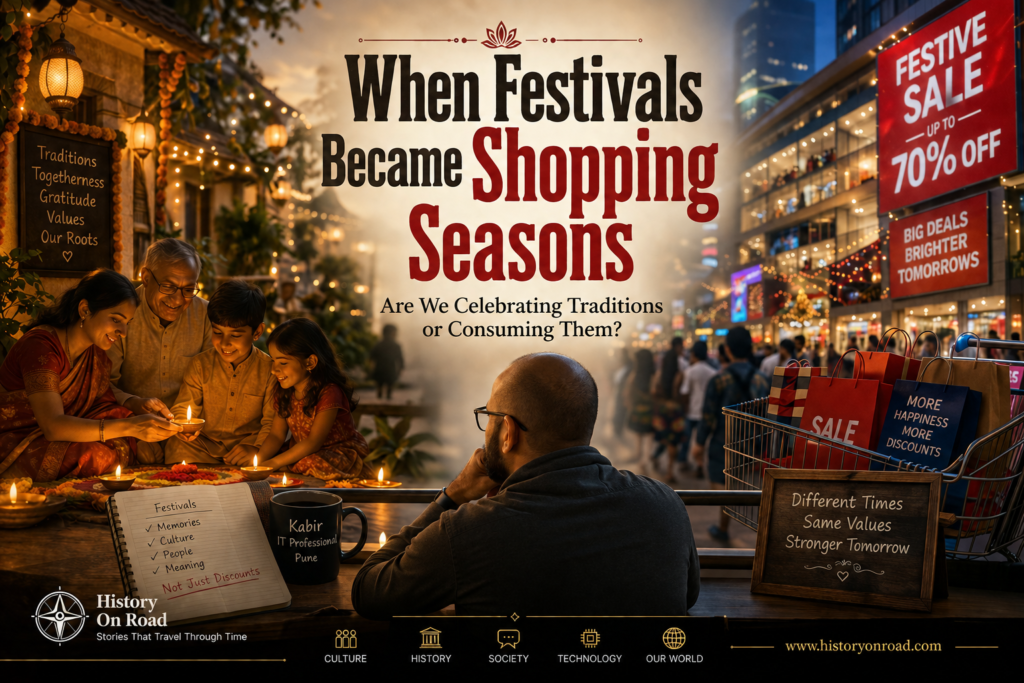
“One evening, while driving home through Pune’s endless traffic, I noticed something strange. The streets were glowing with festive lights, shopping malls were overflowing with people, online sales banners flashed on every billboard, and food delivery bikes rushed from one apartment to another. It looked like a festival… yet it didn’t feel like one.”
I am Kabir.
Like thousands of professionals, I work in the IT industry in Pune.
The city has given me opportunities, friendships, and dreams that once seemed distant. It has its positives—innovation, diversity, and endless possibilities. But somewhere between deadlines, traffic jams, crowded metros, and weekend exhaustion, I began asking myself a simple question.
Why do festivals feel different now?
Not because traditions have changed.
Because we have.
The Festival I Remember
As a child, festivals arrived long before the calendar said they would.
Homes echoed with laughter.
Grandparents narrated stories that explained why we celebrated.
Neighbors walked in without calling first.
Children played outside until late evening.
The aroma of homemade sweets drifted through every street.
Nobody cared about the most expensive decoration or the newest outfit.
The celebration itself was enough.
Today, many festivals begin with a notification.
“Mega Sale Starts Tonight.”
“Flat 70% Off.”
“Buy One, Get One Free.”
Sometimes, advertisements seem louder than the festival itself.
When Did Celebration Become Consumption?
Walk into any shopping mall before Diwali, Christmas, Eid, or New Year.
The decorations are breathtaking.
The discounts are irresistible.
The parking lots are overflowing.
None of this is wrong.
Businesses thrive during festive seasons.
Workers earn bonuses.
Small vendors and artisans often receive a much-needed boost.
The economy comes alive.
Yet somewhere along the way, festivals quietly became marketing campaigns.
Instead of asking,
“Who should I visit?”
many of us first ask,
“What’s on sale?”
Festivals Have Always Been More Than Holidays
History tells a different story.
Harvest festivals thanked nature for abundance.
Religious festivals strengthened faith and compassion.
Community celebrations brought together people across generations.
Whether it was Holi, Diwali, Eid, Christmas, Baisakhi, Pongal, Onam, or countless local traditions, festivals were designed to reconnect people—with family, community, nature, and gratitude.
They reminded societies that prosperity meant more than wealth.
It meant belonging.
The City Never Stops
Living in a fast-growing city changes the rhythm of celebration.
Office calendars rarely pause.
Project deadlines don’t disappear because tomorrow is a festival.
Many people celebrate through video calls because their families live hundreds of kilometers away.
Apartment doors often remain closed.
Neighbors may share walls for years without ever sharing a meal.
Ironically, cities bring millions of people together while making genuine human connections harder to find.
Perhaps that is why festivals sometimes feel shorter than the online sale promoting them.
The Social Cost We Rarely Notice
Commercialization itself is not the enemy.
The danger lies in forgetting why traditions existed.
When festivals become performances for social media,
comparison replaces gratitude.
When photographs become more important than conversations,
relationships become background decorations.
Children may remember expensive gifts but forget the stories behind the festival.
Communities become audiences rather than participants.
The celebration survives.
Its soul quietly fades.
An Economic Reality We Cannot Ignore
Festivals are also economic lifelines.
Small businesses wait all year for festive seasons.
Local artisans spend months creating handmade products.
Street vendors, sweet shops, flower sellers, textile workers, transport operators, and countless families depend on festive demand.
Commercial activity creates jobs and strengthens local economies.
This is not something to criticize.
The challenge is balance.
Supporting local artisans often preserves traditions more effectively than buying another mass-produced decoration online.
Every purchase tells a story about the kind of economy we choose to support.
Culture Cannot Be Manufactured
Culture grows slowly.
Advertising campaigns happen overnight.
Traditional recipes, folk music, regional crafts, community gatherings, and local rituals carry memories that no shopping mall can reproduce.
Once these traditions disappear, they cannot simply be relaunched next festive season.
They are inherited.
Or they are lost.
Festivals and the Environment
Modern celebrations have also transformed our relationship with nature.
Plastic decorations replace handmade ones.
Single-use products replace reusable traditions.
Food waste increases.
Packaging multiplies.
Air and noise pollution often overshadow the very values many festivals were created to celebrate.
Across the world, communities are now rediscovering eco-friendly celebrations—not because they are fashionable, but because sustainability was once part of tradition itself.
Perhaps the future of festivals lies in remembering the past.
Politics, Identity, and Public Spaces
Festivals have always reflected society.
They unite communities.
They also reveal divisions.
In many places, celebrations become opportunities for political messaging, public influence, or debates over identity.
Yet history reminds us that festivals have endured for centuries because they created spaces where communities gathered despite differences.
Protecting that shared spirit may be one of the greatest social responsibilities of our time.
So… Are Festivals Losing Their Meaning?
Maybe not.
Maybe the meaning hasn’t disappeared.
Maybe it has simply become harder to hear beneath the noise of advertisements, endless notifications, and hurried lifestyles.
The lamp still burns.
The prayer is still spoken.
The meal is still shared.
The music still plays.
The question is whether we are truly present when these moments unfold.
History On Road Perspective
History is rarely lost in a single day.
It fades quietly—through habits we stop practicing, stories we stop telling, neighborhoods we stop visiting, and traditions we begin treating as products instead of experiences.
Festivals have survived wars, empires, famines, migrations, and centuries of social change because they were never just events on a calendar. They were living expressions of gratitude, community, faith, culture, and hope.
At History On Road, we believe festivals should evolve with time, but they should never lose the values that gave them meaning. Buying gifts, supporting businesses, and embracing modern celebrations are all part of today’s world. Yet perhaps the greatest celebration is still the simplest one: sharing a meal, listening to an elder’s story, visiting someone you’ve been meaning to see, supporting a local artisan, or putting your phone away long enough to be fully present.
Because long after the discounts expire and the decorations come down, it is these moments—not the shopping bags—that become history.
And history has always remembered people more than purchases.