

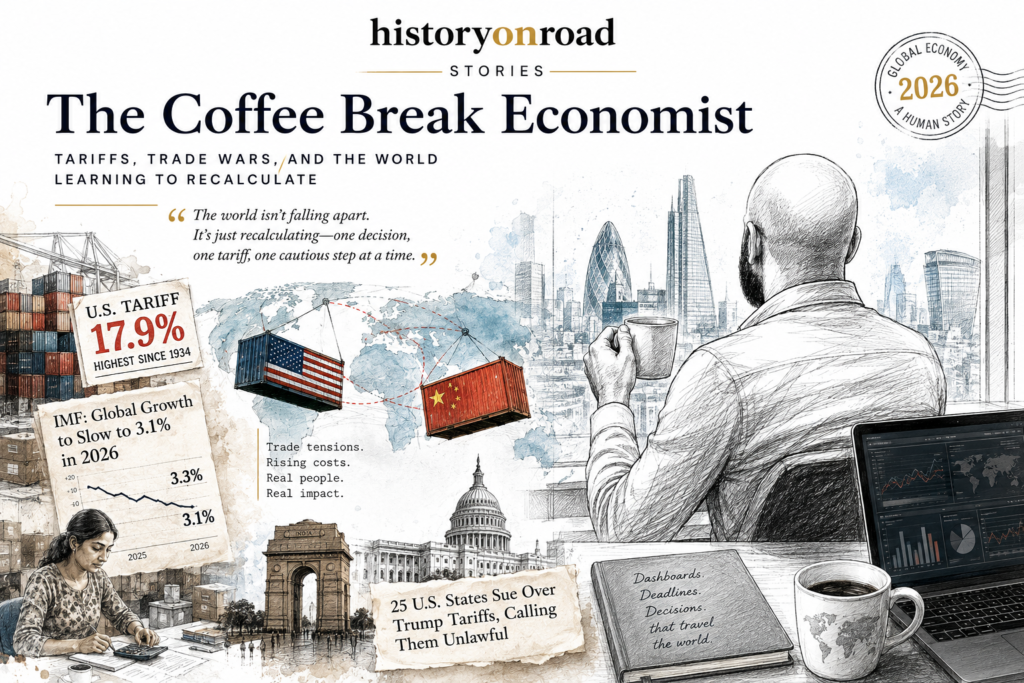
Karthik had a routine. Every morning at 8:45, before the London office filled up, he’d stand by the window with a cup of coffee and check the news on his phone. Ten minutes, no more. Then it was back to dashboards, client calls, and the never-ending Slack pings from his team back in Bangalore.
He’d moved to the UK four years ago, hired as an onsite analytics manager for a mid-size IT services firm. His job was simple to explain but hard to do: sit close to the client, understand what they actually needed, and make sure the delivery team back in India built the right thing. It worked well — until the world started feeling a little more expensive and a lot more unpredictable.
This particular morning, the headline that caught his eye was about the IMF. Global growth, they said, was expected to slow to 3.1% in 2026. Karthik read it twice. Not a crash, not a crisis — just… slower. A bit like a train that hasn’t stopped, but has clearly eased off the accelerator.
He knew why, too. Tariffs. He’d been hearing the word so often this year that it had started showing up in his dreams. The average US tariff had climbed from 2.5% to 17.9% — the highest it had been since 1934. Karthik wasn’t an economist, but even he understood what that meant in plain terms: American companies were paying more to bring in goods from abroad, and someone, somewhere, was footing that bill. Sometimes it was the company. Sometimes it quietly showed up in the price of a phone, a car part, or a bag of coffee at the corner shop.
He thought about Rucha, his cousin in Chennai, who ran a small export business selling handmade home décor to boutique stores in the US. Her margins had gotten thinner every quarter this year. “It’s not that people stopped buying,” she’d told him on a call last month, half-laughing, half-tired. “It’s that everything costs more to ship, and I can’t just pass all of it on to the buyer or they’ll walk away.”
Karthik’s own work sat closer to a different fault line — the one between the US and China over technology. It wasn’t about home décor or steel anymore. It was about who controlled the next generation of AI chips, quantum computing, and robotics. His clients — big UK banks and insurance firms — were rethinking where they hosted their AI models, which chipmakers they trusted for long-term contracts, and how exposed their supply chains were to a single country. In client meetings, “geopolitical risk” had become as normal a phrase as “data governance” used to be.
“We used to plan projects around budgets and timelines,” he told his manager, Sarah, over lunch one Tuesday. “Now every roadmap has a line item for ‘what if the chips get expensive’ or ‘what if this vendor gets sanctioned.’ It’s strange, planning technology decisions around politics.”
Sarah nodded. She’d been in the industry longer than him. “It’s not new, really. It’s just louder now.”
Back home in India, the tariff story had another layer. Karthik’s father, a retired bank manager, still read two newspapers a day, cover to cover. He’d called Karthik excitedly one weekend to talk about a story he’d read — twenty-five Democratic-led US states had filed a lawsuit against the Trump administration, arguing the tariffs had overstepped legal limits. “Even inside America, they’re fighting about this,” his father said. “Your uncle used to say trade wars have no winners, only slower losers. I think he was right.”
Karthik smiled at that. It sounded like something his uncle would say — a man who’d spent thirty years in the textile business and had opinions about tariffs the way other people had opinions about cricket.
What struck Karthik most, though, wasn’t the big numbers. It was how the tariff story kept showing up in small, human ways. A colleague on his team, currently working from Pune, mentioned that a US client had paused a “nice to have” analytics project — not cancelled, just paused, because their own costs had gone up and everyone was being careful. A friend in Seattle, who worked in semiconductors, said his company was now qualifying two backup suppliers for parts they used to source from just one country, “just in case.” None of this was catastrophe. It was caution. A whole world quietly hedging its bets.
That evening, walking back from the tube station in the light August rain, Karthik thought about something the IMF report had said — that the damage from the tariffs had been smaller than originally feared. Not painless. Not ignored. Just smaller than the worst-case story everyone had braced for.
He found that oddly comforting. Not because the problem wasn’t real — Rucha’s shrinking margins were real, the client hesitations were real, the lawsuits were real — but because it reminded him that economies, like people, tend to adjust. Slowly, awkwardly, with a lot of grumbling in between. Companies found new suppliers. Exporters found new markets. Governments argued it out in courtrooms instead of just accepting it.
Karthik didn’t know how 2026 would end. Nobody really did — not the IMF, not his clients, not his father with his two newspapers. But he’d learned something in his years moving between Bangalore and London, watching numbers turn into decisions and decisions turn into someone’s Tuesday getting a little harder or a little easier.
The world wasn’t falling apart. It was just recalculating — one tariff, one lawsuit, one cautious client meeting at a time.
He finished his coffee, put his phone away, and went back to his dashboards.
Historyonroad Opinion: The Bigger Picture
Karthik’s story is one small window into a much larger shift. Step back, and the 2026 tariff moment looks less like a single policy fight and more like a stress test for the whole idea of a connected world economy.
The Economic Angle On paper, a global growth slowdown from roughly 3.3% to 3.1% doesn’t sound dramatic. But growth forecasts are averages, and averages hide unevenness. Exporters like small manufacturers absorb thinner margins quietly, while large firms with more pricing power pass costs down the chain. The rise in the average US tariff to 17.9% — the highest since 1934 — is a reminder that trade policy, once a technical topic for economists, now moves markets, reshapes supply chains, and shows up directly in household budgets. Businesses aren’t waiting for certainty anymore; they’re building in redundancy — second suppliers, alternate markets, buffer costs — which is its own quiet tax on efficiency.
The Social Angle The human cost of tariffs rarely makes headlines the way stock indices do. It shows up instead in paused projects, delayed hiring, and small business owners recalculating their prices at the kitchen table. Communities tied to global trade — from Indian IT hubs to American manufacturing towns — are adjusting in real time, often without much say in the policies driving the change. There’s also a generational layer: younger professionals entering global industries are learning to treat geopolitical risk as a normal part of career planning, not an occasional disruption.
The Political Angle Perhaps the most telling detail in this story isn’t the tariff number itself, but the fact that twenty-five US states have taken their own federal government to court over it. That’s a sign of how contested this approach still is, even domestically. Meanwhile, the US-China friction over AI, quantum computing, and robotics suggests tariffs are no longer just about trade balances — they’re a proxy for a longer contest over technological leadership. Other countries are watching closely, some hedging their alliances, others quietly benefiting as trade routes and investment shift around the two giants.
The Global Takeaway No single country controls this story anymore. Tariffs imposed in Washington ripple into factories in Vietnam, boardrooms in London, and living rooms in Bangalore. The IMF’s own assessment — that the damage has been smaller than feared — isn’t a verdict that everything is fine. It’s a reminder that global economies are resilient, but resilience isn’t the same as painless. The real story of 2026 may not be the tariffs themselves, but how much of the world has learned, once again, to adapt around them.
— for historyonroad