
A HistoryOnRoad Story
The tea stall near the old banyan tree had been Sameer and Shambhu’s Sunday ritual for almost twenty years now. Same two plastic chairs, same chipped glasses of overboiled chai, same argument about whether Sameer’s team would ever win a match this season. But this Sunday, the newspaper folded on the table between them carried a headline that pulled both men away from cricket entirely.
“Ninety-four thousand,” Shambhu said, tapping the page with a finger stained faintly from turmeric. “That’s how many government schools have shut in this country in ten years. Ninety-four thousand, Sameer. Do you understand what that number means?”
Sameer picked up the paper and read it properly this time. “Twenty-five schools a day,” he murmured. “Every single day, for ten years.”
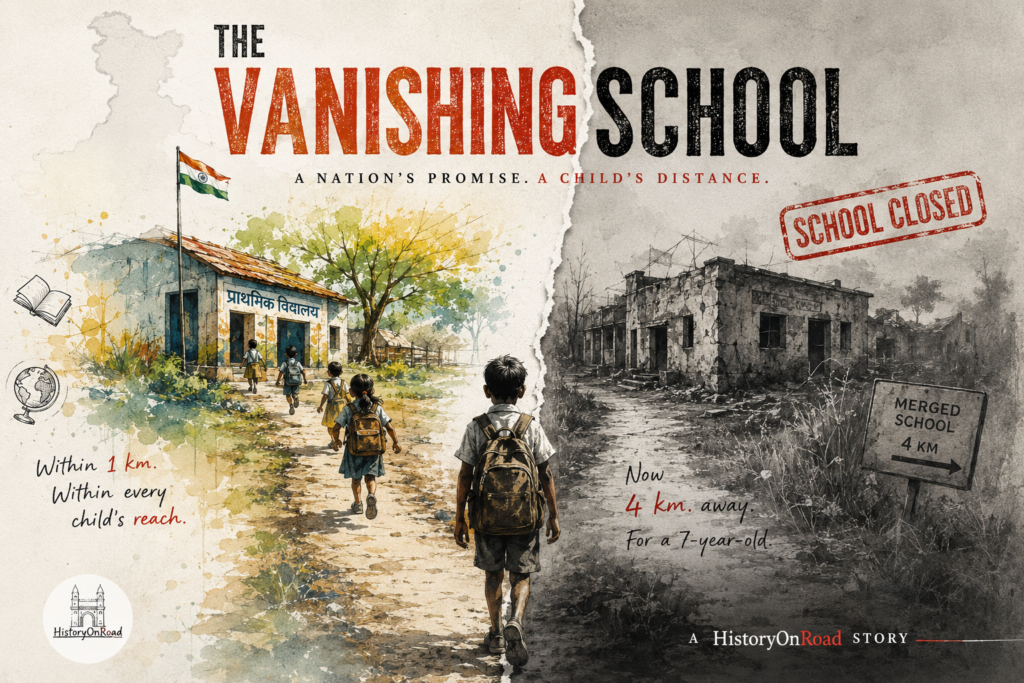
“My nephew’s school in the village — gone. Merged with one four kilometres away, they said. Four kilometres, for a seven-year-old, walking in the rain.” Shambhu shook his head. “You remember our school? Government Primary, no fancy building, leaking roof half the year. But it was there. Fifty steps from my house.”
“I remember,” Sameer said. “And I remember something else, Shambhu — I remember why it was there. That wasn’t an accident either.”
Shambhu raised an eyebrow. “What do you mean?”
“Think back. When we were boys, half the villages around here had no school within walking distance at all. It was the eighties, nineties — children just didn’t go, especially girls, because the nearest school was an hour’s walk and no parent was sending a seven-year-old daughter alone down that road. Then came Sarva Shiksha Abhiyan, in 2001. The whole mission was to put a primary school within a kilometre of every child in this country. Lakhs of new schools were opened in that decade — ours was one of them. And then in 2009, the Right to Education Act made it law: a primary school within a kilometre, an upper primary within three. It wasn’t charity. It was a deliberate, twenty-year national project to put a school within walking reach of every last child.”
Shambhu sat back. “So what we’re watching now is that project — undone.”
“That’s exactly the story behind the story,” Sameer said. “It’s not just ‘schools are closing.’ It’s that the country spent two decades building outward, school by school, village by village, on the principle that distance was the enemy of education. And now the principle itself has quietly flipped. The new doctrine is called ‘rationalisation’ — consolidate the small ones, merge them into fewer, bigger schools. Same government, opposite instinct, one generation apart.”
“But why the flip?” Shambhu asked. “Nobody reverses a twenty-year policy for no reason.”
“A few reasons are tangled together, and that’s the part the headline never explains,” Sameer said. “One — fewer children are being born. Our mothers had four or five children each. My daughter wants one, maybe two. The country’s fertility rate has dropped below replacement level. So some of these schools that took ten students where there used to be eighty aren’t victims of policy at all — the children they were built for simply don’t exist anymore in those numbers.”
“That much I’ll accept.”
“But two — and this is the part politicians don’t say out loud — teacher salaries are one of the largest single expenses in every state’s budget. A school with fifteen students still needs a headmaster, still needs two or three teachers, still needs a building maintained. States under fiscal pressure look at a map full of half-empty, expensive-to-run schools and see an easy place to cut. ‘Rationalisation’ is partly a genuine response to emptying villages, and partly a state finance decision wearing the more respectable name.”
Shambhu frowned. “And which one is my nephew’s school?”
“Officially, the first. In practice, probably a bit of both — except in his case, the promised second half never arrived. Thirteen thousand teacher posts are lying vacant in that state alone. So the theory says: three weak schools become one strong one, properly staffed, with real teachers for every subject, a functioning library, maybe even a lab. What your nephew actually got was one weaker school, further away, still short-staffed. The building closed. The investment that was supposed to replace it didn’t turn up.”
“That’s the whole trick, isn’t it,” Shambhu said slowly. “The word ‘rationalisation’ sounds like arithmetic — you close three, you open one better one, and the sum comes out even, or ahead. But arithmetic on paper isn’t arithmetic in a seven-year-old’s legs.”
“And it isn’t evenly spread, either,” Sameer added. “Uttar Pradesh alone lost close to twenty-five thousand schools this decade. Madhya Pradesh, more than twenty-two thousand. Those two states account for a huge share of the national number. This isn’t one uniform national story — it’s a handful of states closing schools hard and fast, and the reasons in each state’s assembly are its own, because education sits on the Concurrent List. Delhi can write the policy; the states decide how to actually swing the axe.”
Shambhu stirred his tea though it needed no stirring. “And where do the children go, when the axe swings and the promised better school doesn’t arrive?”
“That’s the real fear,” Sameer said. “Total government-school enrolment has dropped by over two crore students in ten years. Some of that is fewer births. But some of it is children quietly disappearing off the rolls — girls first, usually, the moment the school stops being around the corner, exactly the pattern the Right to Education Act was written to prevent in the first place. Private schools are expanding into the same years, the same districts, but only for the families who can afford fees, uniforms, the van outside.”
“So the poor man’s school closes, and the rich man’s school multiplies down the road,” Shambhu said. “We’re not just watching schools disappear, Sameer. We’re watching the country quietly retire the very idea it spent twenty years building — that every child, however far from the city, deserves a school within reach.”
A group of schoolchildren walked past the stall — private-school uniforms, a van idling nearby to collect them. Both men watched them go.
“You said there’s one scenario where this could actually be good,” Sameer said after a while. “I want to hear that part, because right now all I feel is worried.”
Shambhu managed a small, tired smile. “If — and it’s a big if — every closure genuinely became what Sarva Shiksha Abhiyan and the RTE Act once promised in reverse: not more schools, but better ones. If that fifty-step school became a five-minute walk to a school with real teachers in every subject, a functioning library, equipment that actually sits in the lab instead of just being budgeted for. If the vacant posts got filled instead of piling up. If ‘rationalisation’ meant investment following the child, not disappearing with the building. Then maybe, just maybe, fewer schools with more inside them could serve our children better than a scattering of half-staffed ones we once fought so hard to build.”
“That’s a lot of ifs.”
“It is,” Shambhu admitted. “And the numbers, so far, suggest we’re getting the closures without the promise — empty buildings, longer walks, vacant teacher posts, and a report from the government’s own policy body quietly confirming what people in the villages have been saying for years. The story isn’t that a policy changed. It’s that nobody told the seven-year-olds walking the extra four kilometres why.”
Sameer looked at the folded newspaper again, then out at the road where the school van had already disappeared around the corner.
“Masterji always said a nation’s roads tell you where it’s going,” he said quietly, “but its schools tell you who it’s leaving behind — and whether anyone even noticed the leaving.”
Shambhu raised his half-empty glass, as if in a toast to nothing worth celebrating. “Then let’s hope somebody up there starts reading the second half of the report, and not just the number in the headline — and remembers why we built those fifty-step schools in the first place.”
They sat a while longer, two middle-aged men on plastic chairs, watching the road empty out — worried, the way only people who once walked fifty steps to school can be worried, about children now walking four kilometres to reach one, wondering not just what had changed, but why the country had quietly decided to change its mind.
Notes: The Story Behind the Story
- The reversal in context: From 2001 (Sarva Shiksha Abhiyan) through the 2009 Right to Education Act, national policy explicitly mandated schools within 1–3 km of every child. The current wave of “rationalisation” — closing or merging low-enrolment schools — is a departure from that two-decade doctrine, not a continuation of it.
- The headline number: 94,000+ government schools closed between 2014–15 and 2024–25 (NITI Aayog), or 93,000+ per the Ministry of Education’s February 2026 Lok Sabha response — roughly 25 closures a day, with over 70,000 concentrated in the first half of the decade.
- Where it’s concentrated: Uttar Pradesh (24,590+) and Madhya Pradesh (22,438) account for a disproportionate share of closures — this is not a uniform national trend but a handful of states acting under the Concurrent List’s flexibility.
- The demographic driver: India’s total fertility rate has fallen from over 3 in the early 1990s to around 2.0 today, below replacement level — genuinely shrinking the pool of school-age children in many areas.
- The fiscal driver (less discussed): Teacher salaries are a major line item in state education budgets; consolidating low-enrolment schools is also a cost-saving lever, independent of whether promised quality improvements materialise.
- The gap between theory and practice: Thousands of teacher posts remain vacant even after consolidation in the worst-affected states, suggesting the “better-resourced school” promise behind rationalisation isn’t consistently being kept.
- The consequence: Government-school enrolment fell by roughly 2.26 crore over the decade — partly demographic, but also reflecting dropout risk (particularly for girls) as distance to school increases, even as private-school enrolment grows in the same years.
Sources: NITI Aayog (2024–25 school education data); Ministry of Education response in the Lok Sabha, February 2026; Sarva Shiksha Abhiyan (2001) and Right to Education Act (2009) provisions.