

A Tale of Gunya and Jivali from the Satpuda Hills
They say that long ago, when the monsoon clouds still remembered how to gather thick and low over the Satpuda ranges, Ganpati Bappa himself once wandered these hills — not on his mouse, not in his grand elephant-headed form that fills the cities during Chaturthi, but as a humble traveller with dust on his feet and a bundle on his shoulder. He liked to walk among the people who lived close to the soil, the ones who greeted every sunrise with a folk song and every stranger with an open door. This is the story of one such night, spent in a small hamlet called Gastamba Dongar, tucked into the folds of the hills near Makrani village in Nandurbar district, and of the couple who lived there — Gunya and his wife Jivali.
I. The Village on the Hill
Gastamba Dongar was not a village you found on a map easily. To reach it, one had to leave the last bus stop at Makrani, cross a stream that ran clear and cold even in summer, and climb a footpath worn smooth by generations of bare feet. The huts stood in a loose cluster on the hillside, their walls made of mud and bamboo, their roofs thatched with teak leaves gathered from the forest. Smoke rose gently from cooking fires each evening, curling up to meet the mist that rolled down from the peaks.
The people here were farmers of the hill slopes — growing nagli, kodra, and maize on terraced fields — and keepers of small herds of goats. They knew the forest the way a person knows their own home: which roots could heal a fever, which berries were sweet and which were poison, which trees gave the best wood for a plough, and which paths the leopard preferred to walk at dusk. Life was hard here, shaped by the rhythm of rain and harvest, but it was also rich — rich in song, in festival, in the closeness of people who depended on one another.
Among them lived Gunya, a young man known through the hills for two things: the strength in his arms when the fields needed ploughing, and the steadiness of his word when a promise had been made.
II. Gunya and Jivali
Gunya had married Jivali three monsoons ago, after the traditional matchmaking of their community, where elders from both families sat together under a mahua tree and blessed the union with rice and turmeric. Jivali came from a family in a neighbouring hamlet, known for the fine bamboo baskets her mother wove. She brought that same skill with her — hands that could turn stripped bamboo into baskets, mats, and winnowing fans so well-made that women from villages two hills away would send word asking for one.
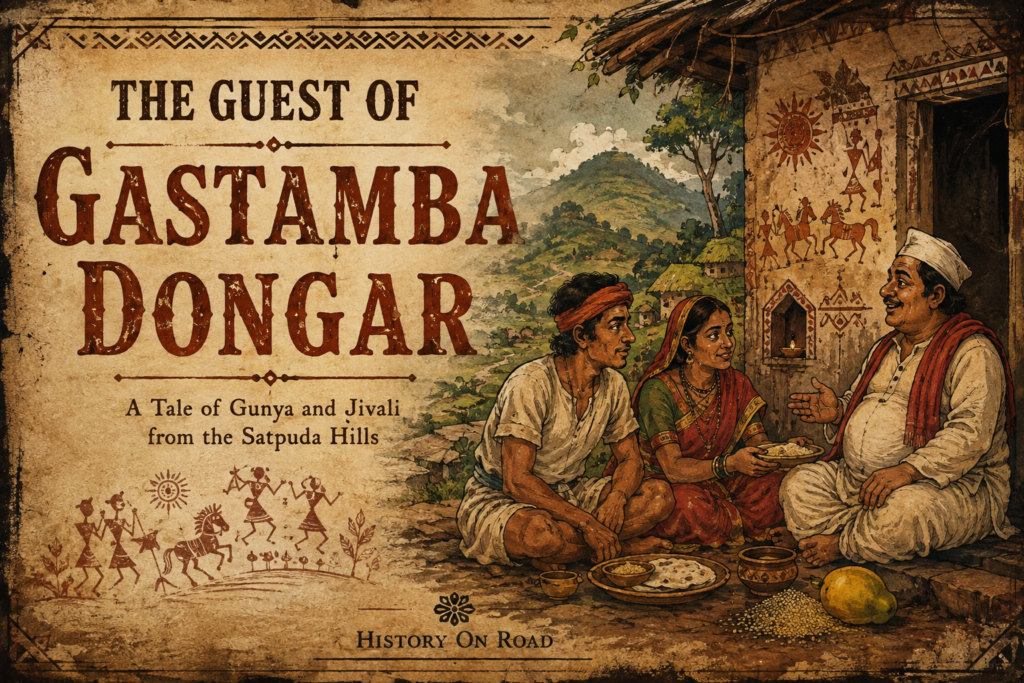
Their home was small — two rooms, a courtyard swept clean every morning, and a tulsi plant that Jivali tended with the same devotion her grandmother had taught her. On the mud wall near the door, painted in white rice-paste, was a Pithora-style design — horses, the sun, and figures of the gods their community honoured, renewed every year during the harvest festival.
Gunya rose before the sun each day. He would first bow toward the eastern sky, then toward the hill itself — for in his belief, and the belief of his people, the hill was not merely land but a living presence, a guardian spirit they called Dongar Dev, who watched over the crops, the water, and the safety of the village. Only after this quiet greeting would he pick up his plough and walk to the fields.
Jivali, meanwhile, would light the first fire of the day, and before she cooked a single grain for her own family, she would set aside a small portion — a pinch of grain, a drop of oil — as an offering left at the base of the old banyan tree at the village edge, a custom passed to her by her mother, meant to thank the earth before taking from it.
III. The Value of a Given Word
In Gastamba Dongar, there were no locks on the doors, and no need for them. A person’s word was considered stronger than any wooden bolt. It was said in the village that if Gunya told you the rains would come by the fifth day of the month, you could plan your sowing by it — not because he could read the sky better than anyone else, but because he never spoke a promise he was not certain he could keep.
One incident was often retold by the elders around the evening fires. A trader from the plains had once come up the hill path to buy forest honey and tamarind from the villagers, offering a fair price and promising to return within a fortnight with cloth and salt in exchange, as was the custom of barter in those days. The other villagers, wary of traders who did not return, refused to hand over their goods without payment first. But Gunya, who had spoken with the trader and looked him in the eye, vouched for him and gave him a full basket of honeycomb on trust alone.
Fifteen days passed. Then twenty. The villagers began to murmur that Gunya had been foolish, that the trader had cheated him as traders from the plains sometimes did. Jivali herself grew anxious, though she said nothing to shame her husband, only sat beside him in the evenings as he waited by the courtyard gate. On the twenty-third day, thin and limping from a fever that had delayed him in a village near the river, the trader climbed the hill path with a bundle of cloth, a sack of salt, and profuse apologies for the delay.
Gunya took only what had been agreed — no more, refusing the extra length of cloth the grateful trader tried to press on him for his patience. “A promise has a measure,” he told the trader. “I will not take more than what was owed, even if you offer it with a full heart.” This story spread through the hills long after, not because it was extraordinary, but because it captured something the people of Gastamba Dongar held as an ordinary truth: that honesty was not a virtue to be performed, but a debt owed quietly, to oneself as much as to others.
IV. The Stranger at the Door
It was on an evening thick with the smell of wet earth, just after the first rains of the season, that the traveller came to Gastamba Dongar. He was short and round-bellied, dressed in simple traveller’s clothes, carrying nothing but a walking stick and a small cloth bundle. He said his name was Gajanan, and that he had lost his way descending from the ridge above, and asked only for a place to rest and perhaps a little food, for he had eaten nothing since morning.
Many of the villagers had already latched their doors against the evening chill by the time he reached the hamlet, and dusk was turning quickly to dark — a time when few strangers were welcomed in, not from unkindness, but from the caution the forest itself demanded. But Gunya, returning from the fields with Jivali, saw the stranger sitting wearily on a stone near the village well and did not hesitate.
“Our roof is small,” Gunya said, “but there is always room for one more at the fire.”
Jivali, without being asked, went in and set a fresh portion of nagli bhakri and a bowl of wild vegetable curry before the guest, along with a cup of warm buttermilk, the same meal the family would eat that night — nothing more, nothing less, for that was all they had, and hospitality in their home meant sharing what was theirs, not performing a feast they could not afford.
As they ate together by the fire, the traveller asked Gunya many questions — about the harvest, about the forest, about the customs of the hill. Gunya answered plainly, without exaggeration, and when asked if life was difficult, he said, “It is what it is. The hill gives what it gives, and we are grateful for it. What more should a person ask of the earth than enough?”
The traveller asked, too, about the small clay lamp Jivali lit each evening at the base of the tulsi plant, and she explained it was to welcome any wandering soul, human or divine, who might pass by hungry or cold — for her grandmother had taught her that no guest should ever be turned away from a door, whoever they might be.
The stranger smiled at this, ate his simple meal with evident contentment, and slept that night on a mat near the fire. Before dawn, when Jivali rose to light the first flame of the morning, she found the mat folded neatly and the guest already gone — but resting where he had slept was a single ripe mango, out of season, its skin glowing faintly gold in the early light, and beside it, a small heap of grain that had not been there the evening before, enough to see the family comfortably through to the next harvest.
Gunya and Jivali never spoke loudly of what they suspected that morning. They simply looked at each other, then toward the hill, and bowed their heads in quiet thanks, choosing to keep the moment as their own rather than turn it into a tale for boasting. Only years later, when their children were grown, did Jivali tell her grandchildren, by the fire, of the round-bellied traveller who had once shared their meal — and let them wonder for themselves who he might have been.
V. What Remained
The rains came generously that year, and the nagli grew tall on the terraces. Life in Gastamba Dongar continued much as it always had — the early bows to the sun and the hill, the small offerings left at the banyan tree, the bamboo baskets carried to distant markets, the doors that never needed locks.
What people remembered, when they told this story afterward, was not a miracle of gold or fortune, but something smaller and steadier: that a couple who had little had still given freely; that a man who dealt honestly with a stranger had been treated honestly in return by fortune itself; and that in the quiet hills of the Satpuda range, the oldest wealth a person could hold was not in the granary, but in a word kept and a door left open.
In the villages around Nandurbar, elders still say that Dongar Dev walks the hill paths sometimes, in the shape of an ordinary traveller, to see how the hearts of the people fare — and that the hills remember every kindness shown to a stranger at nightfall.
This is a work of fiction, written in the spirit of the region’s rich oral storytelling tradition, and does not claim to depict any specific real family or event.