

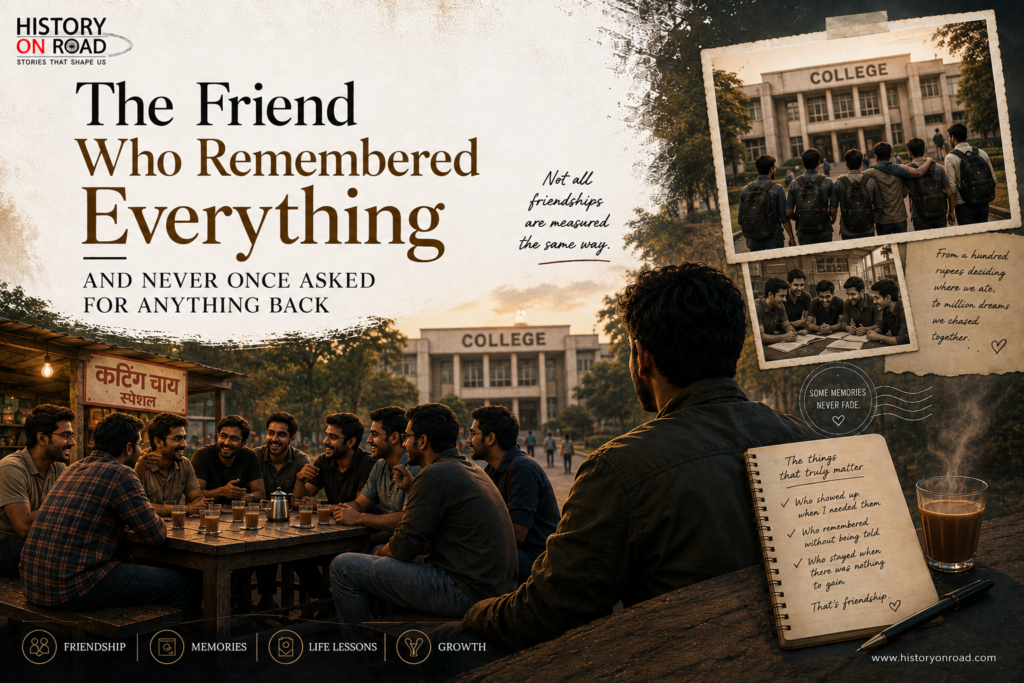
What do you do when you discover that an old friend loves you differently than you love him — and that the difference has been there, quietly, all along?
There were nine of them.
Nobody remembers exactly when the friendship started. There was no single day marking the beginning. It grew the ordinary way — through a shared hostel room, roadside tea, borrowed motorcycles, terrible jokes, and evenings when nobody particularly wanted to go home.
Back then, a hundred rupees decided where they ate. A power cut turned into a two-hour rooftop conversation because there was nothing else to do and no reason to stop talking. They had big plans and almost no money, and somehow that never seemed to matter.
Years later, eight of them worked in tech.
Karan was a cloud engineer — quiet, dependable, the one people called when something actually needed fixing. Manish, a product manager, was the one who organized the gatherings and sent the reminder texts nobody else bothered to send. Rakesh worked in cybersecurity and had a habit of noticing what people tried to hide. Sanjay, a data analyst, was the quietest of them all — and perhaps the one who remembered the most.
Rohan was the group’s built-in comedian, able to lighten even the most uncomfortable silences. Devraj, who worked in HR, had a natural instinct for reading people. Kunal was always plotting the next road trip before the last one had even ended. Ashwin, a business analyst, was the steady one — the one who usually kept the group from drifting apart.
And then there was Aditya.
Aditya was different.
He didn’t work in tech. He ran a transport business he’d built up, over years of long hours, from a single rented truck into something genuinely successful. His days were full of drivers, fuel costs, broken-down vehicles, difficult clients, and the constant, grinding unpredictability of running something on your own.
The others respected what he’d built. Nobody doubted that.
But over the years, they noticed something about him — quietly, not all at once.
Aditya seemed to measure people differently.
Not cruelly. Not even consciously, most of the time. Just quietly.
He grew closest to the friends who were doing well — the ones with useful contacts, growing salaries, or connections that might, someday, be worth something. He had other friends outside the group too, and strangely, most of those friendships seemed to orbit around money or opportunity.
There was nothing wrong with knowing successful people. Nobody thought that.
The problem, if there was one, was that Aditya sometimes seemed interested in a person because of what came attached to him.
If Karan got a raise, Aditya wanted the number.
If Kunal bought a new bike, Aditya wanted to know the price, the loan, the dealership.
If Ashwin mentioned a useful business contact, Aditya suddenly wanted an introduction.
But when someone was struggling, his interest quietly thinned.
Sanjay noticed. He always noticed.
He remembered birthdays without being reminded. He called when someone was unwell. He remembered whose father was going through a hard time, whose exam was coming up, who had been silently low for weeks without saying so.
He never thought of this as anything remarkable. To him, it was simply what friendship meant.
He never kept a ledger.
If he covered a bill, he forgot it by dessert. If he drove two hours to help someone move, he never brought it up again. If a friend forgot his birthday, he let it go without a second thought. If someone earned more than him, it never once occurred to him to feel smaller for it.
He believed friendship was one of the only relationships in life that shouldn’t require keeping score.
That was probably why Aditya’s habits troubled him more than they troubled the others.
Not because he disliked Aditya. He didn’t. He’d loved him as a friend for close to twenty years.
That was exactly the problem.
There were small moments, easy to miss individually.
One evening, Karan mentioned a big promotion. Everyone congratulated him. Aditya smiled and asked, “What’s the package now?”
Karan laughed it off. “You never change.”
“Just curious,” Aditya said.
Later, when Kunal mentioned he was finally buying a car, Aditya asked about the model, the price, the EMI. But when Sanjay mentioned, almost in passing, that work had been difficult lately, Aditya barely asked a follow-up question.
Sanjay noticed. He said nothing.
Another time, Ashwin mentioned a new business contact he’d made. Aditya leaned in immediately. “Who is he? What does he do? Can you introduce me?”
Sanjay watched the exchange quietly, wondering why some friends’ struggles left Aditya distant while their opportunities made him suddenly, fully present.
There were comparisons too. “You should switch companies,” Aditya would tell Rohan, half-joking. “You’re still earning that much?” Everyone would laugh. The laughter, sometimes, felt just slightly forced.
And there was the habit of carrying stories from one friend to another — “Don’t take it seriously, I’m only telling you because you’re close to me” — some of it harmless, some of it not. When it turned out later that something had been exaggerated, Aditya would simply shrug. “Maybe I misunderstood.”
None of it was ever big enough to break the group. That was exactly why it survived — a little envy here, a little comparison there, nothing anyone could hold up as proof of anything.
The others understood it. They simply never let him see that they did.
Maybe that was because they also remembered the other side of Aditya. He’d sat outside the ICU all night when Rakesh’s father had emergency surgery. He’d helped Devraj move flats on a weekend he could have easily skipped. He’d driven six hours through the night to make it to Manish’s wedding. People were complicated. A person could be generous in one moment and calculating in the next, and the group understood that as well as anyone.
Understanding someone, though, doesn’t mean their behavior stops costing you something.
Years passed. Careers grew demanding. Families expanded. The Sunday afternoons that used to happen every week became rare enough to plan weeks in advance.
So when Manish finally managed to get seven of them together on a Sunday — Devraj was traveling for work and couldn’t make it — everyone showed up more eager than they expected to be.
For a few hours, they were twenty again.
Rohan told the same three jokes he’d been telling for a decade. Kunal pulled out old photographs. Rakesh quietly answered work messages between conversations. Ashwin tried, and failed, to control the music. Karan sat mostly quiet, smiling.
Sanjay watched all of it and felt something settle warmly in his chest. These were his people. He had spent years collecting small memories of them without ever meaning to.
There was a photo of all nine crammed onto two motorcycles. Another from a roadside dhaba where they’d pooled every rupee between them to cover the bill. Sanjay remembered that night specifically — nobody had had enough cash, and Aditya had quietly made up the difference without saying a word. Nobody had thanked him properly. Sanjay still remembered it, all these years later. Not because he tracked it. Because that was simply how he remembered friendship — not in transactions, but in moments.
Then Rohan brought up one of Aditya’s early, disastrous business ideas — something involving importing decorative lamps — and everyone laughed. Aditya smiled, but it didn’t quite reach his eyes.
“We should let all that go,” he said. “We’re not kids anymore. What’s the point of dragging up old stories?”
The room quieted slightly. Nobody argued — the words sounded reasonable enough on the surface.
“We should look forward, not back,” Aditya continued. “People change. Priorities change.”
Ashwin nodded. “Fair enough.”
The conversation moved on. But Sanjay felt something he couldn’t quite name. Not anger — something closer to grief.
Because those old stories weren’t gossip to him. They were evidence — that they’d once been young together, broke together, laughing together long before salaries and job titles had learned to sit at the table with them.
Aditya wanted to leave the past behind. Sanjay wanted to keep it. Not to live inside it, but because he believed it was the very reason any of them had become friends in the first place.
Later, on the balcony, it was just the eight of them — minus Aditya, who had stepped away to take a call.
“Does anyone else feel like we don’t all mean the same thing when we say friendship?” Sanjay finally asked.
Rakesh looked over. “We’ve all noticed. Nobody wants to be the one to say it.”
“Why not?” Sanjay asked.
Ashwin answered quietly. “Because what would we even say? It sounds like an accusation the second you put it into words.”
Sanjay looked through the glass door at Aditya, still on his call, laughing at something. He didn’t have an answer either.
That was the hardest part — how do you tell a friend, I think you value me differently depending on what I can offer you, without it sounding like a verdict? How do you explain that you’re not hurt by one incident, but by a hundred small ones that mean almost nothing individually?
Sanjay decided not to say anything that day.
A few weeks later, the group met at their old tea stall. The road outside had changed. The shops had changed. The wooden bench they used to fight over was gone. The tea, somehow, still tasted the same.
Kunal looked around. “We used to come here because none of us had a rupee to spare.”
Rohan grinned. “Speak for yourself. I still come here for the financial discipline.”
Everyone laughed. For a moment, they had no job titles, no salaries, no comparisons — just nine friends, minus Devraj, who called in halfway through and got put on speaker.
Then Aditya said, almost gently, “We really should stop bringing up the past.”
This time, Sanjay didn’t laugh along.
“Why?” he asked.
Aditya shrugged. “We’re older now.”
Sanjay held his glass of tea for a moment. “I don’t think the past is the problem. I think it’s that we don’t all remember it the same way.”
Nobody spoke.
“I don’t remember who paid for what,” Sanjay said. “I remember who showed up. I don’t remember whose salary was higher. I remember who stayed when someone had nothing. I don’t remember whose bike was better. I remember who gave someone a lift home at midnight because there was nowhere else to go.”
He paused. “Maybe that’s why it’s hard for me when friendship starts to sound like something that has to be useful to be worth keeping.”
Aditya looked away, then back at him. “You think I don’t care about you?”
Sanjay shook his head. “I think you care. I just think we care in different currencies. I spent a long time assuming everyone was spending the same one.”
Nobody moved. It wasn’t said in anger, which somehow made it land harder.
Then Sanjay looked around at the others. “And that’s okay.”
He wasn’t asking Aditya to become someone else. He wasn’t demanding an apology. He had simply stopped pretending not to notice.
Rohan, sensing the weight in the silence, broke it the only way he knew how. “Can we at least agree Aditya had a full head of hair in that motorcycle photo?”
Even Aditya laughed. The tension eased. But something had been said that couldn’t be un-said.
Nothing changed dramatically after that afternoon. Aditya didn’t transform into someone else. The small comparisons still surfaced occasionally. The selective attention still showed up here and there. The ambition never left him — it was, after all, part of what had built his business from nothing.
But the others stopped expecting him to hold friendship the way Sanjay did. And strangely, that made things lighter rather than heavier.
Sanjay still answered Aditya’s calls. Still went to his son’s birthday party. Still wished him well, honestly and without resentment.
He simply stopped handing over his whole heart with the quiet expectation that it would come back to him shaped exactly the same way.
That, he decided, was the real lesson. Giving everything in a friendship was never something to regret. Expecting everyone to give it back in identical form — that was the mistake.
Some people measure friendship in time. Some in loyalty. Some in memory. Some, understandably, in what a relationship might offer them in a world that doesn’t make anything easy. None of these are necessarily wrong ways to love someone. They’re just different currencies.
The real skill, Sanjay thought, is knowing which currency you’re being paid in — so you’re not disappointed expecting one and receiving another.
The group chat still survives, against the usual odds. Every few months, someone — usually Kunal — sends an old photograph with a ridiculous caption, and everyone piles on, Aditya included.
Sanjay always looks a little longer than the rest.
Nine young faces with no money, no titles, and no idea what the years would eventually do to them. They had been happy anyway. Maybe that’s why the photographs still matter to him — they’re from a time before anyone had learned to compare, before some friendships quietly started turning into something closer to networks, without anyone quite deciding that should happen.
He knows he can’t go back. Nobody can. He’s stopped wanting to. The past isn’t a place to live in — it’s simply worth remembering, because it shows you exactly who stayed when there was nothing to be gained by staying.
And maybe that’s the one thing Aditya never fully learned: that letting go of the past isn’t the same thing as maturity. Sometimes, holding onto it is.
If the nine of them ever sit around that same tea stall decades from now — complaining about their backs, showing photos of their grandchildren, still arguing over who owes whom for a cup of tea from two decades ago — there will likely still be a small, quiet gap where the different ways of loving someone never quite lined up.
That’s fine. Friendship was never going to require everyone to feel it the same way.
It only ever required honesty — and, eventually, the willingness to say the quiet thing out loud.



Borrowed Glory in Kalikapur: The Story of a Village Election