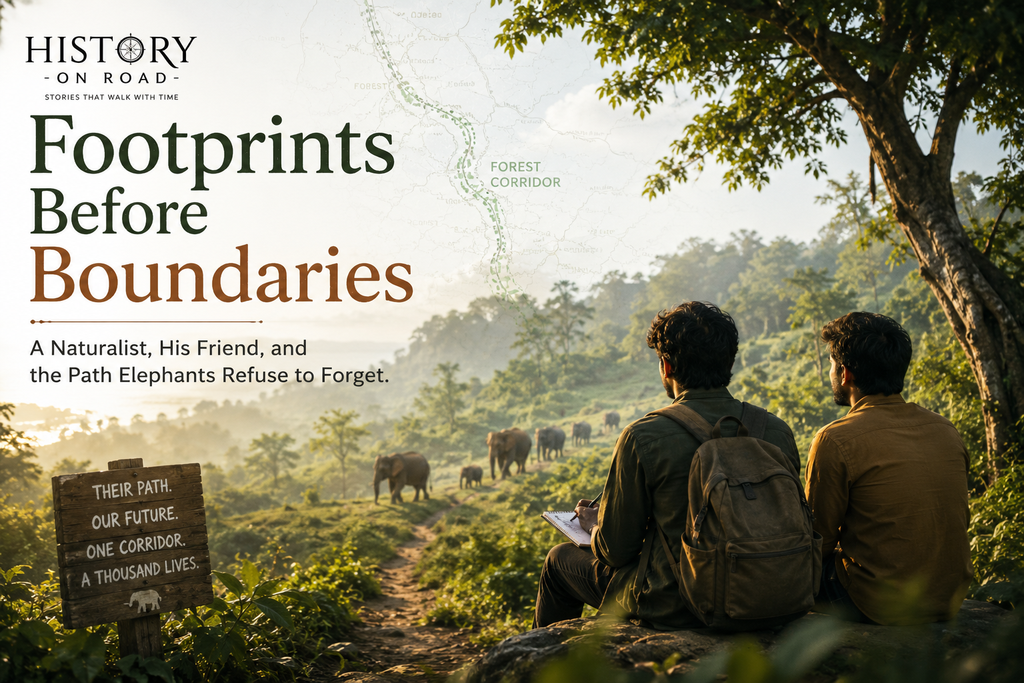

Footprints Before Boundaries: A Naturalist, His Friend, and the Path Elephants Refuse to Forget
A historyonroad original

Ganesh had a habit of stopping mid-sentence whenever he heard something move in the undergrowth. It used to annoy people. It annoyed his UPSC coaching classmates in Thiruvananthapuram, who thought a boy preparing for the civil services exam should have his ears trained on current affairs debates, not on the rustle of leaves. It annoyed his mother, who worried that a son obsessed with elephants and blogging about forests would never crack an exam that rewarded punctuality of thought over wonder. But it never annoyed Sundar.
Sundar had known Ganesh since their school days at a government school near Peroorkada, back when the two of them shared a single cricket bat between four boys and neither owned a bicycle. They had grown up along different tracks since then — Sundar into the noisy, handshake-heavy world of local politics, following in the footsteps of his father, a two-term corporator known across the ward for solving water disputes with tea and patience; and Ganesh into a quieter, more solitary world of binoculars, field notebooks, and a blog nobody outside his small circle read, called Ganesh Walks.
It was Sundar who called that Friday evening.
“There’s a programme this weekend,” he said. “Forest department, some NGO people, a few local corporators including my father. They’re doing an awareness walk near the Ghats — something about elephant corridors. My father wants me to attend, represent the family, shake hands, you know the drill. Come with me. You’ll actually understand what they’re talking about. I’ll just be nodding.”
Ganesh laughed. “You make it sound like I’m your translator.”
“You are,” Sundar said. “You’re the only person I know who gets genuinely excited about animal movement patterns.”
They left before dawn on Saturday, taking the ghat road that wound up past tea estates and small settlements where mist still clung to the tin roofs. Ganesh had brought his old canvas bag, heavier than usual, stuffed with a camera, a notebook already half full of sketches, and a battered field guide to Western Ghats mammals that had survived three monsoons and one accidental dip in a stream.
“You know,” Ganesh said, watching the estates blur past the window, “elephants in this landscape have been walking the same seasonal routes for centuries. Long before there were roads or plantations or district boundaries. They move between forest patches looking for water, for particular fruiting trees, for salt licks. It’s not wandering. It’s memory. Herds pass down these routes from grandmother to mother to calf.”
Sundar, half paying attention while scrolling through messages from his father’s office, said, “So when people say elephants are ‘straying’ into villages—”
“That word bothers me,” Ganesh said. “They’re not straying anywhere. We built villages and plantations across paths that were theirs first. The elephant isn’t lost. We are, in some sense — we forgot whose ground this was.”
The car went quiet for a moment, the kind of quiet that happens between old friends when one has said something the other needs to sit with.
The walk itself began at a small forest checkpost, where a young range officer named Priya briefed the gathered group — a mix of schoolteachers, a couple of retired planters, a handful of local politicians including Sundar’s father, and two researchers from a conservation collective. She unrolled a laminated map and traced her finger along a thin green ribbon that connected two forest blocks separated by a stretch of private estate land and a narrow public road.
“This,” she said, “is what we call a corridor. Not a fenced enclosure. Not a reserve. Just a strip of connectivity — sometimes only a few hundred metres wide — that allows elephants to pass between two larger habitats without being forced through farmland or settlements.”
Ganesh was already scribbling notes, occasionally lifting his camera to photograph a fig tree heavy with fruit, the kind, Priya explained, that elephants specifically time their movements around.
“If this corridor is blocked,” she continued, “by a resort, a quarry, a fence, even a badly placed compound wall — the elephants don’t simply stop moving. They find another way. Often that way runs straight through someone’s paddy field or coconut grove.”
One of the retired planters raised a hand. “So the burden falls on us farmers to just accept the damage?”
Priya nodded, acknowledging the tension honestly. “It’s not about accepting damage silently. It’s about protecting the paths so the damage doesn’t happen in the first place. Compensation schemes exist, early-warning systems exist, but the most lasting solution is keeping the corridor open. Prevention is kinder to everyone — the farmer and the elephant.”
Sundar’s father, who had been listening with the practiced neutrality of a man used to complaints on both sides of an issue, finally spoke. “This is exactly the kind of local coordination our ward committee should be doing more of. Not after the crop is damaged. Before.”
Ganesh looked up from his notebook, surprised. He had expected, if he was honest, a bit of empty photo-op politics from the local leaders that day. Instead, he saw something closer to genuine listening.
They walked nearly six kilometres that morning, tracing the edge of the corridor through patches of shade-grown cardamom and old-growth forest. Ganesh pointed out flattened grass where a herd had passed recently, bark stripped clean off a jackfruit tree, a set of overlapping footprints in the mud near a stream — an adult and what looked like a calf.
“They were here maybe two nights ago,” he said quietly, almost to himself.
Sundar crouched beside him, studying the print. “It’s strange. I’ve lived near these hills my whole life and never really looked at the ground like this.”
“Most people don’t,” Ganesh said. “We look at maps of roads and voter lists and property lines. Nobody draws a map of where the elephants walk. But that map exists too. It’s just older than ours.”
Sundar was quiet for a while, then said, “You should write about today. Not just for your blog. Properly — the way you write when something actually moves you.”
“I’m supposed to be studying for prelims,” Ganesh said, half joking.
“You are studying,” Sundar said. “This is the subject nobody puts in the syllabus, but it’s the one that decides whether people like us are any good at governance later. Understanding what a place actually needs before you sign a policy.”
Ganesh didn’t answer immediately. He watched a hornbill cross the canopy overhead, its wingbeats loud in the quiet.
“Maybe,” he finally said, “that’s the real exam.”
By the time they returned to the checkpost, the sun had climbed high and the group had thinned out, most heading back to their vehicles. Sundar’s father lingered near Ganesh, curious about the notes he’d been taking all morning.
“You should send a copy of your observations to the ward office,” he said. “Not for any political reason. Just — most of what we act on comes from what forest officers report. It helps to have someone who actually notices things, who isn’t just filing a form.”
Ganesh nodded, a little startled by the request but pleased by it too.
On the drive home, the two friends didn’t talk much. The silence was comfortable, filled by the sound of the engine climbing down the ghat curves and, somewhere far below, the faint call of a hornbill answering another.
Near the bottom of the hill, Sundar finally spoke. “You know what struck me today? Everyone up there — the officer, my father, even that grumpy planter — they didn’t agree on everything. But nobody argued about whether the corridor mattered. Just about how to protect it without hurting people either.”
“That’s usually where the real work is,” Ganesh said. “Not in deciding whether something matters. In figuring out how to hold two truths at once — a farmer’s field and an elephant’s path — without pretending one doesn’t exist.”
Sundar smiled. “You’d make a decent officer someday, if the elephants ever let you finish your syllabus.”
Ganesh laughed, watching the tea estates give way to town once more, already composing, in his head, the opening line of his next post.
The historyonroad perspective
Every landscape carries two kinds of maps, laid one over the other. There is the map we draw — of roads, districts, plantations and property lines — and there is the older map, walked into existence over generations by creatures who were here long before our boundaries. India’s elephant corridors belong to that second, quieter map. They remind us that movement itself can be a form of memory, passed from one generation of a herd to the next, and that protecting a narrow strip of forest is sometimes less about conservation policy and more about honouring a route that was never really ours to redraw.
Ganesh and Sundar’s walk through the Ghats is a small, human-scale story. But it points to something larger that is playing out at a national level right now, as courts, forest departments and local communities work through how to keep these ancient pathways open even as India’s landscape keeps changing beneath them. What stays true, whichever side of the debate one stands on, is this: a path that has been walked for centuries deserves at least the patience of a generation willing to notice it before it disappears.
That, perhaps, is the real lesson history leaves along the road — not just in ruins and monuments, but in the footprints still being made today.