

A geologist and a wanderer walk into a Himalayan valley two days before the river rewrites it and learn that the most dangerous thing in the mountains is arriving somewhere before you’ve learned to listen to it.
A short story by historyonroad · Fiction · 9 min read
HISTORYONROAD · Field Notes
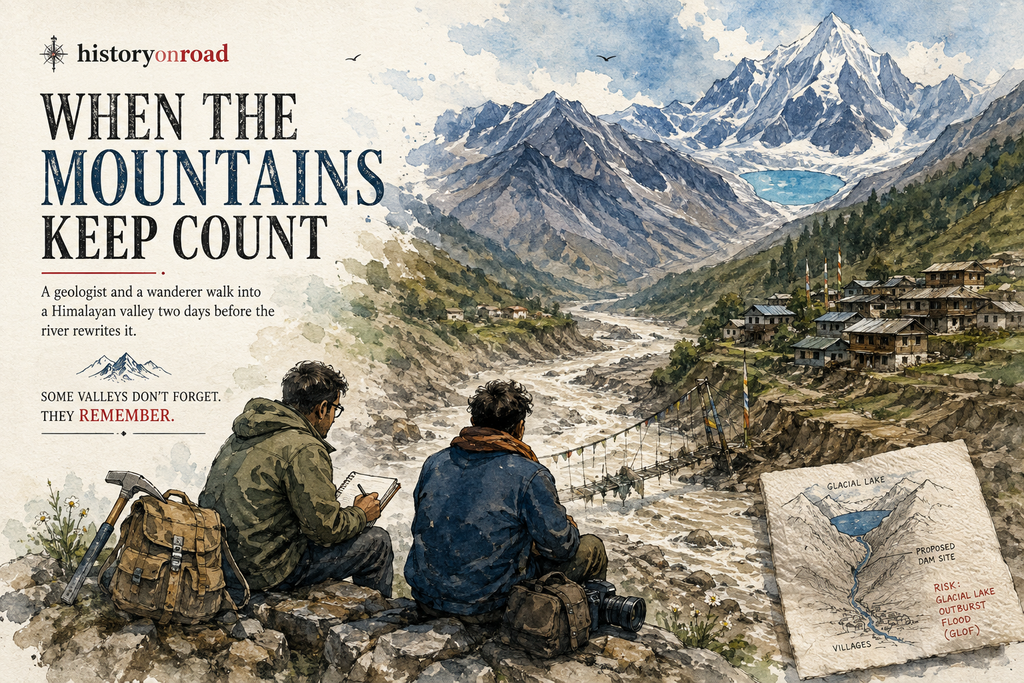
There is a particular silence that exists only above four thousand metres thin, mineral, faintly ringing in the ears and it was the first thing Shiva Prasad noticed when the jeep engine finally cut out at the trailhead. He had heard it before, in a dozen valleys from Ladakh to Sikkim, and it never stopped feeling like an instrument being tuned.
“You always do this,” said Karthik Menon, hauling his camera bag over one shoulder. “Stand there like the mountain owes you an explanation.”
“It usually has one,” Shiva said. “You just have to know where to look.”
They had been friends for over twenty years — long enough that their differences had calcified into a kind of architecture, each man built around the other’s blind spots. Shiva was a geologist by training and temperament, the sort of man who could not walk past a road cutting without slowing the car. Karthik was a travel writer whose modest but devoted readership followed him for his eye, not his facts — a man who trusted a landscape’s first impression more than its geological report. It was Karthik who had proposed this trip: a valley near the Nepal border, threaded by a glacier-fed river, still a full season away from the paved road that would soon deliver it to the wider world. Come before it changes, he had said. He did not yet know how literally that would prove true.
I. The valley that rinsed itself clean
The valley, when it opened before them, had the scrubbed, almost implausible brightness particular to landscapes fed by ice rather than rain a green with something metallic underneath it, as though the grass had been rinsed in cold water and left to dry in high, thin light. A river split the valley floor into braided channels, silver and grey by turns, shifting its own geography from one season to the next with the indifference of something that had never been told to stay still.
Karthik went first for the footbridge cables strung with prayer flags bleached to pastel, the kind of frame that photographs itself. Shiva went for the boulders scattered along the bank, oversized, out of place, deposited there by some flood decades past that no one currently living could date with any confidence.
Every landscape is a sentence, Shiva liked to say, and most people only read the punctuation.
They spent their first night in the valley in the home of Devi Tamang, whose family had farmed its terraces for four generations, and who fed them a thick lentil stew that tasted faintly of woodsmoke. It was over dinner, almost as an aside, that she mentioned the small hydropower project under survey two valleys north — close, she said, to where a glacial lake sat cupped between two ridgelines, a place her mother had always called the blue lake and had always told her children never to build beneath.
“They say it will finally bring real electricity to villages that have only ever had a few hours of it,” Devi said. “My son wants the work. I want him to have it. But I have not forgotten what my mother pointed to.”
Shiva set down his spoon. “Which lake, exactly?”
Devi only shrugged the shrug of someone who had never needed the answer to be precise before tonight.
II. What the riverbed had been keeping
The next morning, in pursuit of a sunrise Karthik wanted for reasons that were entirely aesthetic, Shiva insisted on a detour along a dry streambed that Karthik would ordinarily have walked past without a second glance. He crouched, worked a pinch of grey silt free from between two stones, and held it up like evidence.
“This isn’t ordinary monsoon overflow sediment,” he said. “Look at the layering — coarse material first, fine silt settling on top as the water slows. That pattern usually means one thing in a valley shaped like this one: a sudden, violent release of water, not a river simply rising over days. A lake breaking its banks upstream, most likely — and probably not for the first time.”
Karthik lowered his camera, and for once did not reach immediately for a caption. “You can read all of that from a handful of dirt.”
“Not perfectly. But well enough to worry a little on this valley’s behalf.”
From the ridge above, the whole geography revealed itself at once the braided river, the stepped terraces, a handful of new concrete guesthouses near the village gate, built in quiet anticipation of the tourists the coming road would bring. Karthik photographed all of it. But for the first time on the trip, Shiva noticed, his friend looked longer than he clicked.
“It’s strange,” Karthik said finally. “It might be the most beautiful place I’ve stood in years, and you’re telling me it’s holding its breath.”
“Most beautiful places are,” Shiva said. “Steep young mountains, moving water, glaciers still deciding what to do with themselves it tends to produce spectacular views and unstable ground using exactly the same ingredients.”
III. A napkin at the trailhead teahouse
Two days on, at a teahouse where the trail split toward the proposed dam site, they fell into conversation with a young engineer named Rohan, part of a survey team assessing the valley for the hydropower project. He was earnest in the specific way of young engineers newly responsible for something larger than themselves, genuinely proud to be bringing dependable electricity to villages currently rationed to a few evening hours of diesel-run power.
Shiva liked him immediately, which made what followed no easier.
“Load calculations, turbine specs, transmission routing — it’s a sound design,” Rohan said, sketching lines across a paper napkin with the confidence of someone defending very good work.
“And the lake above it? The moraine-dammed one?”
Rohan’s pen paused. “On the list for a follow-up geological survey. Budget cycles being what they are.”
“A dam downstream of an unstable natural lake isn’t only carrying the river’s usual load,” Shiva said, without any edge in his voice — he had learned long ago that geologists who lecture get ignored, and geologists who ask questions get heard. “It’s carrying the possibility of a single, enormous pulse of water and debris, if that lake’s wall ever gives — to an earthquake, a landslide falling into it, or simple erosion working at it every monsoon. Turbine engineering can be flawless and still not account for a hazard like that.”
Rohan turned the napkin over in his hands, quiet for a moment. “You’re not the first person to say something like this. There was a report last year flagging similar valleys across the region, for exactly this reason — infrastructure moving faster than the hazard mapping above it.”
“That doesn’t mean don’t build,” Shiva said. “It means build with the lake in the plan from day one — upstream monitoring, spillways sized for the worst case, glaciologists and hydrologists and engineers on the same timeline instead of studies that arrive after the concrete already has.”
Karthik, silent over his tea until now, finally spoke. “Is that expensive?”
“Far less than what a valley like this pays when it floods without warning,” Shiva said quietly. “That’s a question more of these mountains have been asking, more urgently, in recent years. This valley is not unusual in that.”
Rohan folded the napkin and slid it into his shirt pocket not a dismissal, Karthik thought, but something closer to a decision to keep it.
IV. The night the river remembered its own shape
Their last night in the valley, the rain arrived harder than any forecast had promised a monsoon straggler, weeks later than it should have exhausted itself. Near two in the morning, Shiva woke to a sound his body recognised before his mind caught up: the low, grinding register of a river carrying more than water. He woke Karthik, and together with Devi’s family they climbed to higher ground behind the homestay, watching by torchlight as the valley’s braided channels merged into a single brown torrent, swallowing the footbridge’s lower cables whole.
By dawn, the water had receded, leaving the valley rearranged new sandbars where none had been, a shifted channel, one collapsed stretch of the trail they had walked two mornings before. No one in the village was hurt. It was, Devi said afterward, an ordinary bad night the kind the valley produced every few years, mild beside what her grandmother used to describe.
But Karthik, standing at the edge of the altered riverbank with his camera hanging forgotten against his hip, understood something his friend’s lectures on sediment layers had never quite landed until now. The valley was not a backdrop. It was a living manuscript, rewriting itself in real time — and every structure set inside it, bridge or homestay or dam, was a negotiation with something far older, and far more patient, than any human blueprint.
“You knew this could happen,” he said.
“I knew it was possible. Not when. That’s the honest answer geologists give, and it’s rarely the satisfying one.”
“It’s more satisfying than pretending you don’t know,” Karthik said.
V. What they carried out
They left three days later, the road still cratered in places, Devi’s son already out at dawn clearing debris from the family’s irrigation channel with a borrowed shovel. Karthik’s last photographs from the valley were not of the prayer-flagged bridge or the sunrise ridge that had drawn them there. They were ordinary things — a resurfaced boulder, a fresh sandbar, the ghost of Rohan’s napkin sketch, photographed before the two men parted ways at the teahouse.
On the long descent, Karthik finally asked the question he had been holding since that conversation. “So what do we actually do with a place like this? Refuse to build anything at all?”
“We build with humility instead of certainty,” Shiva said. “Map the lakes before we plan the dams, not after. Put sensors upstream, and warning systems that reach the villages first, not just the control rooms. Remember that a valley this beautiful is beautiful precisely because it’s still changing — and design for the change, instead of drawing the plans as if the valley were already finished.”
Karthik looked back once, toward the ridgeline dissolving behind them, the blue lake somewhere beyond it, patient and unseen. “I think that’s the actual story,” he said. “Not the dam. Not even the flood. The listening, in between.”
The historyonroad perspective
At historyonroad, we travel to understand the quiet negotiations between people and land that allow a place to endure not simply to admire what a landscape looks like today. Shiva and Karthik’s journey is a work of fiction, but the valley they walk through is drawn from something entirely real: across the high Himalaya, mountains hold memory in their sediment, their moraines, and the oral histories of families who have watched a single ridgeline for generations. The friendship at the centre of this story a geologist who reads the ground, a traveller who frames its beauty is, we think, the dual attention every community, planner, and visitor now owes these landscapes as development reaches further into them: wonder held alongside vigilance. The most durable infrastructure these valleys will ever have may not be the one poured in concrete, but the one built in conversation with the mountain’s own unhurried, exacting memory.
— historyonroad Editorial