
A HistoryOnRoad Special Report
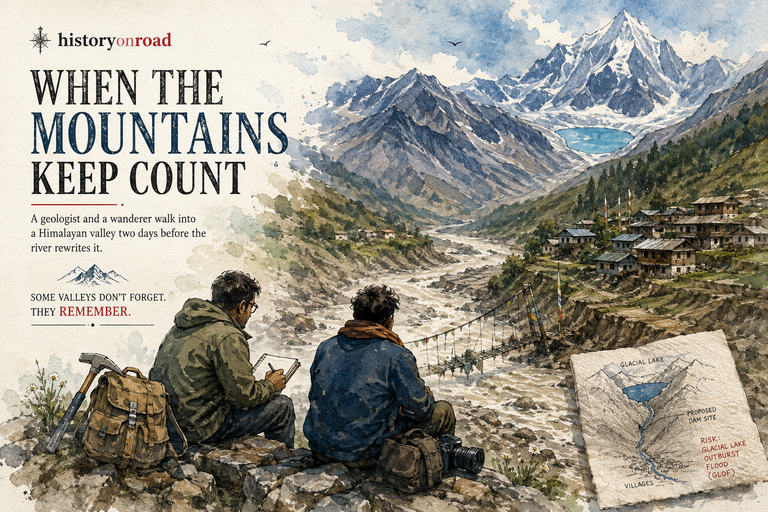
In the last week of August 2026, two very different corners of the earth delivered the same warning. In the Himalayas, a portion of a glacier near Langtang Lirung broke away and thundered down the mountainside, triggering a catastrophic flood along the Nepal and Tibet border. Villages in Nepal’s Rasuwa district were swallowed within minutes. Hundreds of people lost their lives, thousands remain missing, and entire communities are still searching for loved ones who simply vanished when the water rose thirty feet in half an hour.
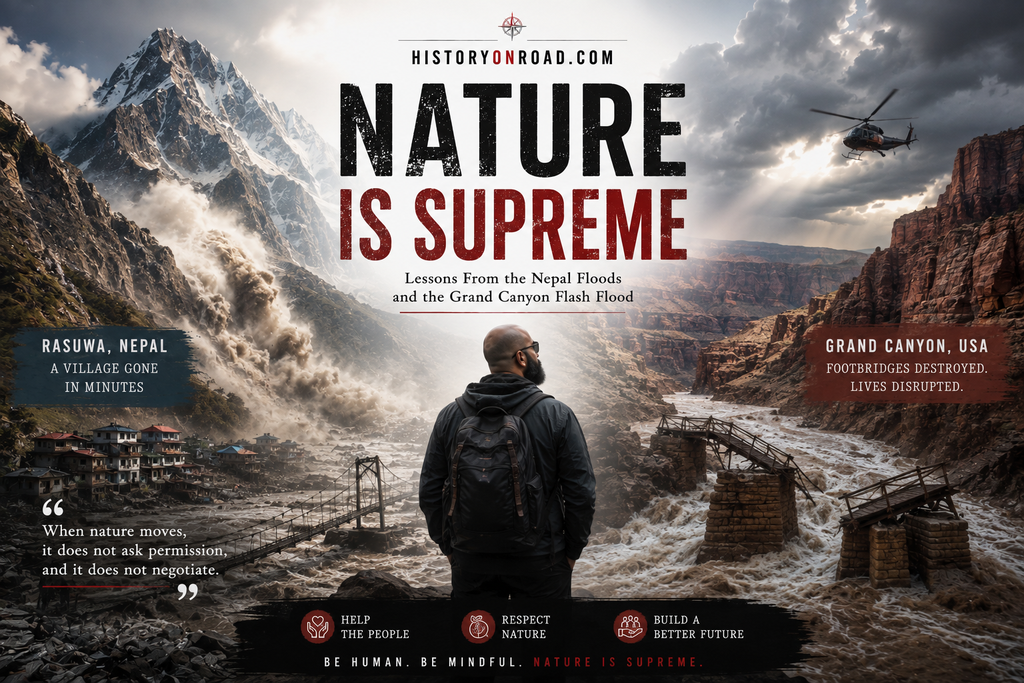
A few days later, on the other side of the planet, storm clouds gathered over the Grand Canyon. A sudden flash flood tore through Bright Angel Canyon and the historic Phantom Ranch area, destroying nearly every footbridge along Bright Angel Creek. More than fifteen hikers were left unaccounted for. Dozens of others had to be airlifted out of one of the most photographed and beloved landscapes in the United States.
Two continents. Two cultures. One shared message. When nature moves, it does not ask permission, and it does not negotiate.
Why We Must Pause and Ask Ourselves Hard Questions
It is easy to scroll past disaster headlines and move on with our day. But before we do, HistoryOnRoad asks every reader to sit with a few honest questions.
When was the last time you thanked a river, a mountain, or a forest for simply existing?
Do we visit nature to admire it, or do we visit it expecting it to perform for our cameras and our convenience?
When we build roads into fragile valleys, when we clear forests for resorts, when we ignore glacial warnings and warming trends, are we truly thinking about the people downstream who never asked for that risk?
And perhaps the most uncomfortable question of all: if nature can erase a village or a canyon trail in minutes, why do so many of us still treat it as background scenery rather than the very system that keeps us alive?
These are not questions meant to shame anyone. They are meant to wake something up. Because both Nepal and the Grand Canyon prove one thing beyond doubt. Nature does not owe us stability. It offers us balance, and balance only holds when we respect the relationship.
What Actually Happened, and Why It Matters
In Nepal, scientists believe warming temperatures weakened a section of glacier high in the Himalayas until it finally gave way, sending a wall of ice, rock, and water down the valley. Rivers that residents had known their entire lives turned unrecognizable within minutes. Bridges, roads, and homes were gone before rescue teams could even reach the area. Families are still waiting by riverbanks, hoping for news of relatives who were swept away.
At the Grand Canyon, monsoon storms sent a wall of water through a canyon corridor that hikers had walked safely for generations. Stone bridge pylons were all that remained where footbridges once stood. A water pipeline that serves the entire park was knocked out. People who had planned a peaceful hike through one of the seven natural wonders of the world found themselves needing a helicopter to get home safely.
Neither disaster was caused by malice. Neither was entirely without warning either. Climate scientists have spent years cautioning that glacial melt is accelerating and that monsoon and storm patterns are becoming more intense and less predictable. These events are not isolated accidents. They are part of a pattern the planet has been signaling to us for a long time.
Development Is Not the Enemy, But Ignorance Is
HistoryOnRoad believes deeply in progress. Roads connect villages to hospitals. Trails bring travelers to landscapes that change how they see the world. Bridges, lodges, and infrastructure allow ordinary people to experience places that were once reserved for only the boldest explorers. None of that is wrong.
What is wrong is development without listening. Building in a floodplain without studying its history. Constructing near a glacier without monitoring its health. Encouraging tourism in fragile corridors without investing equally in warning systems, evacuation routes, and community education.
Development and nature are not automatically enemies. They become enemies only when human ambition forgets to ask nature for its terms first. A river has a memory. A mountain has a pattern. A canyon has a rhythm shaped over millions of years. When we build alongside these forces instead of against them, both people and landscapes can thrive together.
What It Truly Means to Be a Human Being
There is a reason the phrase is “human being” and not simply “human doing.” Being implies presence, awareness, and responsibility. It implies that we are meant to exist in relationship with the world around us, not simply extract from it and move on.
To be a human being in the truest sense means noticing the sky before a storm instead of ignoring the warning because the itinerary is already booked. It means respecting local knowledge, the wisdom passed down by generations who have lived beside these rivers and mountains far longer than any tourist board or travel blog. It means understanding that every trail we walk and every glacier we photograph is not a backdrop for our story. It is a living system with its own story, one that deserves care rather than conquest.
Being human also means showing up for each other when nature reminds us how small we are. In Nepal, ordinary citizens, soldiers, and volunteers waded through mud and debris to search for survivors, often with nothing more than their bare hands and courage. At the Grand Canyon, park rangers, pilots, and rescue teams worked around the clock, flying through unpredictable weather to bring stranded hikers home. These are the moments that remind us what humanity looks like at its best. Not our comfort, not our convenience, but our compassion in the face of loss.
How You Can Actually Help
Awareness alone does not rebuild a bridge or comfort a grieving family. HistoryOnRoad encourages every reader to turn concern into action in ways that are real and achievable.
Donate to credible, on the ground relief organizations working directly in Nepal, including local Nepali disaster response networks, established humanitarian groups, and community fundraisers verified by trusted local sources. Every contribution, however small, helps deliver clean water, shelter, and medical care to families who have lost everything.
Support Grand Canyon and National Park Service recovery efforts by respecting closures, sharing verified official updates instead of rumors, and considering a donation to park foundations that fund trail and infrastructure repair once search and rescue operations conclude.
Learn basic wilderness and flood safety before your next outdoor adventure. Know the signs of flash flooding, understand evacuation routes, register your hiking plans with rangers, and always carry more supplies than you think you will need.
Advocate locally for better early warning systems, sustainable tourism planning, and climate resilient infrastructure in the places you love to visit. Ask your travel companies, your local governments, and even yourself whether the places you cherish are being protected as fiercely as they are being promoted.
Most importantly, carry empathy forward. Check in on friends or family who may have connections to Nepal or to visitors at the Grand Canyon. Grief does not always make headlines, but it is very real for the families still waiting for answers.
A Pattern the Earth Keeps Repeating
Neither Nepal nor the Grand Canyon is experiencing this kind of disaster for the first time. Nepal’s mountain valleys have seen glacial and monsoon flooding before, including a major glacier collapse in the same region roughly a decade ago that also destroyed villages and took hundreds of lives. The Grand Canyon has seen hikers swept away by flash floods in past summers as well, long before this latest tragedy reached the scale it has now.
That repetition is not a coincidence. It is a pattern, and patterns are messages if we are willing to read them. Warmer temperatures are destabilizing glaciers that have stood for thousands of years. Storm systems are intensifying and arriving with less predictability, which means the margin for error in fragile canyons, valleys, and coastlines keeps shrinking. Every time we ignore the pattern and rebuild exactly as before, without stronger warning systems, without smarter zoning, without genuine respect for the land’s history, we are choosing to be surprised again.
History, in fact, is the very thing HistoryOnRoad exists to honor. And history has quietly been trying to teach us this lesson for generations. Ancient communities that lived closest to rivers and mountains often built their homes on higher ground, left buffer zones near waterways, and passed down oral warnings about which slopes were unstable and which seasons demanded caution. Somewhere along the way, as convenience and speed became priorities, some of that inherited wisdom was set aside. Perhaps the truest form of progress now is not simply building faster, but remembering what our ancestors already understood about living beside powerful landscapes.
A Call to Every Reader of HistoryOnRoad
We travel because we crave connection with something larger than ourselves. A canyon carved over millions of years. A mountain range that touches the clouds. A river that has fed civilizations since before recorded history. That connection is a privilege, not a right.
Nature has once again reminded us who holds the final word. It is not arrogance to admire a glacier or a canyon. It is arrogance to assume they will always bend to our schedule, our comfort, or our convenience.
So here is our closing question to you. The next time you stand at the edge of something vast and beautiful, will you simply take a photograph and move on, or will you pause long enough to truly listen to what that place is telling you?
Nature is not decoration. Nature is not entertainment. Nature is the foundation beneath everything we call civilization, and it has been patient with us for a very long time.
Let the families of Nepal and the hikers of the Grand Canyon be more than a headline we scroll past. Let them be the reason we choose, starting today, to walk a little more gently, build a little more wisely, and love this planet the way it has always deserved to be loved.
Because in the end, being human was never about dominating the earth. It was always about belonging to it.
HistoryOnRoad stands with the communities of Nepal, Tibet, and the Grand Canyon during this time of loss and recovery. If you wish to contribute to verified relief efforts, please consult official government and international humanitarian sources for the most current and trustworthy ways to help.