

Explained:
History, Design, and the Lesson Behind It
Some objects from the ancient world survive in museums as silent artifacts, admired for their age but disconnected from the lives of the people who made them. Then there are objects like the Pythagorean Cup, which do something rarer. They still work. They still teach. Pour wine or water into one today, exactly as someone might have done two and a half thousand years ago, and it will deliver the same quiet, humbling lesson it was designed to deliver in the first place. This is the story of that cup, how it functions, where it comes from, and why its message about greed and moderation still feels remarkably relevant today.
What Exactly Is the Pythagorean Cup
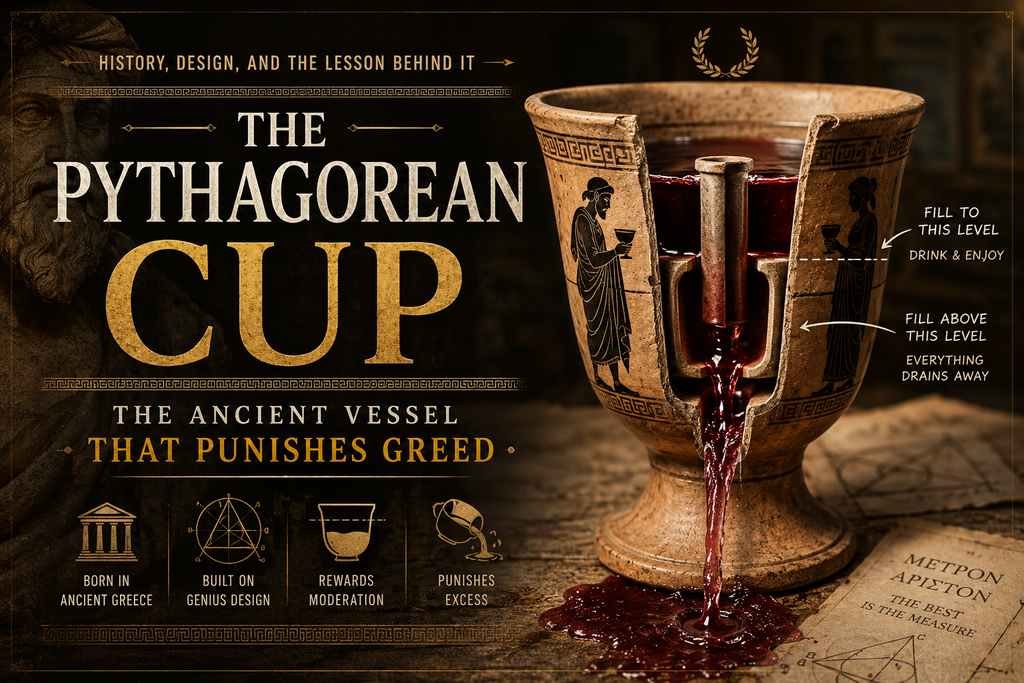
The Pythagorean Cup, sometimes called the Greedy Cup or the Cup of Justice, is an ancient drinking vessel with a hidden design feature that makes it behave very differently from an ordinary cup. From the outside, it looks like a fairly typical clay or ceramic goblet. But rising from the center of the cup is a small column, and hidden within that column is a clever internal mechanism. As long as a person fills the cup to a moderate, reasonable level, it functions exactly like any other cup, holding the liquid safely and allowing it to be drunk in the usual way.
The moment someone tries to fill it beyond a certain point, however, the entire contents of the cup drain away through a hidden opening at its base. The wine or water does not simply spill over the top as one might expect. It disappears completely from the bottom, leaving the overly generous pourer with nothing at all. A cup filled with restraint rewards its owner with a drink. A cup filled with excess punishes its owner with an empty vessel and a wet lap.
It is this built in contrast, reward for moderation and loss for excess, that gives the cup its enduring reputation as both a scientific curiosity and a moral teaching tool.
The Man Behind the Legend
The cup takes its name from Pythagoras, the Greek mathematician and philosopher born around the sixth century BC on the island of Samos. Most people today recognize Pythagoras through the geometric theorem taught in schools around the world, describing the relationship between the sides of a right angled triangle. Yet in his own time, Pythagoras was known for far more than mathematics.
He was the founder of a philosophical and religious community whose members were deeply interested in the connections between numbers, music, ethics, and the natural order of the universe. To Pythagoras and his followers, mathematics was not a cold, abstract subject separated from daily life. It was a way of understanding harmony itself, whether in music, in the movement of the stars, or in the conduct of a human life. Living well, in the Pythagorean view, meant living in balance and proportion, avoiding the extremes of excess in favor of the steady, reasonable middle path.
Given this philosophy, it is easy to understand why tradition credits Pythagoras with designing a cup that physically demonstrates the danger of excess. Whether he personally built the very first version of the cup, or whether the design emerged later from craftsmen inspired by his teachings, remains a matter of historical debate. What is certain is that the cup has carried his name and his philosophy forward for well over two thousand years.
The Engineering Hidden Inside a Simple Cup
What makes the Pythagorean Cup so remarkable is not just its symbolism, but the genuine cleverness of its physical design. Inside the raised central column of the cup sits an arrangement of two tubes, one nested inside the other, connected through a small internal chamber that leads down to a hole at the base of the cup.
While the liquid level inside the cup remains below the top of the inner tube, everything behaves normally, since the liquid has no path to escape. But once the liquid is poured above that critical height, it begins to flow up and over the inner tube, entering the hidden chamber. This triggers a principle known as a siphon, in which a continuous flow of liquid, once started, will keep pulling more liquid along with it due to a combination of gravity and differences in air pressure. Because the siphon effect does not stop once it begins, it continues drawing liquid out of the cup entirely, not just the excess portion, but everything down to the very bottom.
This is precisely why the punishment feels so complete. A person who overfills the cup by even a small amount does not lose a small amount in return. They lose everything they poured. The design does not simply discourage excess. It removes any advantage that excess might have offered, replacing it entirely with loss.
Centuries before anyone had a formal scientific vocabulary for concepts like atmospheric pressure or fluid dynamics, the builders of this cup had already applied these principles successfully, wrapping real physics inside a piece of everyday tableware.
Why the Cup Was Called the Cup of Justice
Historical accounts and long standing local tradition suggest the cup was used in a variety of settings, from philosophical gatherings to shared meals to everyday households. In some tellings, it was used at communal tables as a playful but pointed test of character, particularly for guests who did not yet know the cup’s secret. A newcomer, eager to fill their cup generously, would be met with the sudden and often laughter inducing disappearance of their entire drink, while those who understood the design filled their cups modestly and drank in peace.
Some historical explanations connect the cup to regions where water was scarce and highly valued. In such places, a cup like this may have served a very practical purpose beyond amusement, encouraging people to take only their fair share of a limited resource so that others in the community would have enough as well. Under this reading, the cup becomes more than a personal lesson in self control. It becomes a small piece of social engineering, encouraging fairness in the distribution of something essential to everyone.
This is likely why the cup earned its alternate name, the Cup of Justice. It did not simply discourage individual greed. It protected the interests of the wider group by making selfish behavior immediately and visibly costly.
The Deeper Lesson Behind the Design
What elevates the Pythagorean Cup beyond a clever party trick is the philosophy embedded within its function. The cup does not forbid enjoyment. It does not punish someone for wanting a drink, for celebrating, or for taking part in the pleasures of a shared meal. What it punishes is the refusal to recognize a limit.
This distinction matters. The lesson of the cup is not that desire itself is a flaw to be eliminated. It is that wisdom lies in recognizing where a reasonable boundary sits, and having the discipline to respect it. A person can drink fully and happily from the cup, as many times as they like, so long as each pour respects the built in limit. The cup rewards patience and steady enjoyment over impulsive, greedy accumulation.
This idea reflects a value found throughout Pythagorean philosophy and much of ancient Greek thought more broadly, often referred to as the golden mean, the belief that virtue tends to exist in the balanced space between two extremes rather than at either edge. Courage sits between recklessness and cowardice. Generosity sits between wastefulness and stinginess. And here, contentment sits between deprivation and greed. The cup translates a fairly abstract philosophical idea into something anyone could understand instantly, through nothing more complicated than pouring a drink.
Why This Ancient Lesson Still Matters Today
More than two thousand years after its creation, the message behind the Pythagorean Cup remains strikingly relevant. Modern life often measures success by accumulation, more possessions, more recognition, more comfort, more certainty about tomorrow. There is nothing inherently wrong with ambition or the desire for a better life. But the cup offers a quieter, older kind of wisdom, suggesting that lasting contentment is found not by chasing every possible gain, but by recognizing when enough has genuinely arrived.
This lesson extends well beyond the dinner table. It applies to how people manage their time, their relationships, their ambitions, and their treatment of shared resources, whether that means water, community trust, or simple patience with one another. Excess, the cup reminds us, often does not simply fail to add value. It can actively drain away what was already gained, leaving less behind than if restraint had been practiced from the start.
There is also something deeply human and hopeful in the story of this cup. Rather than relying on punishment through force or authority, it teaches through gentle, self evident consequence. No one needs to scold the person who overfills the cup. The cup teaches on its own, through simple observation. In a world that often struggles to encourage patience and fairness, there is real value in an object, and an idea, that makes the lesson visible and immediate rather than abstract and distant.
A Small Object Carrying a Large Idea
The Pythagorean Cup endures not because of the rarity of its materials or the complexity of its craftsmanship, but because of the honesty of the idea folded into its design. It suggests that a fulfilling life is rarely the one poured to the very brim, chasing every last possible advantage. It is the life poured with awareness, shared generously with others, and enjoyed fully within its natural and reasonable limits.
Attributed to a philosopher who spent his life searching for harmony in numbers, music, and human conduct alike, the cup remains one of history’s simplest and most effective reminders that wisdom does not always require long lectures or complicated arguments. Sometimes it only requires a cup, a little liquid, and the willingness to notice where the line truly sits.
The Historyonroad Perspective
At Historyonroad, we return again and again to objects like the Pythagorean Cup because they prove that history is rarely locked away in the past. It travels forward with us, quietly waiting inside museums, old stories, and household items, ready to be rediscovered by anyone willing to look closely. What draws us to this particular story is not just the cleverness of ancient engineering, though that alone is worth celebrating, but the way a simple drinking vessel manages to hold up a mirror to modern life. We believe history should not only inform, it should guide, encourage, and gently challenge how we live today. The Pythagorean Cup does exactly that, offering a lesson in humanity as relevant now as it was on the island of Samos thousands of years ago. That, to us, is what makes a story worth telling.