
How a Web of Trade Routes Connected Continents, and What It Still Teaches Us About Cooperation
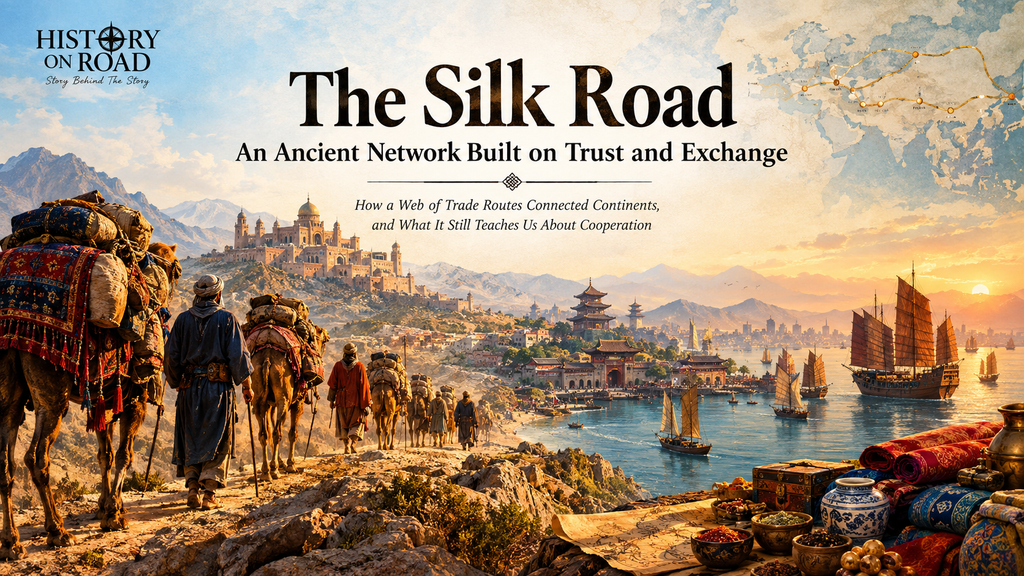
Stretching across thousands of miles, from the eastern edges of China through Central Asia, Persia, Arabia, and into Europe and North Africa, the Silk Road was never a single, clearly marked road at all. It was a vast, interconnected network of trade routes, developed and expanded over centuries, carrying not just goods but ideas, technologies, religions, and cultural practices between civilizations that might otherwise have remained almost entirely isolated from one another. Understanding how this remarkable system functioned, and what allowed it to succeed for so long despite spanning wildly different cultures, languages, and political systems, offers valuable insight into questions the modern world continues to grapple with today, questions about trust, cooperation, and the delicate infrastructure that makes global exchange possible.
More Than a Road, a Living Network
The term Silk Road itself is a relatively modern label, coined in the nineteenth century by a German geographer to describe this sprawling system of ancient trade connections. In reality, the network consisted of numerous overland and maritime routes, expanding and shifting over roughly fifteen hundred years, from around the second century BC through the middle of the second millennium AD.
Named for the valuable Chinese silk that traveled westward along these routes, the network in practice carried an enormous range of goods in both directions. Spices, precious stones, glassware, paper, gunpowder, textiles, tea, and countless other products moved across these connected paths, passing through the hands of numerous intermediary traders, merchants, and communities along the way. Rarely did a single trader travel the entire distance from one end of the network to the other. Instead, goods typically moved in stages, passed from one regional trading community to the next, accumulating value, and often stories, at every stop along the journey.
Trust as the Real Infrastructure
Perhaps the most remarkable aspect of the Silk Road was not the physical goods it transported, but the complex web of trust, negotiation, and cultural adaptation required to keep the entire system functioning across such vast distances and such radically different political and cultural environments. Traders moving along these routes had to navigate different languages, currencies, legal customs, and religious practices, often relying on established relationships, reputational trust, and shared commercial customs that had developed gradually over generations of continued exchange.
Caravanserais, roadside inns built specifically to house traveling merchants and their goods, dotted the routes at regular intervals, offering not just physical shelter but a recognized, semi-standardized space where traders from vastly different backgrounds could interact, negotiate, and conduct business under mutually understood expectations. These institutions represented an early, practical solution to a challenge that remains deeply relevant today: how do you build reliable systems of exchange and cooperation across genuine cultural and political difference?
A Network for Ideas, Not Just Goods
While the exchange of physical goods often receives the most attention, the Silk Road’s most lasting impact may actually be the exchange of ideas, technologies, and cultural practices that traveled alongside the merchandise. Buddhism spread from India into China, Korea, and eventually Japan largely along these trade routes. Papermaking technology, originally developed in China, gradually made its way westward, eventually transforming written communication and record-keeping across the Islamic world and Europe. Mathematical concepts, including the numeral system widely used around the world today, moved through similar channels of exchange, blending and evolving as they passed between different scholarly traditions.
This transmission of knowledge often proved far more transformative in the long run than the physical goods themselves. A bolt of silk was consumed and eventually wore out. An idea, a technology, or a philosophical or religious tradition, once transmitted and adopted, could reshape entire societies for centuries to come.
The Fragility of a Connected System
The Silk Road was never a perfectly stable or uninterrupted system. It expanded and contracted repeatedly over its long history, shaped by shifting political power, war, disease, and changing economic conditions. The rise and fall of empires along its route, from the Han Dynasty to the Mongol Empire to various Persian and Islamic caliphates, directly affected how safely and efficiently goods and ideas could travel. Periods of relative political stability, such as during the height of Mongol control across much of Central Asia, often coincided with increased trade activity and safer travel conditions, while periods of conflict or fragmentation could disrupt or entirely sever established trade connections for extended periods.
This ebb and flow illustrates an important and enduring truth about interconnected systems of exchange, whether ancient trade routes or modern global supply chains. Connectivity, once established, is not automatically permanent or self-sustaining. It requires ongoing political stability, mutual cooperation, and ongoing maintenance of trust and infrastructure to remain functional and beneficial over time.
Why the Silk Road Matters in 2026
In 2026, the world remains deeply interconnected through global trade, technology, and communication networks that, in many ways, represent a modern continuation of the same fundamental impulse that built the Silk Road: the human drive to exchange goods, knowledge, and culture across vast distances and significant differences. Yet this modern global system faces many of the same underlying vulnerabilities that shaped the ancient network’s long, uneven history.
Supply chain disruptions, whether caused by geopolitical conflict, pandemic-related shutdowns, or infrastructure failures, have repeatedly demonstrated in recent years just how quickly seemingly stable global trade connections can be strained or broken. The Silk Road’s history serves as a valuable reminder that global cooperation and exchange, however beneficial, are not automatic or guaranteed. They depend on sustained investment in trust, shared standards, and genuine cross-cultural understanding, precisely the same foundational elements that allowed merchants speaking different languages and following different customs to successfully trade with one another along these routes for well over a thousand years.
There is also a valuable lesson here about the value of cultural exchange itself, particularly relevant in a period where global politics sometimes trends toward increased isolationism or suspicion of outside influence. The Silk Road stands as powerful historical evidence that sustained contact between different cultures, when built on mutual benefit and respect rather than domination, tends to produce genuine, lasting enrichment for all parties involved, spreading not just goods but valuable knowledge, technology, and ideas that individual, isolated societies would have taken far longer, if ever, to develop entirely on their own.
Finally, the Silk Road offers a hopeful model for how genuine cooperation can function even amid significant difference. The merchants, translators, innkeepers, and communities who kept this network functioning across centuries did not require identical beliefs, governments, or cultural practices to successfully cooperate. They required only enough shared trust, mutual benefit, and practical goodwill to keep the exchange moving forward, a lesson worth remembering in a world of 2026 still frequently divided along political, cultural, and ideological lines.
The Maritime Silk Road
While the overland routes through Central Asia often receive the most attention, the Silk Road network also included significant maritime trade routes, connecting ports across the Indian Ocean, the South China Sea, and eventually reaching East Africa and the Arabian Peninsula. These maritime routes, sometimes referred to collectively as the Maritime Silk Road, allowed for the transport of larger and heavier goods than overland caravans could practically manage, including bulk quantities of spices, ceramics, and other valuable materials that would have been considerably more difficult and costly to move across long overland distances.
The maritime routes required their own specialized navigational knowledge, shipbuilding techniques, and understanding of seasonal wind patterns, particularly the monsoon winds that shaped sailing schedules across the Indian Ocean for centuries. Port cities along these maritime routes, from Guangzhou in China to Calicut in India to various trading centers along the East African coast, developed into genuinely cosmopolitan hubs of exchange, where merchants, sailors, and travelers from remarkably diverse cultural and religious backgrounds regularly interacted, traded, and, in many documented cases, settled permanently, contributing to increasingly diverse and interconnected urban populations throughout the region.
This maritime dimension of the network illustrates that the Silk Road’s broader legacy of connection and exchange was never limited to a single mode of transportation or a single geographic corridor. It represented, more accurately, a sprawling, adaptable, multi-generational human effort to connect distant peoples and markets through whatever routes, overland or maritime, proved most practical and effective given the technology and conditions of a given era.
A Legacy Written Into the Modern World
Many aspects of daily life today carry faint but real traces of the Silk Road’s influence, from the numeral systems used in mathematics worldwide, to religious and philosophical traditions that shaped entire civilizations, to the very concept of a genuinely global marketplace connecting distant producers and consumers. The network’s physical roads have long since faded, overtaken by modern highways, railways, and shipping lanes, but its underlying legacy, proof that sustained, mutually beneficial exchange across genuine difference is both possible and profoundly valuable, remains very much alive.
The Human Cost and Complexity Worth Acknowledging
Any honest account of the Silk Road should also acknowledge that this vast network of exchange was not without genuine hardship and complexity. Trade caravans faced real dangers, including harsh desert and mountain terrain, banditry, and the constant risk of disease spreading along heavily trafficked routes, a dynamic tragically illustrated by the transmission of plague along Silk Road connections during the fourteenth century, contributing to one of the most devastating pandemics in recorded human history. Not all exchange along the network was conducted on equal or fair terms, and power imbalances between different regions and empires shaped trade relationships in ways that sometimes benefited certain parties considerably more than others.
Acknowledging this complexity does not diminish the genuine value of the Silk Road as a historical example of cross-cultural exchange and cooperation. It simply reflects a more complete, honest understanding of how large-scale human systems of connection actually function in practice, rarely perfectly equitable or entirely without cost, yet still capable of producing genuinely valuable, lasting benefits when approached with sufficient care, mutual respect, and shared commitment to the relationships involved. This same balanced honesty remains valuable when evaluating modern systems of global trade and cooperation today.
The Historyonroad Perspective
At Historyonroad, the Silk Road embodies precisely the kind of history we find most meaningful: not a single dramatic event, but a long, patient, evolving story of human cooperation across genuine difference. It reminds us that connection between distant peoples and cultures is neither new nor easy, but it is achievable, and historically, it has produced some of humanity’s most valuable and lasting exchanges of ideas, technology, and mutual understanding. In a world of 2026 still working through complex questions about globalization, trust, and cross-cultural cooperation, the long, winding story of the Silk Road offers real, grounded guidance, proof that sustained goodwill and shared benefit can hold a connected world together, even across enormous distance and difference.
Category: Ancient History
Hashtags:
#SilkRoad #AncientHistory #TradeRoutes #CulturalExchange #WorldHistory #MaritimeSilkRoad