
What the Loss of Humanity’s Greatest Ancient Library Teaches About Protecting Knowledge Today
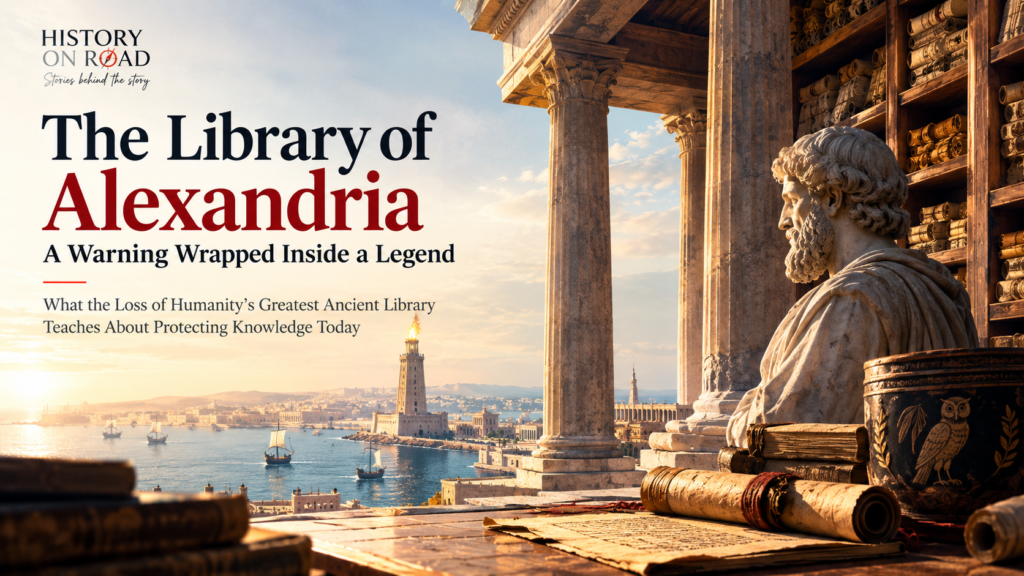
Few institutions from the ancient world capture the imagination quite like the Library of Alexandria. Founded in Egypt sometime in the early third century BC, likely under the patronage of the Ptolemaic dynasty that ruled following the conquests of Alexander the Great, the library became, for a significant stretch of the ancient world, the largest and most comprehensive collection of written knowledge humanity had ever assembled in one place. Its eventual loss, gradual, contested, and still debated among historians, has become one of history’s most enduring symbols of the fragility of human knowledge. This is the story of what the library represented, how it may have been lost, and why its legacy carries genuine, urgent relevance in 2026.
An Unprecedented Center of Knowledge
The Library of Alexandria was not simply a building filled with scrolls. It functioned as part of a broader research institution known as the Mouseion, a center dedicated to scholarship, science, and learning that attracted some of the most significant intellectual figures of the ancient Mediterranean world. Scholars associated with the library and its surrounding institution are credited with major advances across mathematics, astronomy, medicine, geography, and literary scholarship, including figures whose work would influence science for centuries to come.
Estimates of the library’s total collection vary considerably among historians, with some ancient sources suggesting it held several hundred thousand scrolls at its height, representing an extraordinary concentration of accumulated human knowledge for its era. The library reportedly pursued an active and, by some accounts, fairly aggressive acquisition policy, with ships arriving in the harbor of Alexandria sometimes required to surrender any books or scrolls on board for copying, with copies rather than the originals occasionally returned to their owners. Whatever the precise historical accuracy of these specific stories, they reflect a broader truth, that Alexandria pursued the ambitious, almost obsessive goal of gathering as complete a record of human knowledge as possible within a single location.
The Uncertain Story of Its Loss
Despite the library’s legendary status, the precise details surrounding its decline and eventual disappearance remain genuinely uncertain and debated among historians, a fact that is itself an important and often overlooked part of the story. Popular tradition has often pointed to a single dramatic event, frequently associated with Julius Caesar’s military campaign in Alexandria in 48 BC, during which fires reportedly spread from the harbor into parts of the city. However, most serious historians now believe the library’s decline was far more gradual and multifaceted, unfolding over centuries rather than in one single catastrophic incident.
Contributing factors likely included periods of political instability and reduced royal patronage following the decline of Ptolemaic rule, changing religious and political priorities under later Roman administration, and simple, ordinary neglect, the kind of gradual institutional decay that can slowly hollow out even the most impressive achievements when sustained funding, attention, and care are no longer consistently provided. By the time later, well-documented incidents affecting religious and cultural institutions in Alexandria occurred in subsequent centuries, much of the original library’s collection may have already been diminished or dispersed through this slower, quieter process of decline.
This more nuanced historical understanding matters, because it shifts the lesson of the Library of Alexandria away from a single dramatic villain or catastrophic event, and toward something more universally applicable and, frankly, more unsettling, the reality that knowledge and institutions can erode gradually, through neglect, shifting priorities, and reduced investment, long before any single dramatic incident finishes the job.
A Symbol Larger Than Its Exact History
Regardless of the precise historical details, which remain genuinely contested among scholars, the Library of Alexandria has come to symbolize something larger and more universally resonant, the immense value, and the profound fragility, of concentrated human knowledge. It represents both the extraordinary heights of what organized, well-funded scholarship can achieve, and a sobering reminder of how easily such achievements can be lost, whether through sudden destruction or slow, quiet neglect.
This symbolic weight has made the library a recurring reference point across centuries of subsequent discussion about libraries, archives, education, and the broader responsibility of preserving accumulated human knowledge for future generations.
Why This Matters in 2026
In 2026, humanity holds access to a volume of accumulated knowledge and information that would have seemed genuinely unimaginable even a few decades ago, let alone in the ancient world. Yet the underlying lesson of the Library of Alexandria remains strikingly, and somewhat uncomfortably, relevant.
Digital information, despite its apparent permanence and easy accessibility, is not immune to the same fundamental vulnerabilities that eventually diminished the ancient library, dependence on continued institutional support, ongoing maintenance, and sustained collective will to preserve and protect it. Digital archives can be lost through outdated file formats, discontinued platforms, corporate decisions to shut down services, cyberattacks, or simple, ordinary organizational neglect. Entire online communities, research archives, and digital records have already disappeared in recent years, sometimes with startlingly little public notice, echoing, in a distinctly modern form, the same gradual erosion that likely affected the library at Alexandria over the centuries.
There is also a pressing modern parallel around the deliberate restriction or distortion of access to information, whether through censorship, the deliberate spread of misinformation, or restricted access to educational resources in various parts of the world. The Library of Alexandria’s ambition, to gather and preserve knowledge as openly and comprehensively as possible, stands as a powerful historical counterpoint to any modern trend toward restricting, distorting, or gatekeeping access to accurate information and education.
Additionally, in an era where artificial intelligence systems are trained on and increasingly mediate access to vast quantities of human knowledge, questions about how that knowledge is preserved, curated, verified, and made accessible carry a weight directly comparable to the ambitions and responsibilities once held by the scholars and administrators of ancient Alexandria. Decisions being made right now about digital preservation, open access to research, and equitable global access to education and information will significantly shape whether future generations inherit an Alexandria-like wealth of accessible knowledge, or face their own version of Alexandria’s quiet, gradual loss.
The Scholars Who Made the Library Great
Beyond its impressive collection of scrolls, the Library of Alexandria’s true significance lay in the community of scholars it attracted and supported. Figures associated with the library and its broader research institution made lasting contributions across numerous fields of study. Eratosthenes, who served as head librarian, is credited with calculating the circumference of the earth with remarkable accuracy using little more than careful observation and geometric reasoning. Euclid, whose foundational work on geometry would shape mathematical education for well over two thousand years afterward, is believed to have worked in Alexandria during this same general period. Physicians associated with the city made significant advances in the study of human anatomy, while astronomers refined mathematical models of the heavens that would influence scientific thought for centuries.
This concentration of talent was not accidental. It reflected a deliberate institutional commitment to supporting scholarship through royal patronage, providing resources, housing, and time for sustained research, rather than expecting scholars to fund their own work independently. This model, an institution deliberately structured to support long-term, undirected scholarly inquiry, represents an important early precursor to the modern university and research institution, structures that remain central to how humanity continues to generate and preserve new knowledge today.
The loss of the library, then, represented not simply the loss of a large collection of scrolls, but the disruption of an entire supportive ecosystem for scholarship, one that had taken generations of sustained investment to build and that could not be quickly or easily recreated once meaningfully disrupted.
The Ongoing Responsibility of Preservation
Perhaps the most valuable lesson embedded in the story of the Library of Alexandria is that the preservation of knowledge is never a finished task. It requires continuous, active investment, institutional support, and genuine collective will, not a single triumphant achievement that, once accomplished, can simply be left to maintain itself indefinitely. The scholars and administrators who built and expanded the ancient library clearly understood this, actively pursuing new acquisitions and supporting ongoing scholarship throughout the institution’s most successful periods. It was only once that sustained investment and attention began to waver that the library’s slow decline took hold.
This is a lesson directly applicable to modern libraries, universities, digital archives, and educational institutions of every kind, all of which depend on continued funding, public support, and sustained institutional commitment to remain genuinely valuable and accessible over the long term, rather than gradually eroding through neglect, however well-intentioned their original founding may have been.
Modern Efforts to Build a New Alexandria
The enduring symbolic power of the Library of Alexandria has directly inspired numerous modern efforts aimed at large-scale knowledge preservation and open access. The Bibliotheca Alexandrina, a major library and cultural institution opened in the city of Alexandria in 2002, was explicitly conceived as a modern successor to the ancient library, intended to revive its spirit of open scholarship and cultural exchange for a contemporary audience. Various digital archiving initiatives, including large-scale efforts to preserve web content, open access academic research repositories, and international digital library projects, similarly draw explicit inspiration from Alexandria’s ancient ambition to gather and preserve as much human knowledge as possible in an accessible, organized form.
These modern efforts, while operating with vastly more advanced technology than existed in the ancient world, ultimately face a strikingly similar underlying challenge, ensuring sustained institutional commitment, funding, and public support over the long term, rather than relying on an initial burst of enthusiasm and investment that inevitably fades without continued attention. The ancient library’s story suggests that the greatest threat to any such project is rarely a single dramatic event, but rather the slow, quiet erosion of sustained care and resourcing over time, a lesson every modern institution attempting to build its own version of Alexandria would do well to remember.
The Historyonroad Perspective
At Historyonroad, the story of the Library of Alexandria resonates deeply with our own mission, using history not simply to entertain, but to genuinely inform and guide present-day decisions and priorities. It would be easy to treat the library purely as a tragic, almost mythical loss from the distant past, worth a moment of reflection before moving on. We think it deserves to be treated as something closer to an active warning, still very much applicable to how we manage, fund, and protect knowledge in our own time. In 2026, as digital archives grow vast and artificial intelligence reshapes how humanity accesses information, the quiet lesson of Alexandria feels less like ancient history and more like an urgent, ongoing responsibility, one we believe deserves far more attention than it currently receives.
Category: Ancient History, Knowledge Preservation
Hashtags: #LibraryOfAlexandria, #AncientHistory, #Historyonroad, #DigitalPreservation, #KnowledgePreservation, #Alexandria, #Mouseion, #Eratosthenes, #Euclid, #OpenAccess, #HistoryLessons, #AncientEgypt, #Ptolemaic, #Libraries, #HistoryMatters