
“How a Lonely Fisherman Found a Daughter on the Steps of a Church”
And the Man Who Never Left
The monsoon came early to the island of Kharvan that year, and it came angry.
Shivay was forty-two, a Marathi man from the Konkan belt who had left his village long ago and never quite explained why. He lived alone in a tin-roofed house at the far edge of the island, where the road ended in red mud and the sea began. He had a boat, a Royal Enfield older than some of the island’s coconut trees, and a silence he wore like a second shirt.
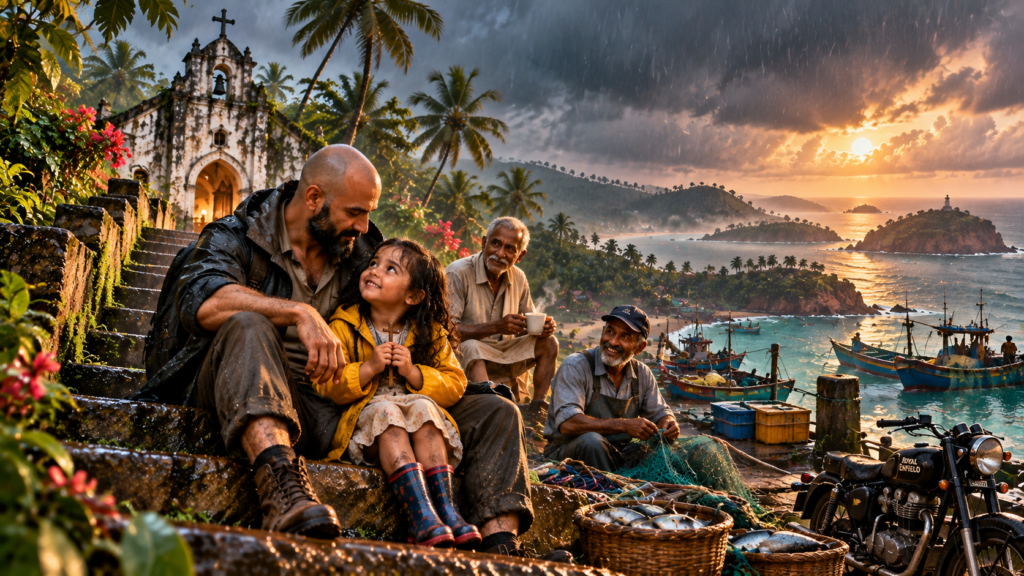
On a grey June morning, he walked up the hill to check on the old chapel of Saint Anselm. Nobody had held a Mass there in years. Moss had crept over its white walls, and the stone steps were cracked and slippery with rain.
He heard her before he saw her.
It was not a loud cry. It was a thin, tired sound, coming from the bushes beside the steps, like a small creature that had been crying so long it had almost run out of voice.
Shivay pushed aside the wet leaves. A baby girl, maybe a year and a half old, lay wrapped in a faded blue cloth, her lips pale, her tiny fingers clenched around a string with a small wooden cross tied to it.
He looked around. There were no footprints that the rain hadn’t erased. No one called out. Only the sea, grey and endless, breathing below the cliff.
“Arre, baby,” he whispered, in the Marathi of his mother’s kitchen. “Kuthun aali tu?” Where did you come from?
The child opened her eyes and looked at him. Then she held out the little cross, as if it were an introduction.
He carried her home inside his raincoat, against his chest, walking slower than he had ever walked in his life.
A Name from the Steps
For three days he did not sleep properly. He warmed rice water on the stove and fed her with a spoon. He wrapped her in his softest cotton lungi. He sat by her mat and listened to her breathing, afraid that if he looked away, it would stop.
On the fourth day, his neighbour Manohar came by with a pot of fish curry, because Manohar always knew when something was wrong on the island, the way the tide knows the moon.
Manohar was seventy, thin as a bamboo pole, with a white moustache and a voice like warm coconut oil. He had buried a wife, raised two sons who now lived in Pune, and kept a small garden of chillies and curry leaves beside his house.
He stood at the door and saw the child sleeping on the mat. He did not ask a single question. He only put down the pot and said, “Shivay, she will need milk, not just rice water. And a name.”
Shivay rubbed his tired face. “She was near the church. She had a cross with her. I don’t know her people, Manohar. I don’t know her faith.”
“Then let the church give her the name,” Manohar said gently. “God keeps strange post offices, Shivay. Sometimes He delivers a child to a doorstep and leaves the address blank.”
Shivay looked at the sleeping girl. Outside, the rain had cleared for a moment, and through the window he saw the evening star hanging above the old chapel’s roof.
“Stella,” he said quietly. “It means star. My mother used to say a star finds you when you stop looking for one.”
The child stirred in her sleep, as though she had heard.
The Years That Followed
Shivay never tried to turn her into anything. He was a Marathi Hindu man raising a child who had arrived with a Christian cross in her fist, and he decided, on the very first night, that he would not argue with the sea or the sky about it.
On Sundays, he walked her to the small parish church in the next village, two hours away by foot when the bike wouldn’t start. He sat at the back, hands folded, not understanding the Latin hymns but understanding the way Stella’s face went soft and quiet inside those walls. The old priest, Father Domnic, never asked him to convert, and Shivay never asked the priest to bless him. They simply nodded at each other every week like two men who had agreed on something without speaking.
At home, Stella learned both worlds. She said her evening prayers to the cross on the wall, and she touched her father’s feet on festival mornings. She ate Konkani fish curry and Marathi puran poli with the same joy. She spoke Marathi with her father, English with the priest, and a tangled mix of both when she was angry.
“Baba,” she would say, because that is what she called him, “you cannot say ‘Stella’ like Goan people say it. You say it like a Marathi man scolding his buffalo.”
“Then I am the only man in Goa whose buffalo is named after a star,” he would answer, and she would laugh until she had hiccups.
The Boat, the Bike, and Old Luka
By the time Stella was seven, Shivay had turned his small fishing boat into a modest business. He sold the morning catch to a few restaurants on the mainland and to families who needed fresh fish without the noise of the market. It was honest work and it paid the bills.
But he could not do it alone, and that is where Luka came in.
Luka was sixty-eight, a Goan fisherman with hands like knotted rope and a left knee that predicted the weather better than any radio. He had once owned three boats and lost them all to debt and bad luck. Shivay never asked for the story. He simply handed Luka a mug of tea one morning and said, “The nets need mending. I need a man who understands knots.”
Luka stayed for good.
He taught Stella how to read the sky before a storm, how to tell a mackerel’s mood from the way it jumped, and how to whistle through her teeth in a way that, he claimed, calmed the sea.
“The sea is not cruel, little star,” he told her once, while they sat on the boat’s edge sorting the morning catch. “It is only honest. It gives you exactly what you bring to it.”
Stella remembered that sentence all her life.
Roads That Led Nowhere Beautiful
Every few weeks, when the work was done and the weather was kind, or even when it wasn’t, Shivay would roll out the old Bullet, kick-start it with one stubborn stomp, and say, “Chal, Stella. Let’s go lose ourselves.”
She would climb up behind him, wrapped in a yellow raincoat two sizes too big, her arms around his waist, her cheek pressed against his back.
They never went to the places on the posters. The beach shacks, the loud clubs, the neon nights where music shook the sand. Shivay had no quarrel with those who loved them. It simply wasn’t their kind of happiness.
Their Goa was somewhere else. It was a laterite trail that dissolved into a hidden waterfall. It was an abandoned lighthouse where gulls argued with the wind. It was a tiny village where an old woman once offered them hot bhakri and refused to take money, saying, “Rain is better shared.”
They rode through paddy fields turned silver by monsoon, past banyan trees older than any map, and stopped wherever the sea looked like it wanted to tell them something. Stella would stand at the edge of a cliff, arms wide, letting the rain soak her hair, while Shivay sat on the bike and watched her with an expression he never let her see.
“Baba,” she asked once, shouting over the wind, “why don’t we go to the parties like everyone else?”
He thought about it for a long moment.
“Because the sea doesn’t shout, Stella,” he said. “And the things that matter most never do either.”
The Question
When she turned twelve, Stella asked what every found child eventually asks.
It was evening. They were sitting on the verandah, watching the fishing boats come home like tired birds. Manohar had joined them with a flask of ginger tea.
“Baba,” she said softly, “do you think my real mother thinks about me?”
The verandah fell quiet. Even the waves seemed to lower their voices.
Shivay did not answer right away. He took her small hand in his rough one and looked at the horizon.
“I don’t know who she was, Stella,” he said at last. “Maybe she was afraid. Maybe she was poor. Maybe she left you where she believed someone kind would find you. I will never know. But I know this. On the morning I found you, you held out a little cross to a stranger, as if you were saying, ‘Please stay.’ And I did.”
Stella’s eyes filled. “You stayed.”
“I did. And I’m not going anywhere.”
Manohar wiped his eyes with the end of his shawl and pretended it was the smoke from somebody’s kitchen.
The Storm Season
The year Stella turned sixteen, a cyclone brushed past the coast. The island lost power for six days. Roofs flew off, boats snapped their ropes, and the sea climbed higher than anyone remembered.
Shivay’s boat was tied at the small jetty, and he would not leave it. It was his livelihood, and Luka’s too.
“I’ll go with you,” Stella said, pulling on her raincoat.
“No.”
“Baba, you taught me how to tie the knots. Luka taught me how to read the waves. I am not a child you found in the bushes anymore.”
He stared at her, and for a moment he saw the girl on the steps, and the young woman standing in front of him, and he understood that both of them were his daughter.
“Then hold the rope,” he said, voice rough. “And do not let go.”
They worked through the night, the three of them, Shivay, Stella and Luka, soaked to the bone, shouting over the wind, hauling the boat to higher ground. Manohar stood at his gate holding a lantern, because it was the only help an old man could give, and it was enough. The light guided them home.
By dawn, the storm had passed. The boat was safe. Stella fell asleep on the verandah with her head on her father’s shoulder, her hands still stiff from holding the rope.
Luka looked at them both and murmured, “The sea took three boats from me once. But it gave me this family instead. Fair trade, I think.”
What the Island Remembers
Years passed the way tides do, quietly and completely.
Stella grew into a woman with her father’s steady eyes and her own fearless laugh. She learned to manage the fishing accounts, to speak up for fair prices, and to teach the island’s children how to swim. Manohar grew older, then older still, and when his hands could no longer hold a watering can, Stella watered his chilli plants for him every morning without being asked. Luka’s knee finally won its long argument with the weather, and he spent his last winters on a chair by the jetty, directing the nets like an old captain.
Shivay’s hair turned grey at the temples. His Bullet developed new sounds, and he refused to fix any of them.
On an October evening, years after that first rain-soaked morning, the two of them rode up the hill to the old chapel of Saint Anselm. Somebody had finally repaired its roof. A single candle burned inside.
Stella sat on the same worn steps where she had been found, and Shivay sat beside her. For a while they said nothing. The sea below was gold and calm.
“Baba,” she said, resting her head on his shoulder, “do you know what I thought when I was little?”
“What?”
“I thought the church was where my story began.”
He smiled and shook his head. “No, Stella. The church is only where I found the first page. Our story began when you held out that little cross and I decided to stay.”
She laughed softly, tears running down her cheeks, and held his hand tighter.
Far below, the waves rolled in, one after another, as they always had, as if the sea itself was keeping count of the years, the roads, the rains, and the love that nobody had planned.
In a land famous for its noise and its parties, a Marathi man and a Goan-raised girl had built something quieter and far more lasting.
A home, with no blood tie and no reason except love.
This is a work of fiction. All characters, places, and events are imaginary. Any resemblance to real persons or locations is purely coincidental.
Category: Fiction / Emotional Stories / Travel & Culture
Hashtags: #HistoryOnRoad, #GoaStories, #FatherDaughterLove, #IslandLife, #BulletRides, #EmotionalFiction