

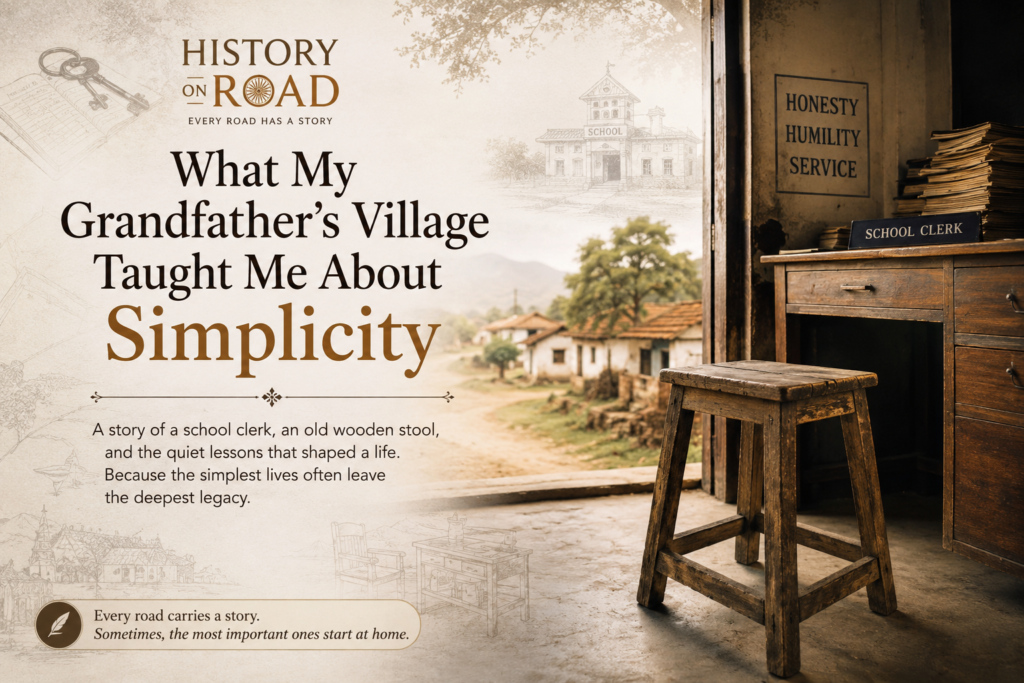
There’s an old wooden stool that still sits in the corner of my grandfather’s house. It has no cushion, no polish, nothing to make it special to anyone walking past. But if you sat on it as a child, you’d know it was where the most important lessons of your life were quietly handed to you — not in speeches, but in silence.
My grandfather was a clerk in a school. Not a headmaster, not a trustee, not a name anyone outside the village would recognize. Just a clerk — the man who kept the registers, filed the records, and showed up early enough to unlock the gates before anyone else arrived. It was, by every worldly measure, an ordinary job. And yet I have never met a man who carried it with as much dignity as he did.
The Man Who Never Needed to Prove Anything
I’ve met people since who have more money, more titles, more admiration from strangers. I have not met anyone as honest, as humble, or as simple as him.
He never raised his voice. He never spoke about people behind their backs. He never asked for more than what was owed to him — not a rupee, not a favor, not a shortcut. In a world that often rewards the loudest voice in the room, he made his peace being the quietest one, and somehow, that quiet carried more weight than anything shouted around it.
I remember watching him deal with people who came to the school with problems — a parent worried about fees, a teacher confused about a transfer order, a former student who just wanted to say hello twenty years later. He listened to all of them the same way: fully, patiently, without making anyone feel small for needing help. He didn’t have power in any official sense. But everyone who left his desk left a little lighter than when they arrived.
Simplicity Was Never an Accident
It would be easy to romanticize this — to say he was simple because he didn’t know any better, because the village never showed him another way to live. But that isn’t true. He knew exactly what the world outside offered. He chose this anyway.
His simplicity wasn’t the absence of ambition. It was a decision, made and remade every single day, to value character over comfort. To believe that a good name, quietly earned, outlasts a good bank balance loudly spent. He didn’t wear this belief like a badge. He just lived it, the way some people breathe without thinking about it.
That’s the part I didn’t understand as a child and can’t stop thinking about now. Being humble takes far more strength than being important. It’s easy to be modest when no one’s watching. It’s much harder to stay that way when you finally have the chance to be anything else — and he had that chance, many times over, and every time, he chose to remain exactly who he was.
What the Village Really Taught Me
I used to think the biggest lesson from my grandfather’s village was about slowness — about a simpler time before phones and deadlines swallowed our attention. And maybe there’s some truth in that. But the real lesson wasn’t about the pace of life. It was about the size of a life well-lived.
He didn’t need a large life to live a full one. A steady job, a home he built with his own hands, neighbors who trusted him, and a family who never once doubted his word — that was enough. Not because he lacked more, but because he understood something most of us spend our whole lives trying to learn: that dignity doesn’t need an audience.
Carrying It Forward
I don’t work in a village school. I don’t keep records by hand or greet the same faces every morning for forty years. My life looks nothing like his. But every time I’m tempted to cut a corner, exaggerate a little, or take credit that isn’t mine, I think of that wooden stool in the corner of his house, and the man who sat beside it — never impressive to strangers, unforgettable to everyone who actually knew him.
Some people build monuments. My grandfather built a reputation, one honest day at a time, in a small office in a small school, in a village that most maps don’t bother to mark. It’s the quietest kind of legacy there is. It’s also, I’ve come to believe, the only kind that truly matters.
A HistoryOnRoad Perspective
We built HistoryOnRoad on the belief that every road carries a story and every destination holds a memory. But this story reminds us that some of the most important history isn’t found at a monument, a fort, or a temple we travel miles to visit — it’s found sitting quietly in a school clerk’s office, on an old wooden stool, in a village most maps don’t bother to mark.
A school register, a set of keys, a desk opened before sunrise every single day for decades — these aren’t the artifacts we usually go looking for. Yet they hold the same weight as any ancient ruin, because they carry the same thing every good story does: proof of a life lived with meaning. My grandfather never traveled far, never made headlines, never needed a plaque to be remembered. But the honesty, humility, and quiet dignity he practiced at that desk are exactly the kind of “hidden history” we chase across forts, roads, and cities — we just don’t always think to look for it at home first.
That’s the real lesson this story leaves us with: you don’t need a destination to find history worth telling. Sometimes it’s already sitting in your own family, waiting for someone to notice.
Every road carries a story. Sometimes, the most important ones start at home.