
Is Corruption the Biggest Threat to India’s Future?
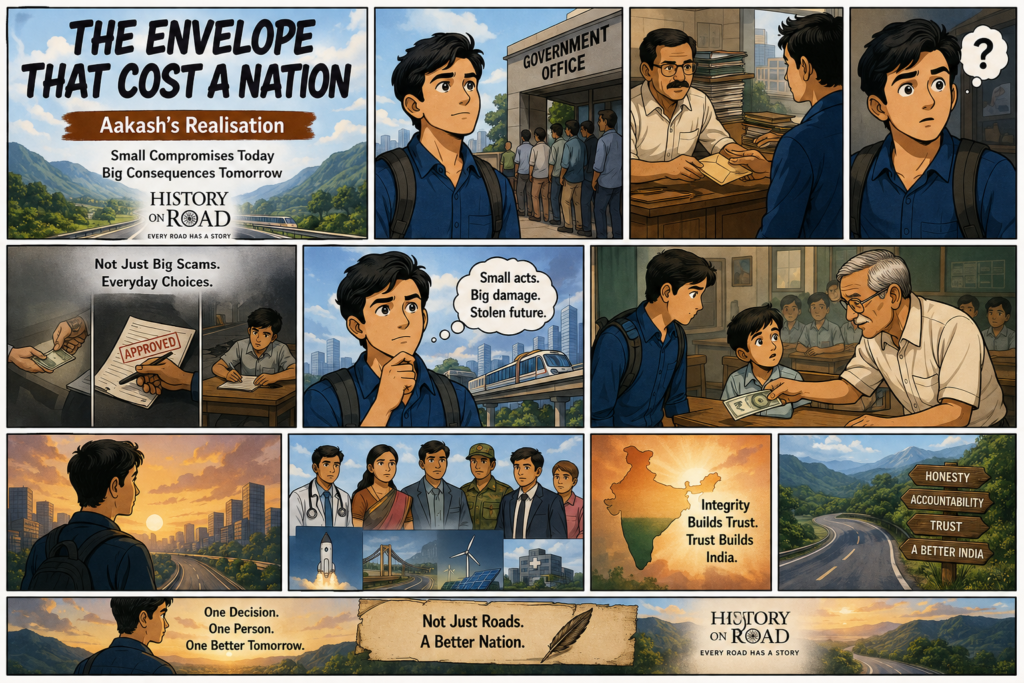
The first time Aakash Pawar saw corruption, it wasn’t in a courtroom or on a television debate.
It was inside a small brown envelope.
He was twenty-four, a software engineer from Pune, returning home after a week-long trek through the Sahyadris. The roads were crowded, the monsoon had painted the hills emerald green, and everywhere people spoke proudly about India’s future—new expressways, AI startups, electric vehicles, record-breaking digital payments, and dreams of becoming a developed nation.
For someone like Aakash, it felt like history was unfolding in real time.
Until he reached a government office.
His father had been trying to get a simple land record updated for months. Every document was correct. Every signature was in place. Every visit ended with the same sentence.
“Come next week.”
One afternoon, an elderly man waiting beside them leaned closer.
“If you want the work done today… put ₹2,000 inside an envelope.”
The file moved in less than ten minutes.
Aakash stood frozen.
Not because the amount was large.
Because everyone behaved as though it was completely normal.
The Most Dangerous Habit
That evening he couldn’t stop thinking about it.
India often speaks about corruption as if it belongs only to giant scams worth thousands of crores.
But what if the country’s biggest problem wasn’t spectacular corruption?
What if it was ordinary corruption?
The kind nobody reports because everyone expects it.
The extra cash slipped across a counter.
The fake bill approved because “everyone does it.”
The contractor who uses cheaper cement.
The official who delays paperwork until someone “understands the system.”
The student who cheats because marks matter more than honesty.
Tiny compromises.
Repeated millions of times.
Together they become something enormous.
A City Racing Forward
Pune had changed dramatically over the last decade.
Metro lines stretched across the skyline.
Glass office towers replaced old factories.
Technology parks attracted talent from every corner of the country.
Artificial intelligence, automation, clean energy, semiconductor manufacturing—India was building an economy that looked increasingly prepared for the future.
Yet every day Aakash noticed another contradiction.
Beautiful roads that developed potholes within months.
Public projects delayed despite generous budgets.
Footpaths built one week and dug up the next.
Government schools waiting for repairs while funds disappeared somewhere along the chain.
People blamed politicians.
Politicians blamed bureaucracy.
Officials blamed procedures.
Eventually everyone blamed someone else.
Meanwhile, ordinary citizens simply learned to live with lower expectations.
The Price Nobody Calculates
Corruption doesn’t only steal money.
It steals trust.
When people stop believing institutions are fair, they stop believing rules matter.
Businesses hesitate to invest.
Young professionals begin looking abroad.
Talented officers become frustrated.
Honest contractors lose projects.
Citizens stop asking difficult questions because they assume nothing will change.
The loss cannot be measured on a balance sheet.
It slowly weakens the invisible foundation every successful nation depends upon.
A Lesson From an Unexpected Place
Weeks later, Aakash visited a government school in a small village while volunteering with friends.
The building wasn’t impressive.
Its walls carried faded paint.
The playground had more dust than grass.
Inside one classroom sat an elderly headmaster quietly checking attendance registers.
One child accidentally dropped ₹500 near the teacher’s desk.
The headmaster noticed it immediately.
He picked it up and walked across every classroom until he found the student who had lost it.
Nobody applauded.
Nobody recorded a video.
Nobody posted it online.
It was simply the right thing to do.
On the drive back to Pune, Aakash realised something.
Integrity survives the same way corruption spreads.
One decision at a time.
One person at a time.
One generation teaching the next what honesty looks like.
The India Worth Building
India’s greatest strength has never been only its economy.
It has been its people.
Scientists launching missions to the Moon.
Doctors serving remote villages.
Teachers changing lives with limited resources.
Entrepreneurs solving impossible problems.
Soldiers guarding borders through impossible weather.
Millions of honest citizens doing invisible work every single day.
Perhaps corruption isn’t India’s destiny.
Perhaps it is simply the longest habit we have yet to break.
If India hopes to become a truly developed nation, skyscrapers alone won’t get us there.
Expressways won’t.
Artificial intelligence won’t.
Economic growth won’t.
Character must grow alongside infrastructure.
Otherwise, we’ll keep constructing impressive cities on foundations that quietly crumble beneath them.
A HistoryOnRoad Perspective
At HistoryOnRoad, we often travel across ancient forts, forgotten temples, abandoned settlements, and centuries-old roads searching for stories that shaped civilizations.
One lesson appears again and again throughout history: kingdoms rarely collapse because they run out of wealth. They decline when integrity slowly disappears from within. The strongest walls cannot protect a nation whose foundations are weakened by dishonesty.
Aakash Pawar’s story is fictional, but its question is very real. Every road India builds, every bridge it inaugurates, and every milestone it celebrates ultimately depends on the values of the people who build and protect them. History reminds us that progress measured only in concrete and steel is incomplete without ethics, accountability, and public trust.
Every road carries a story. The roads that endure the longest are built not only with stone and asphalt, but with honesty.