

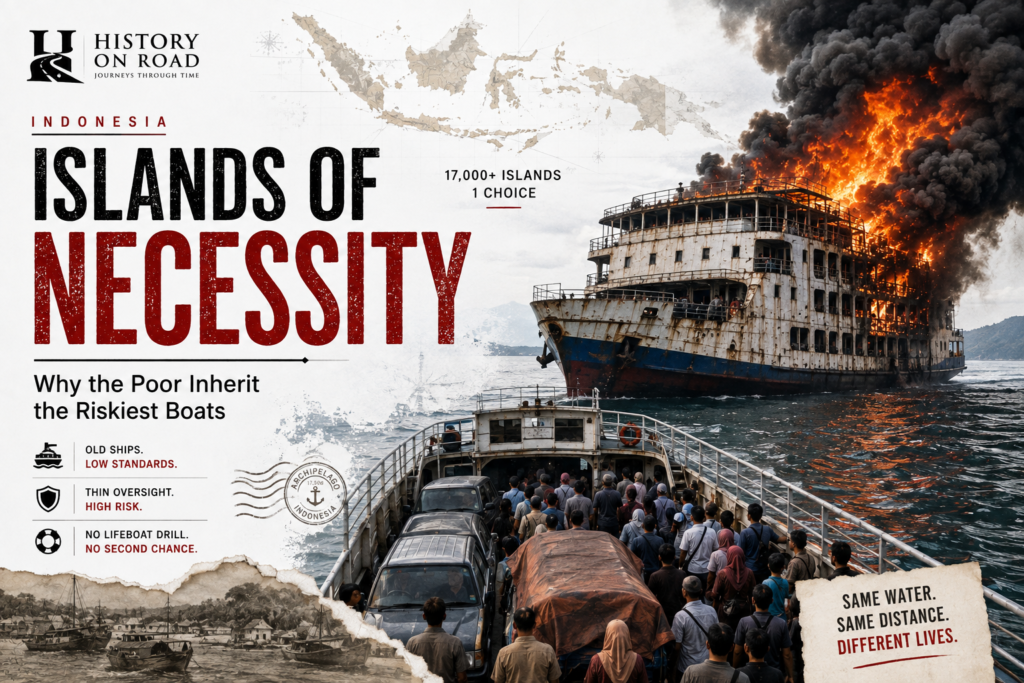
There is a version of Indonesia you can see from a cruise ship, and a version you can only see from the deck of a ferry that should have been retired years ago.
Both versions cross the same water. Only one of them gets a lifeboat drill.
I keep coming back to this thought after reading about another ferry fire in the waters off Madura — men, women, and children choosing between flame and open sea, a company that had lived through nearly this exact tragedy once before, and a rescue effort slowed by the simple, brutal fact that the nearest ship carrying help couldn’t get close enough. It’s tempting to file this under “accident” and move on. But an accident implies something unpredictable. This wasn’t that. This was inheritance.
Geography as Destiny
Indonesia is not a country so much as a constellation — more than seventeen thousand islands, held together by nothing but water and the vessels willing to cross it. For a wealthy traveler, that’s poetry: island-hopping, turquoise straits, the romance of archipelagic life. For millions of ordinary Indonesians, it’s logistics. It’s how you get to work, to a wedding, to a hospital, to a job on another island because there’s none where you were born.
When geography demands that much movement from a population, transportation stops being a choice and becomes a tax — paid disproportionately by whoever has the least room to negotiate the terms. The wealthy fly. Everyone else finds a berth on whatever ferry is cheapest, oldest, and next to leave port. That’s not a metaphor. The ship at the center of the recent tragedy was built in Japan in 1992, sailed decades on a domestic Japanese route, and only came to Indonesia in 2015 — a hand-me-down vessel doing frontline work in one of the world’s most demanding maritime environments.
Old ships aren’t inherently dangerous. Old ships that have quietly slipped through decades of underfunded inspection regimes are a different matter entirely.
The Economics of Looking Away
Here’s the uncomfortable arithmetic: proper fire suppression systems, vehicle-deck sensors, updated wiring, and regular structural refits cost money. Enforcing those standards costs money too — inspectors, oversight bodies, real consequences for operators who cut corners. And the people footing an inter-island ferry ticket are, almost by definition, the people least able to absorb that cost being passed on to them.
So a quiet trade happens, one that nobody signs off on explicitly but that everybody understands. Ticket prices stay low. Vessels stay in service past the point where they’d be scrapped elsewhere. Oversight stays thin. And the risk — the actual, physical risk of fire, of capsizing, of a rescue that arrives too late — gets absorbed by the passengers, who had the least say in any of it.
This isn’t unique to Indonesia. It’s the same pattern that shows up in overcrowded buses in South Asia, in unsafe fishing boats off West Africa, in the informal transit systems that spring up wherever formal infrastructure has failed to meet demand. Poverty doesn’t just mean less. It means less safety, quietly built into the price of getting from one place to another.
What History Keeps Teaching, and We Keep Unlearning
Travel writers love to talk about the romance of the sea route — the idea that a ferry crossing is somehow more honest, more human, than a flight. There’s truth in that. You feel the distance. You see the horizon change. You share deck space with strangers whose lives briefly run parallel to yours.
But romanticizing the ferry only works if you’re not the one whose safety was optional. The archipelago has taught this lesson before — a sister ship from the very same operator caught fire on almost the same route nine years earlier, with an almost identical death toll. History rarely repeats by accident. It repeats when the underlying conditions never actually changed — the same aging fleet, the same thin oversight, the same population with no better option, boarding again because the alternative is not boarding at all.
The Real Question
The question worth sitting with isn’t “how did this fire start.” Investigators will eventually answer that. The harder question is why a country whose entire identity is built on water travel still asks its poorest citizens to gamble with the vessels doing that travel — and why the rest of us only notice when the gamble is lost publicly enough to make headlines.
Every ferry crossing is a small act of faith. It shouldn’t require faith at all. It should require nothing more than a boat that was built, maintained, and inspected as if the people on board mattered exactly as much as the cargo in its hold.
— HistoryOnRoad