

A story of two Indias, one heart, and the responsibility of every citizen.
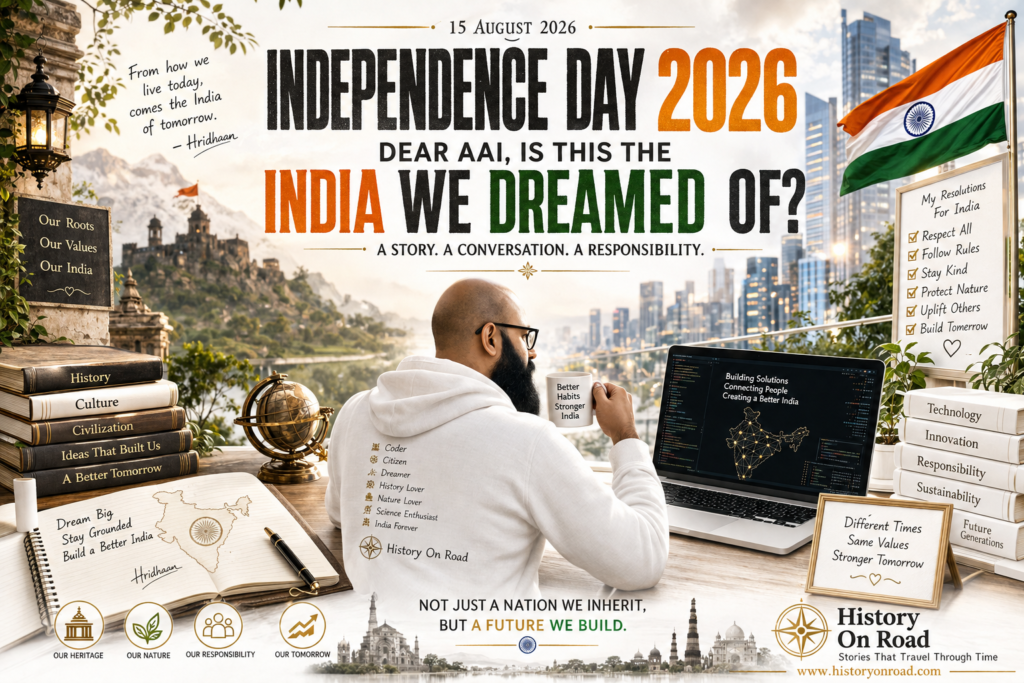
It was still dark when I reached our village.
The clock on the dashboard read 4:42 AM.
A soft drizzle had washed the narrow roads during the night. The smell of wet soil entered through the slightly open window, carrying memories I didn’t know were still alive inside me.
I stopped the car near the old banyan tree.
The village looked exactly as I remembered.
No giant billboards.
No endless traffic.
No horns fighting each other.
Only the sound of crickets, distant temple bells, and a rooster proudly announcing the arrival of another morning.
For the first time in weeks…
…my phone had no network.
Strangely, it felt like freedom.
“Hridhaan आला का?“
Before I could knock, Aai had already opened the wooden door.
“Mothers don’t need notifications,” Baba often says.
“They know.”
Aai hugged me as if I had returned after years instead of two months.
“You’ve become thinner.”
Every Indian mother believes this, regardless of reality.
I laughed.
“No Aai… Pune has just made me lighter.”
She smiled, but her eyes understood something my words didn’t.
I work in Pune.
Like thousands of young professionals, I write software for clients living thousands of kilometers away.
Ironically…
I spend every day connecting people across continents while struggling to spend enough time with the people who matter the most.
The company calls it Work From Home.
Sometimes I wonder…
Which home?
The apartment where I sleep?
Or the village where my heart still wakes up every morning?
By sunrise the village school had begun preparing for Independence Day.
Children ran across the ground carrying tiny Tricolours almost bigger than themselves.
One little boy kept saluting everyone.
Nobody corrected him.
Everyone smiled.
Perhaps patriotism looks best when it is innocent.
Baba walked beside me towards the fields.
The rain had painted everything green.
“So…” he asked.
“How is city life?”
I looked at him.
How could I explain Pune in one sentence?
How could I describe a place where dreams and exhaustion live in the same apartment?
“It’s beautiful, Baba.”
“And difficult.”
He nodded.
He didn’t ask anything more.
Some fathers know silence is a better listener than questions.
The city has given me many things.
Knowledge.
Opportunity.
Friends from every corner of India.
Exposure to different cultures.
Access to technology that our grandparents could never have imagined.
It taught me to dream bigger.
To compete globally.
To appreciate diversity.
But the city has also taken something.
Time.
Patience.
Conversations.
Even festivals sometimes arrive like calendar notifications.
Sometimes I leave my office after sunset without realizing birds had already returned home hours ago.
Back in the village…
Time still walks.
It doesn’t run.
The tea stall opens before sunrise not because customers demand it…
…but because conversations do.
People still ask about each other’s families.
They remember birthdays without Facebook.
They know who needs help before WhatsApp messages begin circulating.
Life feels slower.
Yet somehow…
People seem less hurried.
That afternoon Aai was preparing Puran Poli.
The entire house smelled like childhood.
I sat beside her.
She asked the simplest question.
“Hridhaan…”
“Are people happy in the city?”
I wanted to answer immediately.
Instead…
I kept watching the flour in her hands.
Because the truth wasn’t simple.
Yes.
Many people are successful.
Many have built extraordinary careers.
Many have achieved things previous generations never imagined.
India’s young minds are designing satellites…
building startups…
discovering medicines…
creating global businesses…
leading research laboratories…
representing the country in science, sports, arts and technology.
There has never been a better time to dream.
Yet…
There has never been a harder time to slow down.
Sometimes entire apartment buildings celebrate festivals together.
Sometimes neighbors don’t know each other’s names for years.
Sometimes we donate online with one click.
Sometimes we ignore the hungry man standing outside the same restaurant.
We are becoming incredibly connected.
Yet strangely…
Many people feel increasingly alone.
After lunch Baba switched on the television.
Every news channel looked like a battlefield.
Everyone was shouting.
Nobody seemed interested in listening.
I quietly switched it off.
Baba looked at me and smiled.
“When voices become louder than thoughts…”
“…truth quietly leaves the room.”
His words stayed with me all day.
I don’t know much about politics.
Perhaps I never will.
But I know something about people.
History has taught us that civilizations rarely fall because people disagree.
They fall when people stop respecting each other despite disagreement.
India has survived thousands of years not because everyone thought alike.
India survived because it learned to live with differences.
That has always been our greatest strength.
I hope it always remains so.
In the evening I walked towards the river.
Plastic bottles floated beside lotus flowers.
Somebody had thrown garbage near the temple steps.
I felt embarrassed.
Not because foreigners might see it.
Because we had done it ourselves.
We proudly speak about loving our motherland.
Yet sometimes we forget that rivers are also mothers.
Forests are also mothers.
The soil feeding us is also our mother.
Patriotism cannot end at the border.
It must begin in our own street.
While returning home I saw a little girl carefully picking plastic wrappers from the playground.
Nobody had asked her.
Nobody was recording a video.
Nobody would post her photograph online.
She simply wanted the playground to look beautiful before tomorrow’s flag hoisting.
That child taught me more about citizenship than countless speeches.
Sometimes we expect governments to solve problems that begin inside our own habits.
We demand cleaner cities…
while throwing garbage through moving vehicle windows.
We expect honest leaders…
while celebrating dishonest shortcuts.
We complain about traffic…
while refusing to follow traffic rules.
We criticize corruption…
yet occasionally search for easier ways around regulations.
A nation is not transformed only inside Parliament.
It is transformed inside ordinary homes.
Aai placed dinner before us.
The power suddenly went out.
The entire village disappeared into darkness.
Except…
It didn’t.
The stars arrived.
Thousands of them.
I had forgotten how many stars existed.
In Pune…
Buildings often replace the sky.
That night…
The sky returned.
“Baba…”
I asked.
“Was India better before?”
He laughed softly.
“No.”
“Every generation thinks that.”
“We had our own struggles.”
“You have yours.”
“The question isn’t whether India was better.”
“The question is…”
“Will you leave it better than you found it?”
I don’t think any university could have taught me a greater lesson.
The next morning was 15 August 2026.
The school ground was overflowing.
Children stood proudly wearing white uniforms.
Some sang perfectly.
Some forgot the lyrics halfway through.
One little boy proudly waved the Tricolour upside down until his teacher gently corrected him.
Nobody laughed.
Everyone clapped.
Because love for a nation begins with learning.
Not perfection.
As the National Flag rose into the sky…
I didn’t think about military power.
I didn’t think about GDP.
I didn’t think about stock markets.
I thought about responsibility.
Freedom had been gifted to us by people who sacrificed everything.
Responsibility is the only gift we can return.
When the ceremony ended…
An old farmer quietly folded the flag with extraordinary care.
A group of young volunteers collected every piece of litter from the ground before leaving.
Children helped them without being asked.
Someone offered drinking water to complete strangers.
Nobody knew their names.
Yet for a brief moment…
India looked exactly as it should.
On my drive back to Pune…
Traffic slowly increased.
Billboards reappeared.
Phone notifications returned.
Deadlines waited.
Meetings resumed.
Life accelerated once again.
But something inside me had changed.
The village hadn’t made me reject the city.
The city hadn’t made me forget the village.
Both had taught me something valuable.
One showed me how to build the future.
The other reminded me why it should be built.
Dear Aai…
If you ever ask me again whether people in cities are happy…
I will say…
Some are.
Some are not.
Just like villages.
Happiness was never hiding inside skyscrapers or farms.
It has always lived inside human values.
Inside honesty.
Inside compassion.
Inside respect.
Inside responsibility.
Inside gratitude.
Inside the courage to do the right thing when nobody is watching.
And perhaps…
That is the India our freedom fighters hoped would exist.
Not merely an independent India.
But an India where freedom would walk hand in hand with discipline.
Where technology would strengthen humanity.
Where education would create wisdom instead of arrogance.
Where differences would create dialogue instead of hatred.
Where development would protect nature rather than destroy it.
Where success would never come at the cost of kindness.
Where every citizen would quietly say—
“I may not change the whole country today…
…but I refuse to make it worse.”
History On Road Perspective
History remembers emperors, kingdoms, revolutions, and great inventions. Yet if we look closely, every great civilization was sustained not only by extraordinary leaders but by ordinary people who chose honesty over convenience, duty over indifference, and unity over division.
India’s future will not be written only by artificial intelligence, economic growth, elections, or global rankings. It will also be written by the child who plants a tree, the citizen who follows traffic rules, the traveler who respects heritage, the teacher who inspires curiosity, the engineer who builds responsibly, the farmer who nurtures the land, and the family that teaches its children that being a good human being is the highest form of patriotism.
As I folded the Tricolour before leaving my village, I realized something simple yet profound.
The flag does not ask us to be perfect.
It asks us to be worthy.
And perhaps that is the true meaning of Independence—not only the freedom our ancestors won for us, but the character we choose to build for the generations yet to come.
Jai Hind.

Borrowed Glory in Kalikapur: The Story of a Village Election