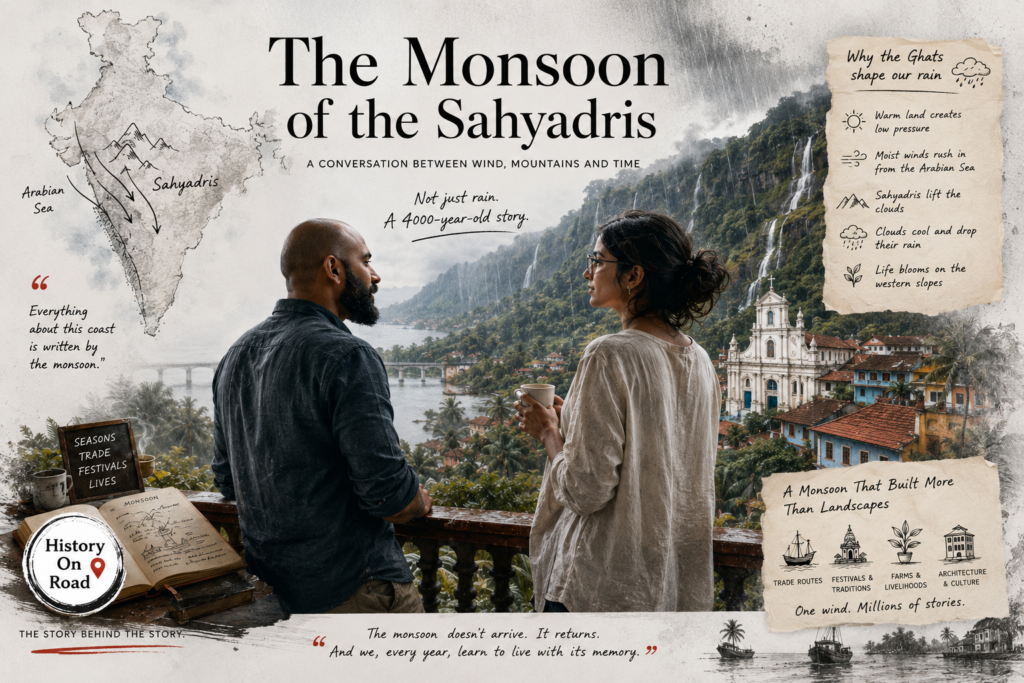

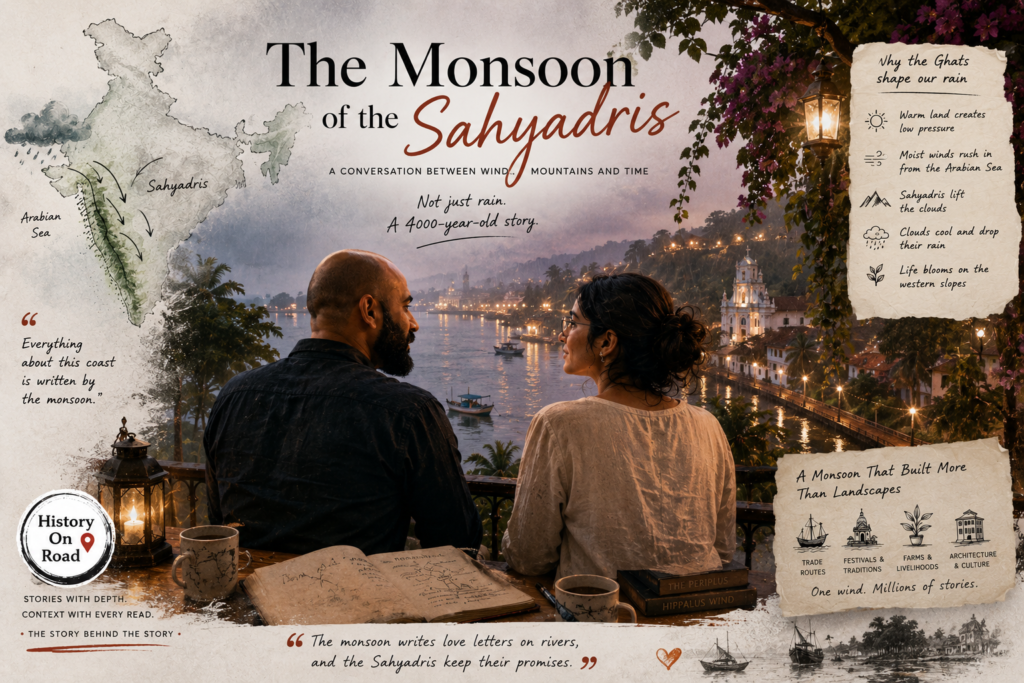
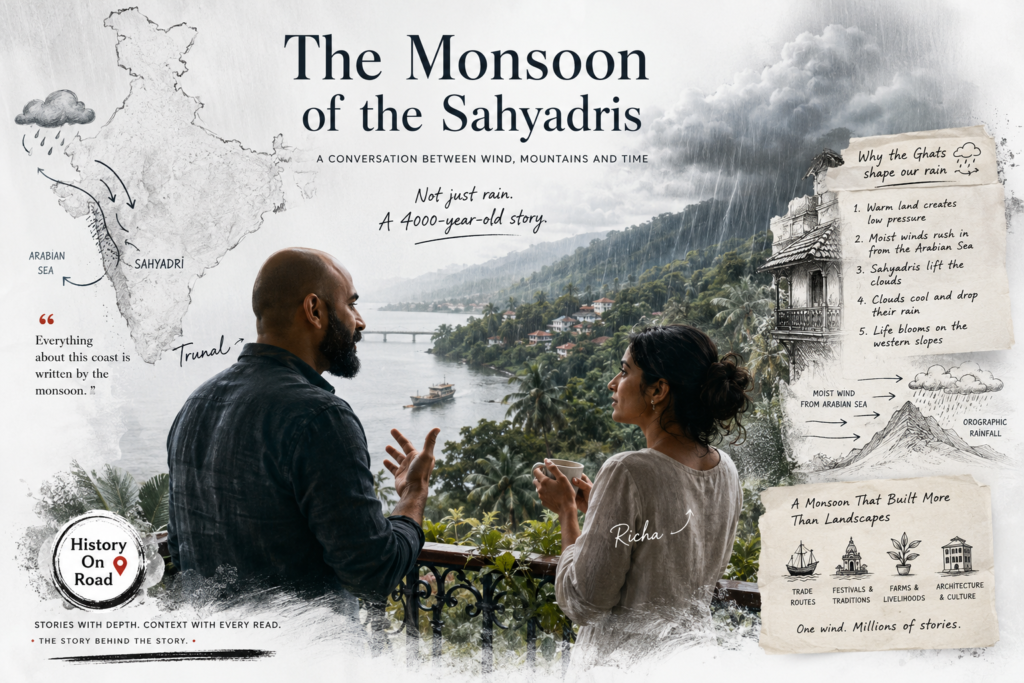
The rain had been falling over Panjim since four in the morning, steady and unhurried, the kind that seemed to have made peace with the roofs and the river and had no intention of leaving soon. Richa stood at the balcony of their old Fontainhas house, watching the Mandovi swell against its banks, a cup of ginger tea cooling in her hands. Behind her, Trunal was hunched over his laptop, half-dressed for a field visit he would probably cancel, scrolling through satellite images of cloud bands stretched like grey ribbons across the Arabian Sea.
“You’ve been staring at that river for twenty minutes,” he said, without looking up.
“I’ve never gotten used to it,” Richa said. “Even after three monsoons here, it still feels like the sky is doing something enormous and secret.”
“It is,” Trunal said, finally shutting his laptop. “Enormous, yes. Secret — not really. We’ve spent about four thousand years trying to understand it, and we’ve only mostly succeeded.”
Richa turned around, amused. “Four thousand years?”
“At least.” He came and stood beside her, resting his elbows on the wet railing. “The word itself comes from mausam, Arabic for season. Arab traders sailing to the Malabar coast used it to describe the shifting winds — blow one way for six months, reverse and blow the other way for the next six. They didn’t understand the physics, but they understood the pattern well enough to time entire fortunes around it.”
“Fortunes?”
“Spice fortunes. Pepper, cardamom, cinnamon — all of it moved on monsoon winds. Ships from Arabia and later Europe would wait months at port because sailing against the monsoon was nearly suicidal. The word for season became the word for the wind, and eventually the word for the rain the wind brought.”
Richa smiled. “So even the name is a piece of trade history.”
“Everything about this coast is.” Trunal gestured out toward the hills faintly visible through the haze, the long green spine of the Sahyadris rising behind the city. “That range you’re looking at — the Western Ghats — is one of the main reasons Goa exists the way it does. The reason there’s a coast at all with this kind of green, this kind of water.”
She followed his gaze. The hills looked soft-edged in the rain, layered in mist. “Explain it properly. Not the tourist version.”
He grinned — she always asked for this, ever since they’d met three years ago, when she’d come down from Pune for a two-week holiday and never quite finished leaving. He was doing his doctoral work with the meteorological department then, chasing monsoon models with the same seriousness other people chased money. Now she still asked him things not because she couldn’t read them herself, but because she liked hearing him think aloud.
“Alright,” he said. “Picture the subcontinent in April. Land heats up faster than the ocean — it always does, because water has a higher heat capacity, it takes longer to warm and longer to cool. So by early summer the interior of India, especially over places like Rajasthan and the Deccan plateau, becomes a low-pressure zone. Hot air rises, leaves a vacuum near the surface.”
“And the ocean is cooler, so it’s high pressure.”
“Exactly. Air wants to move from high pressure to low pressure, so moist air from the Arabian Sea and the Indian Ocean starts rushing inland to fill that gap. That’s your southwest monsoon. It usually hits the Kerala coast around the first of June, then marches north along the Western Ghats.”
“And the Ghats stop it?”
“Not stop — they lift it. That’s the important part.” He pulled his hand up through the air like a slope. “The Sahyadris run almost parallel to the coast, north to south, and the moist wind coming off the sea hits that wall and has nowhere to go but up. As it rises it cools, and cool air can’t hold as much water vapor, so it dumps it — right there on the western slopes. That’s called orographic rainfall. It’s why a place like Amboli or Mahabaleshwar, just up in the hills, gets seven, eight meters of rain a year, while Pune, barely a hundred kilometers to the east on the other side of the ridge, might get a fraction of that. The Ghats create their own rain shadow.”
Richa looked at the hills with new respect. “So the mountains are basically wringing the clouds out like a towel before they can go further.”
“That’s a better description than half my professors ever gave,” Trunal laughed. “Yes. The eastern Deccan lives in the shadow of what the western coast receives. It’s one of the sharpest rainfall gradients anywhere in the world, over such a short distance.”
She sipped her tea, quiet for a moment, watching a fisherman push his boat out past the jetty despite the rain — an old man, unhurried, as if this were simply Tuesday. “Did people always know this? About the wind reversing, the mountains, all of it?”
“They knew the pattern long before they knew the physics,” Trunal said. “Sailors read the monsoon the way you’d read a familiar face. There’s a Roman-Egyptian sailor, or possibly a Greek merchant — we’re honestly not sure who wrote it — who left behind a first-century trade guide called the Periplus of the Erythraean Sea. It describes using the Hippalus wind, named after a navigator, to sail directly across the open ocean from the Red Sea to India instead of hugging the coast the whole way. That’s roughly when people in the Mediterranean world started deliberately using the monsoon rather than just surviving it.”
“And in India itself?”
“Sanskrit texts talk about varsha — the rain season — as one of six seasons in the traditional calendar. Agricultural life here was built entirely around anticipating it. Kharif crops — rice, millet, cotton — are sown with the first rains and harvested after. There are old temple carvings and inscriptions recording drought years, famine years, because the whole revenue system of kingdoms depended on the monsoon behaving itself.”
“That’s a heavy thing to build an economy on,” Richa said. “A single wind.”
“It still mostly is, honestly. Even today something like sixty percent of India’s farmland depends on rain rather than irrigation. When the British were running the country, a failed monsoon wasn’t an inconvenience — it was catastrophe. The famine of 1876 to ’78 killed millions across the Deccan and south India after the rains failed two years running. That’s actually why the India Meteorological Department was founded in 1875 — well, just before that famine, but it was the failures right after that made forecasting a state priority. They wanted to see disaster coming.”
“Did they manage to?”
“Slowly. There was an English astronomer, Edmond Halley — yes, the comet one — who as early as 1686 wrote a paper proposing that monsoons were driven by differential heating of land and sea. He got the basic mechanism roughly right, centuries before anyone had satellites or upper-air data. But predicting the timing and strength of a given year’s monsoon took much longer. A British mathematician named Gilbert Walker, who ran the Indian Meteorological Department in the early twentieth century, discovered what’s called the Southern Oscillation — this seesaw of pressure between the eastern and western Pacific that we now call El Niño and La Niña. He found it because he was desperately trying to find something, anything, that would let him predict an Indian monsoon in advance.”
“So a search for rain in Bombay ended up explaining ocean currents near South America.”
“That’s science for you,” Trunal said. “You go looking for one thing and stumble onto the shape of the whole planet’s weather.”
Richa was quiet, watching the rain streak the banana leaves in the courtyard below, thick and shining. “It’s strange to think Goa’s rain and Peru’s ocean are talking to each other.”
“They are, in a way. When there’s an El Niño year — the central Pacific warming — Indian monsoons tend to be weaker, drier. A La Niña year usually means a stronger, wetter monsoon. It’s all one connected breathing system.”
She turned to face him properly now. “Tell me about here, though. Not the physics. What did the monsoon actually do to people, on this coast, over centuries?”
Trunal softened, the lecture in him easing into something more personal. “Everything, really. Fishing stops almost entirely from June to July — there’s a formal ban now, but even before regulation, boats simply didn’t go out in seas that violent. So the whole coastal economy shifts for two months. People who fish all year fall back on farming, on stored grain, on selling whatever they’d dried and salted in the calmer months. The old Goan house you’re standing in — the sloped roofs, the deep verandas, the laterite walls — none of that is decorative. Laterite breathes, it doesn’t trap damp the way concrete does. Sloped roofs shed six, seven meters of rainfall a year without pooling. People built their whole architecture as a negotiation with this season.”
“And the festivals?”
“Many of them are timed to it. Sao Joao, in June, is essentially a monsoon festival — people jumping into wells is a celebration that the water table’s finally full again after the dry months. Ganesh Chaturthi comes right in the thick of the season, right when the rice in the fields around the village temples is at its greenest. It isn’t a coincidence. The whole ritual calendar here was written by farmers reading the sky.”
Richa looked out again at the green climbing the hills, the river running fat and brown, the fisherman now a small dot near the far bank. “It doesn’t feel like weather anymore, listening to you. It feels like — I don’t know. A relationship. Something the land and the people have been having a very long, very old conversation about.”
“That’s exactly what it is,” Trunal said. “The Ghats are one of the oldest mountain systems on earth, older than the Himalayas by a wide margin. They’ve been standing in the way of this wind and shaping it for tens of millions of years. Every ecosystem on that slope — the frogs that only breed in monsoon puddles, the endemic orchids that flower nowhere else on the planet, the spice trees the Arabs and later the Portuguese came chasing — all of it exists because of this one seasonal argument between the ocean and the mountains.”
The rain outside had softened into a fine mist, the kind Goans called a passing shower rather than real rain, though Richa suspected it would return by evening, as it always did in July.
“I think,” she said, setting down her empty cup, “I finally understand why you never get tired of this job.”
Trunal smiled and put an arm around her shoulder, both of them watching the hills disappear and reappear through the moving cloud. “It’s not really a job,” he said. “It’s just paying attention to the oldest story this coast has ever told.”
This is, in many ways, the story historyonroad.com exists to tell. We treat every road, every coastline, every ordinary rainy morning as a route into something older than it looks — the trade winds that built ports, the famines that built institutions, the festivals that grew out of a well finally filling with water. Richa and Trunal’s conversation on that balcony in Fontainhas is a small example of what we mean by history on the road: not facts filed away in a textbook, but the living, breathing memory carried in a monsoon, a mountain range, a family recipe, or a roadside shrine. Every place has a season behind it and a science behind that season — our aim is simply to keep noticing, and keep asking.