

History On Road | Social
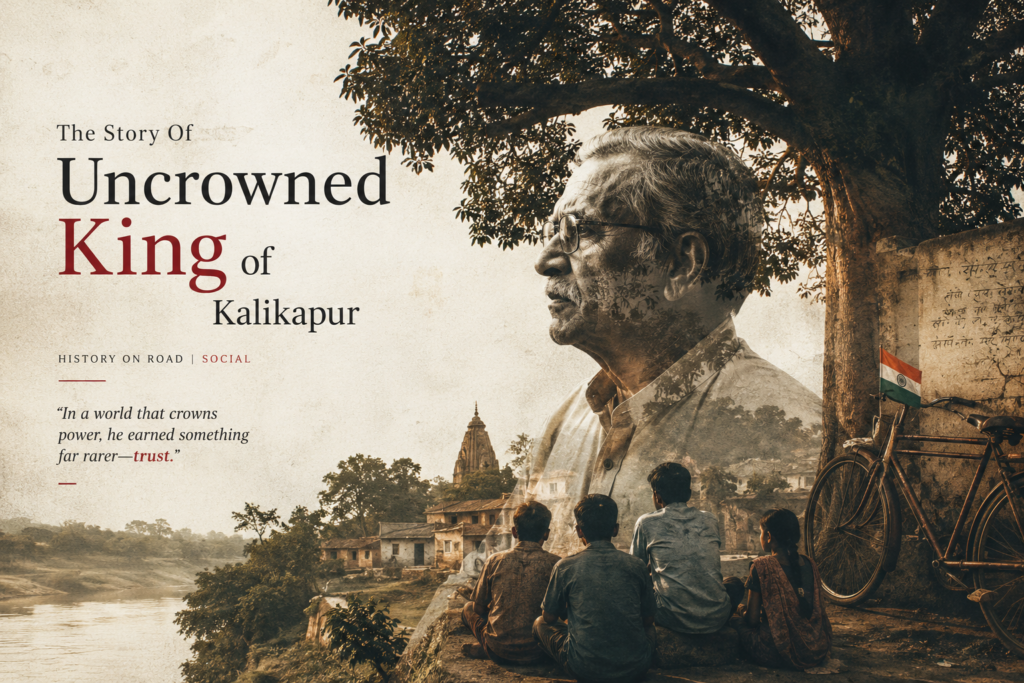
The Last Honest Man of Kalikapur
Kalikapur was the kind of village that appeared on the state map as a small dot and disappeared from most people’s memory the moment they left it. Sugarcane fields on one side, a slow brown river on the other, and in the middle, a peepal tree so old that three generations of children had carved their initials into its bark, one on top of another, until the names blurred together, like the village’s own history.
In Kalikapur, nobody called him by his full name. Old and young, rich and poor, the sarpanch and the sweeper — all of them called him Anna. Big brother. Elder. The word people use when respect has grown too large for a formal title.
Shivaji Anna had spent thirty-two years as a clerk in the taluka office, stamping papers for other men’s land deals, other men’s loans, other men’s disputes. He retired with a government pension of eleven thousand rupees a month, a cupboard full of certificates nobody had asked to see, and something far rarer than money — a reputation that had never once needed correcting. In a village where the sarpanch’s nephew had built a three-storey house from a “poultry business” that owned no chickens, Shivaji Anna still rode the same rusted bicycle to the market, still returned excess change to the vegetable seller, still refused the free sack of fertiliser the block officer offered him “for old time’s sake.” When there was a dispute between two families over a shared well, both sides sent for Anna before they sent for the panchayat, because his word settled arguments that lawyers couldn’t. When the temple needed a trustee nobody would question, they asked a man with almost nothing in his bank account to hold the keys to everything they had.
That was the whole of his fortune. Not land, not gold — the fact that an entire village trusted him with what they couldn’t trust each other with.
His three grandchildren, visiting for Independence Day, had grown up watching that trust get built, one small refusal at a time, without ever quite understanding what it had cost him to earn it.
The Historian Who Stopped Believing in History
Sagar arrived first, on the morning bus that groaned into Kalikapur’s dusty stand a full ninety minutes late. He taught history part-time in three different colleges across two districts because none of them would give him a full post — that had gone, six months earlier, to the education minister’s wife’s cousin, a man who, as far as Sagar could tell, had never read a book that wasn’t a syllabus.
He found his grandfather exactly where he always found him — sitting on the veranda, polishing a small brass box that held a folded, faded tricolour flag.
“Still keeping that old thing, Anna?” Sagar asked, dropping his bag.
“Still teaching that old subject?” Shivaji shot back, not looking up, a smile tugging at his mouth.
Sagar laughed despite himself and sat down on the step. “I don’t know why I still teach it, honestly. What’s the point of history if nobody in the present bothers learning from it? I spend my life explaining how empires fell because of greed and corruption, and I go home and watch the news, and it’s the same story with better wifi.”
“Maybe,” Shivaji said, “you’re teaching it to the wrong people. The ones who need the lesson most are never sitting in your classroom. They’re sitting in offices, making decisions about people they’ll never meet.”
The Artist Who Painted Walls Nobody Paid For
By afternoon, Kabir had arrived too, dust on his sandals and a rolled canvas under his arm — a half-finished mural he’d been commissioned to paint for the village school’s outer wall, for a fee that barely covered his train fare. He’d taken the work anyway, because the headmaster had asked with such quiet hope that refusing felt like a small crime.
He found Bhavana already there, having come the evening before, sitting under the peepal tree correcting a stack of exam papers with a red pen that was almost out of ink.
“You’re grading during a holiday?” Kabir asked, settling beside her.
“Someone has to,” she said, without looking up. “Half these children will drop out after tenth standard to work in the sugarcane fields, and their parents will tell me it’s because they need the money, and nobody — not me, not the collector, not the minister who inaugurated our ‘model school’ on television — will ever ask why a nine-year-old’s labour is worth more to this system than her education.”
Kabir uncapped a tin of blue paint he didn’t need to open yet, just to have something to do with his hands. “I painted a mural last year, in the city, on a government building wall — ‘Beti Bachao, Beti Padhao.’ Save the daughter, educate the daughter. Big, bright letters. Two weeks later I read that the same department’s officer was caught taking bribes for fake scholarship approvals meant for girls exactly like the ones I’d painted smiling on that wall. I stood there wondering if art means anything when the people who commission it don’t believe a word of what they’re asking you to paint.”
Bhavana finally looked up. “Do you know what my students copy the fastest? Not the lessons. The shortcuts. They watch adults take them every single day, and they learn, faster than any subject I teach, that honesty is optional and cleverness is currency. Then they come to this village, and they see Anna, and for one afternoon they’re confused, because here’s a man who never took a shortcut in his life and somehow he’s the one everyone still bows to.”
The Evening Before
That night, the four of them ate together on the veranda — bajra rotis, thin dal, and the kind of comfortable silence that only exists in a home where nobody has to perform for anyone.
It was Kabir who broke it, gently curious rather than mocking. “Anna, doesn’t it ever feel strange? You never became rich. You never became powerful. And yet in this village, when there’s a fight over land, over water, over anything — people walk past the sarpanch’s house and come straight to yours.”
Shivaji set down his roti and looked at all three of them in a way that made the question feel bigger than Kabir had meant it.
“Let me tell you something none of you know,” he said. “In 1987, a contractor offered me forty thousand rupees — more money than I made in two years — to approve a land file that would have taken a widow’s four acres and handed them to a man who’d already stolen half her husband’s inheritance while he was alive. Forty thousand rupees, and all I had to do was stamp one page and forget I’d read it.”
“What did you do?” Bhavana asked, though she already knew the shape of the answer.
“I rejected the file. Legally, cleanly, with every rule on my side. The contractor was furious. Word went around the taluka that I’d turned down a fortune for nothing. Some called me a coward for not taking the easy money. I went home that night and counted the money I didn’t have, and for one evening, even I wondered if I’d made a fool’s choice.”
He paused, turning the brass box over once in his hands.
“But three years later, that widow’s granddaughter became the first girl from Kalikapur to finish a college degree. She’s a schoolteacher in Pune today, like you, Bhavana. Nobody remembers the forty thousand rupees I refused. But when that widow died, her whole family walked to my door first, before the priest, before the panchayat, to ask me to light the final lamp — because in their eyes, I had guarded something more sacred than land. That is the only wealth I have ever truly kept, and the only wealth this village has ever truly trusted me with. Everything else — money, titles, the world’s good opinion — it slips through your hands the moment you die. Respect earned like that doesn’t.”
Independence Day
The morning of August 15th, 2026, Kalikapur woke to the usual sounds — the temple bell, a rooster that never learned to keep proper time, the crackle of the loudspeaker at the panchayat office testing itself before the flag hoisting.
The sarpanch gave a speech about development. A local MLA’s recorded message played over the loudspeaker, promising a bridge that had been promised for eleven years. Children in ironed white shirts stood in uneven rows, more interested in the sweets waiting at the end of the ceremony than the words being said above their heads. Halfway through, the sarpanch himself glanced toward Anna’s rooftop, the way people in Kalikapur always did on important mornings, as if the day wasn’t quite official until his flag went up too.
Shivaji did not attend the official function. He never did. Instead, at the exact moment the panchayat flag went up half a kilometre away, he climbed the narrow stairs to his own roof, flag in hand, three grandchildren following without needing to be asked.
“You could put it up down there,” Sagar said, nodding toward the ceremony below. “With everyone watching. They’d probably ask you to say a few words.”
“I don’t raise this flag to be watched,” Shivaji said. “I raise it because on this one morning, every year, I remind myself what it actually cost, and what I still owe it. That’s not a performance. That’s a debt.”
The flag went up slowly, catching the weak morning wind, and for a moment, all four of them simply watched it without speaking.
Then Bhavana said, quietly, “I think I finally understand what you’ve spent your whole life teaching us without ever calling it a lesson, Anna. Freedom was never the hard part. Seventy-nine years ago, people bled for a piece of paper that said we could govern ourselves. The hard part is what you did after — deciding, every single day since, what kind of person you’d actually be with it. You never became powerful. You became someone this entire village trusts more than anyone with power. I don’t think there’s a bigger achievement than that.”
Shivaji smiled, the quiet smile of a man who had never once performed his goodness for an audience and had, without ever intending to, become the whole village’s proof that it was still possible.
“They call me Anna,” he said softly, “not because I ever asked to be respected. Because I never once tried to be anything other than honest, and this village noticed, slowly, over forty years, that honesty like that doesn’t come around often. That’s not a title I earned in a day. It’s one I’m still earning, every single morning I raise this flag.”
Below them, the loudspeaker crackled into the national anthem, slightly out of tune, entirely sincere — the same imperfect, unstoppable sound that had risen over Kalikapur every August 15th for seventy-nine years, and would rise again the next, carried, in its own small way, by people who still remembered what an honest man looked like.

Borrowed Glory in Kalikapur: The Story of a Village Election