
A HistoryOnRoad Special Report
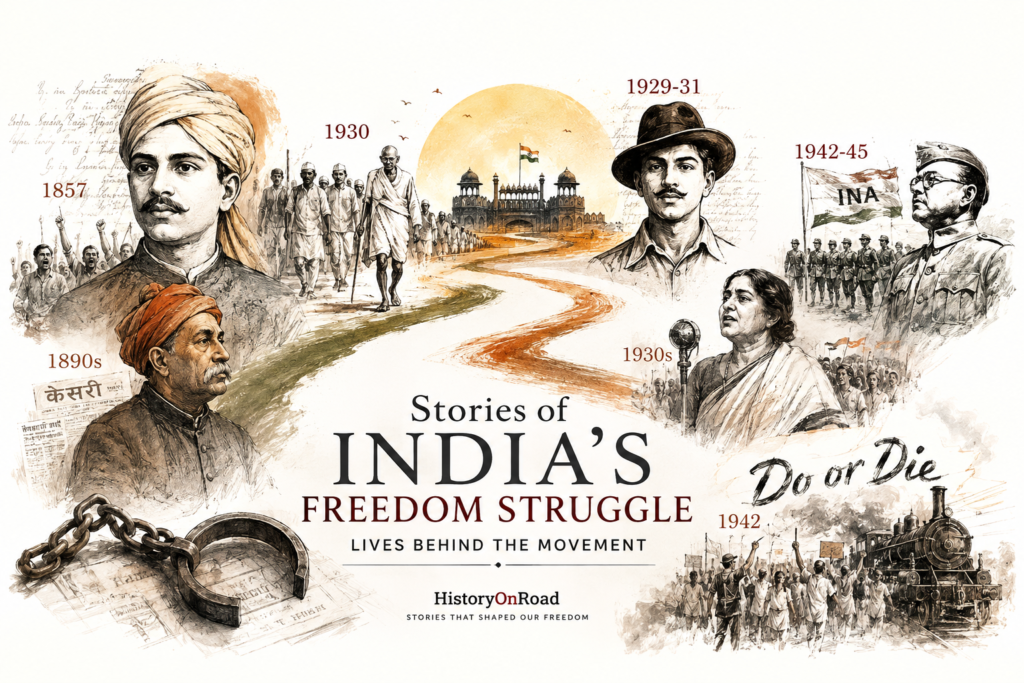
Nearly two centuries of resistance shaped modern India — not as a single uprising, but as a chain of movements, individuals, and moments spread across decades and regions. This report traces seven episodes from that long struggle: figures and events that, together, sketch how India moved from colonial rule to independence in 1947. Each entry draws on well-documented historical record, told here as a short narrative rather than a dry timeline.
1. The Spark at Barrackpore (1857)
In the cantonment town of Barrackpore, near Kolkata, a young sepoy named Mangal Pandey refused to use rifle cartridges he believed were greased with animal fat — a violation of his religious beliefs. On 29 March 1857, his defiance escalated into an armed confrontation with British officers. Pandey was court-martialled and executed within weeks.
His act alone did not cause the Revolt of 1857, but it became a rallying symbol. Within months, uprisings spread across northern and central India, drawing in soldiers, deposed rulers, and peasants alike. Historians estimate the rebellion involved tens of thousands of participants across present-day Uttar Pradesh, Bihar, and Madhya Pradesh before it was suppressed by 1858 — a turning point that ended East India Company rule and brought India directly under the British Crown.
2. “Swaraj Is My Birthright” (1890s–1920)
Decades later, in Pune, a mathematics teacher turned political leader named Bal Gangadhar Tilak began arguing that self-rule was not a privilege to be granted, but a right to be reclaimed. His phrase, “Swaraj is my birthright, and I shall have it,” became one of the earliest rallying cries of organised Indian nationalism.
Tilak used journalism as a tool of mobilisation, writing in newspapers that reached readers far beyond Pune, and reviving public festivals as spaces for political gathering. His repeated imprisonment by British authorities — including a six-year sentence in Mandalay, Burma, from 1908 to 1914 — only widened his following. By the time he died in 1920, the movement he helped shape had already begun shifting toward mass, rather than elite, participation.
3. The March to the Sea (1930)
On 12 March 1930, Mohandas Gandhi set out from his ashram in Sabarmati with roughly 78 companions, walking toward the coastal village of Dandi, some 385 kilometres away. The destination mattered less than the destination’s meaning: salt, a British-taxed monopoly, that ordinary Indians were forbidden from producing themselves.
The 24-day march grew as it moved, drawing thousands of participants by the time Gandhi reached the shore and broke the law by making salt from seawater on 6 April. The Salt March did not end colonial taxation overnight, but it demonstrated something the British had not fully reckoned with: that non-violent, mass civil disobedience could be organised at national scale, filmed, reported, and repeated.
4. A Trial by Design (1929–1931)
In April 1929, two young revolutionaries, Bhagat Singh and Batukeshwar Dutt, threw non-lethal bombs into the Central Legislative Assembly in Delhi, intending not to kill but to be heard. They did not flee. Singh’s stated goal was to use the trial itself as a platform — to force a public reckoning over colonial rule inside a colonial courtroom.
Singh was 23 when he was executed in March 1931, convicted separately in connection with the killing of a British police officer. His writings from prison, arguing for a revolution rooted in ideas rather than personal ambition, continued to circulate among students and workers long after his death, influencing a generation that came of age in the 1930s and 40s.
5. An Army Raised Abroad (1942–1945)
Not all resistance was organised from within India. Subhas Chandra Bose, having broken with the mainstream Congress leadership over strategy, left India in 1941 and eventually took command of the Indian National Army (INA) in Southeast Asia — a force built from Indian prisoners of war and expatriate volunteers under Japanese-controlled territory during the Second World War.
Addressing INA recruits in 1944, Bose urged them forward with the words, “Give me blood, and I will give you freedom.” The INA’s military campaign into northeastern India ultimately failed, and Bose died in a plane crash in 1945 under circumstances still debated by historians. But the subsequent 1945–46 trials of INA officers in Delhi’s Red Fort drew massive public sympathy across India, feeding directly into the political pressure of the final independence years.
6. Women on the Front Lines
The freedom movement is often narrated through its male leaders, but women organised, marched, and were imprisoned in large numbers. Sarojini Naidu, a poet before she became a political leader, took charge of the Dharasana Salt Works protest in May 1930 after Gandhi’s arrest, leading volunteers who were beaten but did not fight back — an event reported internationally and credited with shifting global opinion against colonial policy.
Alongside her, thousands of lesser-documented women — students, homemakers, rural workers — took part in protests, boycotts, and underground networks throughout the 1930s and 40s, often facing the same imprisonment as their male counterparts with far less historical record left behind.
7. “Do or Die” (August 1942)
By 1942, with the Second World War straining British resources, Gandhi launched the Quit India Movement, telling a Bombay crowd on 8 August, “Do or die.” Within hours, the entire top Congress leadership was arrested, triggering spontaneous protests, strikes, and underground resistance across the country without centralised direction.
The British response was severe — by some estimates, over 1,000 people were killed in the crackdown that followed, and tens of thousands were arrested. Quit India did not immediately dislodge colonial rule, but it signalled that governance without consent had become unsustainable. Five years later, on 15 August 1947, India became independent.
A Chain, Not a Single Moment
Read together, these seven episodes show a movement that changed shape repeatedly — from sepoy mutiny to constitutional argument, from armed defiance to mass non-violence, from domestic protest to an army raised on foreign soil. No single leader or method won independence alone; each phase built on the pressure the last had already created.
HistoryOnRoad will continue this series with dedicated features on regional movements, lesser-known revolutionaries, and the everyday lives affected by these years of struggle.