
Two Kinds of Childhood
A Story from a Bengaluru Apartment Complex
The complex was called Green Meadows — six towers, one clubhouse, a strip of grass that the builder’s brochure had called a “park.” On the third floor of Tower B lived Ovi and Aakash, both software engineers, parents of a four-year-old named Satya. Two floors above, in Tower C, lived Richa and Abhilash, also in IT, parents of a boy the same age — Ayaan.
Ovi believed in something simple: a child is not a project to be shipped on a deadline.
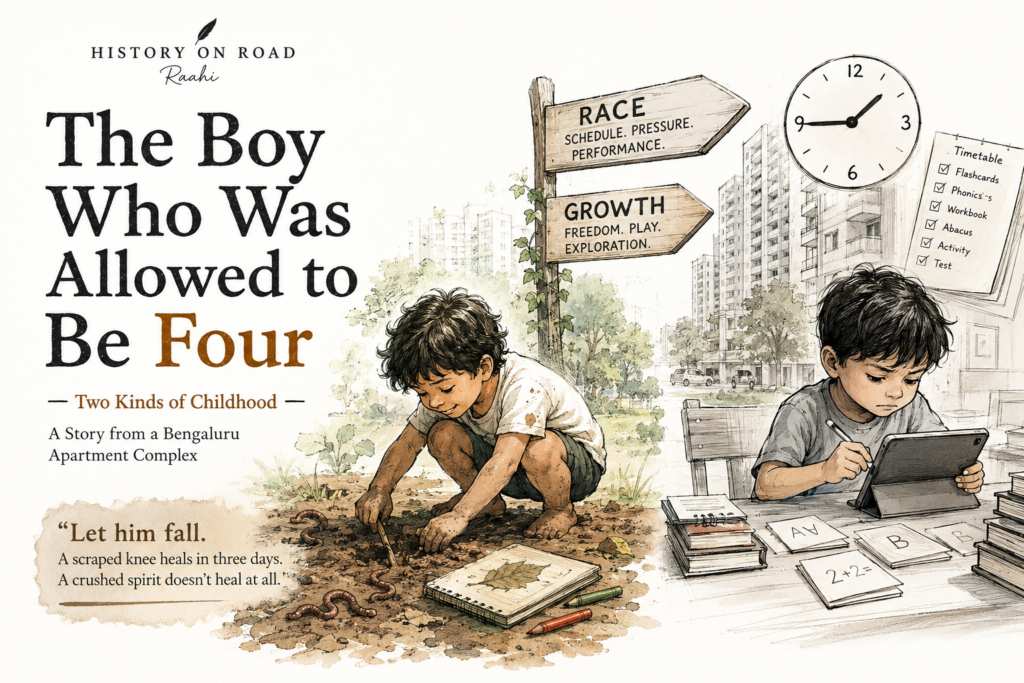
On Saturday mornings, she took Satya to the little patch of mud behind the clubhouse — not the manicured lawn, the real mud, where earthworms surfaced after rain. Aakash would follow with a sketchbook and two crayons, no phone.
“Let him fall,” Aakash would say, when the other fathers flinched as Satya stumbled off the swing. “A scraped knee heals in three days. A crushed spirit doesn’t heal at all.”
They didn’t enroll Satya in a “Little Einsteins” program. They didn’t have a laminated timetable stuck to the fridge with Kannada, Hindi, English, abacus, and phonics slots colour-coded by the hour. Satya still couldn’t recite the alphabet backwards. He could, however, tell you which of the seven trees near Tower B dropped its leaves first, because he’d watched them all monsoon.
He is not behind, Ovi told herself on the nights self-doubt crept in, hearing about Ayaan’s flashcards through the society WhatsApp group. He is just growing at the speed a child is meant to grow.
Upstairs, Richa’s mornings looked different. 6 a.m. flashcards. 6:45 breakfast — usually toast, sometimes skipped because Ayaan wouldn’t eat and there wasn’t time to coax him. 7:15 nursery drop, chosen not because it was near or warm but because its prospectus had the word “International” in gold foil and a waitlist eleven pages long.
“Every other mother in the kitty party has her child in a CBSE-track pre-nursery,” Richa said once, half to Abhilash, half to the mirror. “If Ayaan doesn’t get in now, he’ll be behind for LKG. And if LKG goes wrong, everything after goes wrong.”
Abhilash worked till 9 p.m. most nights, guilt disguised as ambition, ambition disguised as love. Dinner most days came from a delivery app. Ayaan ate in front of a tablet because it was the only way he’d eat at all.
By four, Ayaan had begun correcting other children in the play area. “You’re doing it wrong,” he told a girl building a sandcastle, because that’s what he’d absorbed at home — that there is a right way and a wrong way, and love is conditional on getting it right. When he lost a game of tag, he didn’t cry the ordinary cry of a child who’s tired. He raged, because somewhere he had learned that losing was not allowed.
The society WhatsApp group had a thread once, when Ayaan pushed another boy over a toy car. Richa’s message afterward wasn’t “is the other child okay” — it was “Ayaan needs to learn to defend what’s his, this world doesn’t wait for the polite.”
I am preparing him for the real world, she told herself, not noticing that the “real world” she meant was one she and her friends had invented in a clubhouse, over cucumber sandwiches, comparing school brochures like stock portfolios.
One evening, Aakash sat on the parking-lot bench watching both boys — Satya digging with a stick, Ayaan scrolling a borrowed phone, waiting for his mother.
He thought about the roads back in his hometown, decades ago — how before flyovers and one-way systems, cattle, cycles, and bullock carts all found their own rhythm on the same stretch of mud, nobody honking, nobody rushing, because nobody had decided yet that arriving first meant something. Then came the traffic signal, the deadline, the idea that a road was a race and not a shared space. And once one vehicle sped up, every vehicle behind it had to, or be left behind, or be honked at, or feel like a failure standing still at a green light.
That’s what happened to parenting too, Aakash thought. Somewhere, a few people — with degrees, but not necessarily wisdom — decided childhood was a race with a finish line called “LKG seat” and then “IIT” and then “settled.” And the rest just followed, honking at anyone who idled, because idling looked like falling behind, even when it was actually just living.
It isn’t a school queue, he told himself. It’s a rat race with a toddler entry fee. And a race, once enough people are running it, stops looking optional. It starts looking like the only road that exists — even though the field beside it was always there, quiet, ungoverned, still green.
Ovi and Aakash never joined the kitty parties. They were invited once, politely declined twice, and after that, simply weren’t asked again. It didn’t bother them.
“We’re not being rude,” Ovi said once to a neighbour who asked why they kept to themselves. “We just don’t want Satya’s idea of success to be decided over cucumber sandwiches and school brochures. We’d rather he learn it from mud, trees, and falling down enough times to know how to get up on his own.”
Not everyone agreed with them. Some called them naive, unrealistic, even a little stubborn — after all, competition was real, and the world outside Green Meadows wasn’t going to slow down just because one family opted out of the race. But Ovi and Aakash weren’t trying to win an argument. They were only trying to give one small boy a few more years of simply being four.
The story doesn’t end with a lesson stamped at the bottom, because childhood shouldn’t come with morals attached either — just questions worth sitting with, the way Satya sat with the earthworms after the rain.