

The Moon Never Forgets: A Chai-Time Debate on Space Junk:
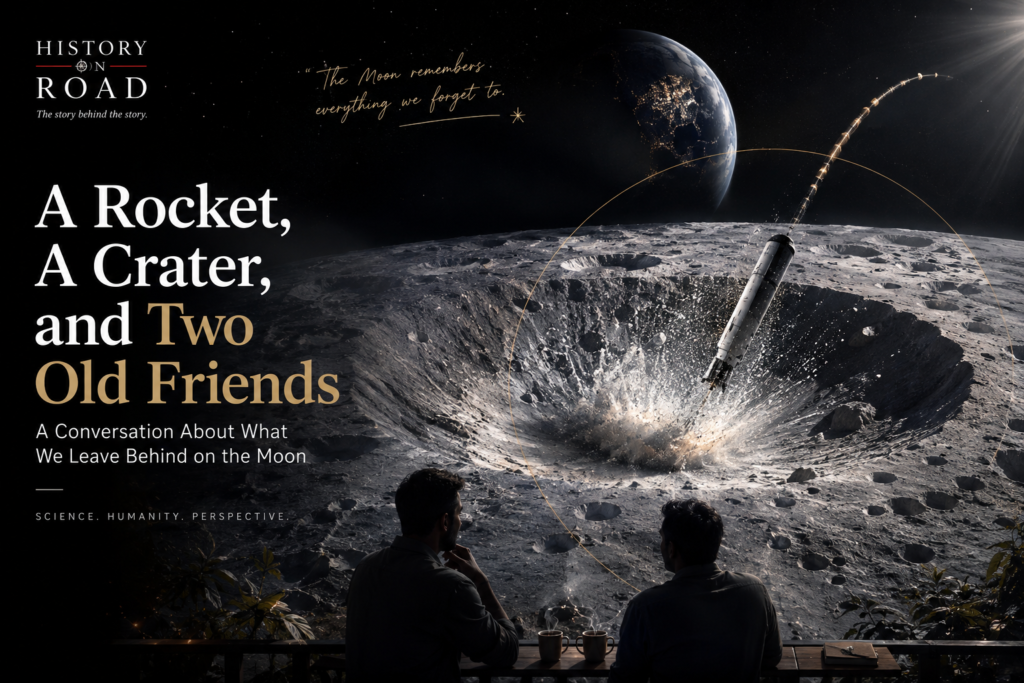
A Rocket, A Crater, and Two Old Friends: A Conversation About What We Leave Behind on the Moon
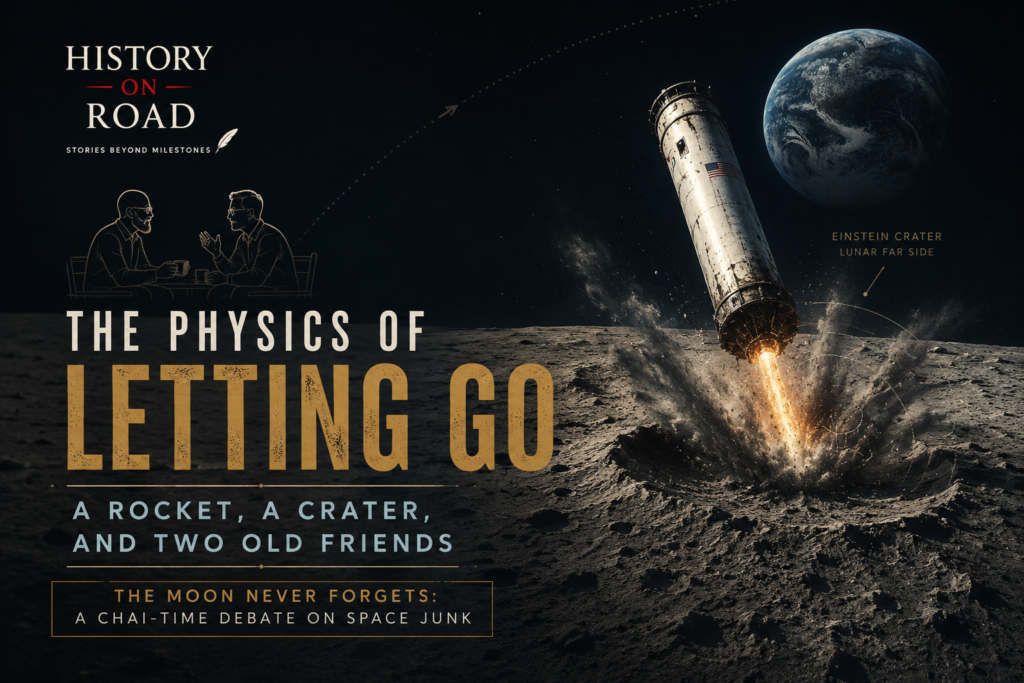
History On Road often finds the story behind the story in the space between two people talking. This week, we eavesdrop on a conversation between Gaurav, a planetary scientist, and Shivaji, a schoolteacher who has spent thirty years teaching children to look up. They meet, as they often do, over chai on Shivaji’s terrace — this time, the morning after a rocket hit the Moon.
Shivaji: So it’s true then? A rocket actually crashed into the Moon last night?
Gaurav: Early this morning, actually. 2:35 a.m. Eastern time — that’s late morning here in India. A Falcon 9 upper stage. Struck near Einstein Crater at about 5,400 miles an hour.
Shivaji: Einstein has a crater on the Moon named after him?
Gaurav: He does. Most of the far side is named for scientists — Einstein, Curie, Mendeleev. The near side got the poets and the mythology. It’s one of those small details that tells you a lot about who was doing the naming, and when.
Shivaji: I’ll admit, my first reaction was almost — offense, on the Moon’s behalf. We just throw our garbage at it now?
Gaurav: That’s the popular reaction, and I understand it. But it wasn’t garbage thrown deliberately, and it wasn’t really new. This stage launched in January 2025. It carried two lunar landers — Firefly’s Blue Ghost and a Japanese lander called Resilience. Once it delivered them, its job was finished. It had no fuel left to steer itself anywhere. It just… drifted.
Shivaji: For a year and a half?
Gaurav: Eighteen months. Stuck in this strange, lopsided orbit around Earth. Too weak to fall back to us, too slow to escape into deep space. And very slowly, things it had no control over — the pull of the Sun, the pull of the Moon, even the faint pressure of sunlight itself — pushed it, degree by degree, onto a collision course.
Shivaji: Sunlight pushed a four-ton rocket?
Gaurav: Photons carry momentum, Shivaji-ji. Not much, individually. But over eighteen months and a quarter-million miles, it adds up. It’s one of the more humbling things about this event, honestly — we build these extraordinarily precise machines, and in the end, it’s something as delicate as light that decides where they land.
Shivaji: Now that is the kind of thing I wish I could put in front of my tenth-standard students. Not the crash — the sunlight steering a rocket part.
Gaurav: Put both in front of them. The crash is what gets their attention. The physics is what keeps it.
Shivaji: Alright, teacher’s brain aside — should I actually be worried about this? Rockets falling on the Moon, debris everywhere?
Gaurav: No danger to anyone, if that’s the worry. NASA said this plainly — a meteoroid carrying similar energy hits the Moon roughly once every six days on its own. The Moon has no atmosphere to burn things up, so it’s been getting struck, quietly, for four and a half billion years. We just don’t usually get to watch.
Shivaji: But this time we did.
Gaurav: This time we knew the exact minute in advance. Independent astronomers tracked this stage for months. NASA’s near-Earth object office — the same team that watches for asteroids that might threaten us — refined the trajectory down to the hour. Observatories in Chile, Hawaii, South Korea’s Danuri orbiter — they all pointed their instruments at Einstein Crater and waited.
Shivaji: Why does anyone care to watch a piece of scrap metal hit a rock?
Gaurav: Because it isn’t really about the scrap metal. It’s a free experiment. When something hits an airless surface at that speed, it throws up a plume of dust and vapour — sodium, lithium, debris. Scientists want to understand how that plume behaves, how big the crater gets, how the material scatters. That tells us something about the Moon’s subsurface. And practically — every future lander we send there kicks up its own version of that same cloud when it touches down. Better to learn the physics on an abandoned rocket stage than on a spacecraft with people nearby.
Shivaji: So an accident became a classroom.
Gaurav: In a sense, yes. Though I’d push back gently on “accident.” Nobody aimed it there. But nobody was surprised by it either. There’s a difference.
Shivaji: You said this has happened before?
Gaurav: In 2022, almost the identical story — a mystery rocket stage tracked toward a lunar impact. Everyone initially blamed SpaceX. Turned out to be a Chinese Long March rocket instead. The mix-up lasted for weeks before anyone corrected it.
Shivaji: That is almost more interesting than the impact itself.
Gaurav: I think so too. It tells you something uncomfortable — most of what we’ve launched into deep space over the decades isn’t being tracked carefully. Things drift for years, sometimes anonymously, until they collide with something and force us to pay attention.
Shivaji: So the Moon is becoming… what, exactly? A dumping ground we haven’t admitted to yet?
Gaurav: I’d put it differently. It’s becoming a frontier the way every frontier eventually becomes one — visited first, then littered, quietly, long before anyone writes the rules for it. NASA used to crash Apollo-era rocket stages into the Moon on purpose, to shake it and read the seismic data. That was deliberate archaeology, in a way. What happened this week was accidental archaeology. Either way, the Moon keeps the record. No wind, no rain, no rust. Whatever lands there stays exactly as it landed.
Shivaji: That’s rather beautiful, in a sad way. It remembers everything we forget to.
Gaurav: That’s precisely why scientists cared enough to watch. Not because a rocket hit a rock. Because for one morning, all our systems — decades of tracking, coordination, physics — worked together well enough to know the story before it finished happening.
Shivaji: Then perhaps that’s the real headline. Not “Rocket Crashes Into Moon.”
Gaurav: No?
Shivaji: “Humanity Finally Learns to Watch Its Own Mess Land.”
Gaurav: (laughing) Now that, Shivaji-ji, is why you should be the one writing the article, not me.
Somewhere on the Moon, near a crater named for a man who spent his life thinking about how light and gravity bend the paths of things, there is now a fresh scar roughly the width of a two-storey building — put there by sunlight, gravity, and eighteen months of drifting. The Moon will keep it long after this conversation, and the rocket that made it, are both forgotten.



Borrowed Glory in Kalikapur: The Story of a Village Election