
A HistoryOnRoad Special Report
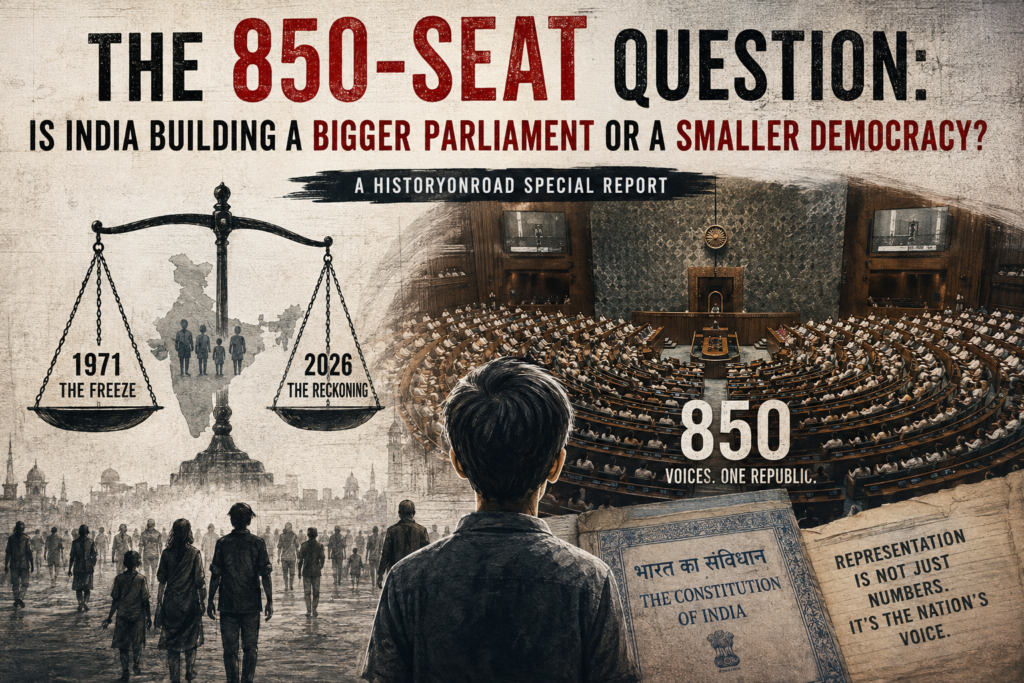
Walk into India’s new Parliament building and you will notice something odd. The Lok Sabha chamber has 888 seats. The current Lok Sabha has only 543 members. For years, the extra chairs were explained away as space for joint sessions. Few believed that was the whole story. In April 2026, the government confirmed the suspicion: it introduced the Constitution (One Hundred and Thirty-First Amendment) Bill, 2026, to raise the Lok Sabha’s strength from 543 to as many as 850 members — 815 from the states and 35 from Union Territories.
It is being sold as a long-overdue correction. It may also be the most consequential redesign of Indian democracy since the Constitution was written. History has a way of repeating its debates — and this one has been brewing for fifty years.
The Freeze That Time Forgot
To understand why 850 is such an explosive number, rewind to 1976. Indira Gandhi’s government, worried that states with faster-shrinking birth rates would be punished with fewer MPs, froze every state’s seat count at 1971 census levels through the 42nd Amendment. The freeze was meant to be temporary — a way of buying time for the whole country to bring its population growth under control before representation was recalculated.
It was extended once, in 2001, until “the first census taken after 2026.” That deadline is now upon us. And the population math has grown wildly out of balance in the meantime: an MP from a northern state today can represent nearly twice as many constituents as an MP from a southern state that controlled its population growth early. One vote, in other words, has stopped being worth the same everywhere.
The new bills — the 131st Constitutional Amendment and the companion Delimitation Bill, 2026 — do two things. First, they scrap the census trigger, letting Parliament decide when delimitation happens and on what population data. Second, they raise the House’s ceiling to 850, a number reportedly chosen because it lets every state gain seats and lets none lose any — a political sweetener designed to defuse the north-south backlash before it starts.
Why “Bigger” Doesn’t Automatically Mean “Better”
Here is where the celebration deserves scrutiny.
A larger Lok Sabha is not, by itself, a healthier one. Representation is not simply an arithmetic exercise of dividing India’s 1.4 billion people into smaller and smaller slices. A parliament’s strength lies in what happens after the numbers are counted — in the quality of debate, the depth of committee scrutiny, and the independence with which MPs can question the executive.
Consider the practical mechanics of an 850-member House. Question Hour, already squeezed for time in a 543-member chamber, would have to be rationed even further. Standing committees — the unglamorous rooms where bills are actually interrogated clause by clause — do not scale efficiently with membership; more members chasing the same floor time and the same committee slots tends to dilute individual scrutiny, not multiply it. A chamber built for spectacle, where hundreds of members sit as a backdrop rather than active participants in legislative give-and-take, risks becoming exactly what critics fear: a very large room for applause rather than argument.
There is also the federal question. Delimitation based on updated population figures is likely to shift seat share toward the northern, faster-growing states and away from the south, even as the total pie grows for everyone. Early estimates suggest Uttar Pradesh and Bihar would gain significantly while Tamil Nadu and Kerala would see their relative weight in Parliament shrink, even if their absolute seat count rises. States that succeeded at population control worry they are, once again, being asked to accept less political voice as the price of good governance — a grievance with real echoes of the federal tensions India has wrestled with since the 1970s freeze was first imposed.
The Democracy Argument
This is where the deeper worry lies. Democracies do not fail only through the dramatic rupture of a coup or an emergency. They can also erode quietly, through institutions that keep their form while losing their function — a parliament that still convenes, still votes, still photographs well, but no longer functions as a genuine check on power.
An oversized chamber, stacked with members who have little realistic chance of speaking, asking a question, or shaping a bill in any given session, can easily drift toward that outcome. When participation becomes symbolic rather than substantive, frustration tends to follow — and frustrated constituencies, feeling unheard by an institution too vast to listen, are fertile ground for exactly the kind of polarised, anti-institutional politics that healthy democracies are built to prevent. Chaos rarely announces itself. It tends to arrive first as apathy, then as anger.
None of this means expansion is inherently wrong. India’s population has nearly tripled since 1971, and the argument that each MP now represents an unreasonably large number of citizens is a fair one. The unfinished promise of one-third reservation for women in Parliament is also tied to this delimitation exercise, giving the reform real, tangible stakes for representation. The question history will ask is not whether India needed more seats, but whether it built the right kind of institution around them — one that strengthens committees, protects debate time, and keeps the federal bargain intact, rather than one that simply makes the chamber louder and the individual MP smaller.
What Comes Next
The Delimitation Commission — chaired by a sitting or retired Supreme Court judge, with the Election Commission as ex-officio members — is expected to carry out the actual redrawing of boundaries once the bills clear Parliament and the states. Its orders, notably, are designed to carry the force of law and sit outside judicial challenge, which has become a flashpoint in its own right, with opposition states questioning both the data being used and the insulation from courts.
Supporters of the bill counter that a bigger House was inevitable given how far constituency sizes have drifted from the Constitution’s original design, and that the 850-seat compromise is precisely what keeps the reform politically survivable — a number engineered so that no state has to accept a real loss. Critics reply that survivability is not the same as soundness, and that a Parliament optimised to avoid political pain may not be the Parliament best equipped to do its job.
Either way, the numbers on the wall of the new Lok Sabha chamber were never just about seating capacity. They were always a preview of an argument India would eventually have to have — about what representation is actually for.
HistoryOnRoad tracks the institutions shaping India’s present against the decisions that built them. For more context on how the 1971 census freeze and the 42nd and 84th Amendments got us here, explore our archive on India’s constitutional history.