

History On Road | Social
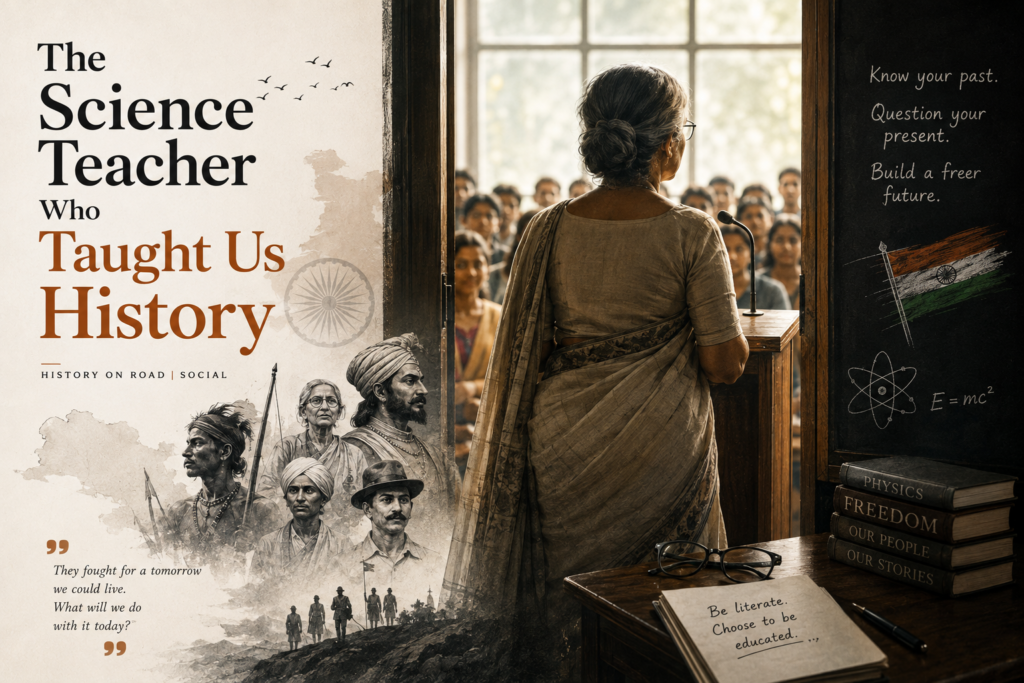
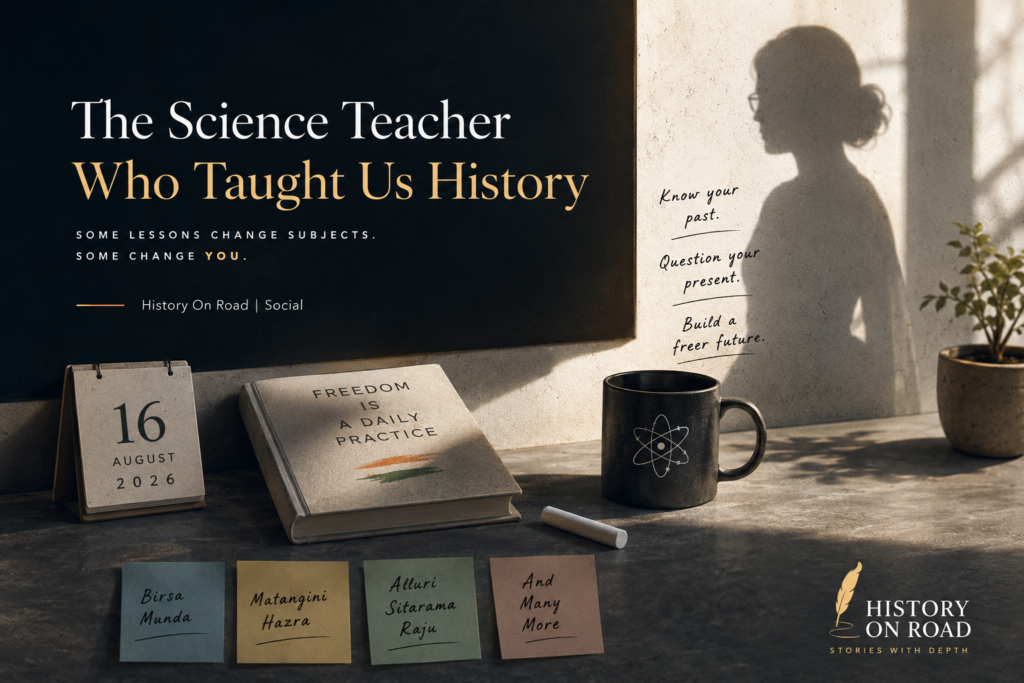
It is the 16th of August, 2026. Yesterday was Independence Day, and I am still smiling about it. I am writing this today because I do not want to lose even one detail of what happened in that hall. Some days give you a holiday. Yesterday gave me a new way of thinking, and I want to hold on to it.
Let me tell you what happened.
Our college calls one Independence Day event every year. Same pattern, every year. Flag hoisting at 8 am. National anthem. Principal’s speech about “our glorious nation.” Sweets at the end. Most years, everyone claps because clapping is easier than listening, and then everyone goes home and forgets.
This year, something wonderful happened by accident. Our chief guest cancelled at the last minute. The principal needed someone to speak, and speak well, in the next two hours. He picked Neeta Ma’am.
Neeta Ma’am teaches us Physics. She is an Associate Professor in the Science Department at our senior college, fifty-eight years old, just two years away from retirement. She talks about Newton, about energy, about atoms. In thirty-odd years of teaching, nobody had ever heard her speak about anything outside her subject. Nobody in that hall — including me — expected her to know anything about history. I remember thinking, this will be short and forgettable, and then we can go home.
I was wrong. Beautifully wrong. And today, a full day later, I still cannot stop thinking about it.
She Did Not Start With A Speech. She Started With A Question.
Neeta Ma’am walked up, no notes in her hand, and the first thing she did was ask a question.
“How many of you can name five freedom fighters of India, right now, in the next ten seconds?”
Hands went up fast. Everyone was confident. Gandhi. Nehru. Bhagat Singh. Subhas Chandra Bose. Easy.
Then she asked the next question.
“Now tell me — how many of you know the name of even one tribal freedom fighter? One woman freedom fighter who was not from a big city? One person who fought the British and died before independence came, and whose name is not printed in your school textbook?”
Nobody raised a hand.
She smiled, not to make us feel small, but the way a good teacher smiles when she is about to give you something valuable.
“Good,” she said. “Now you are ready to actually learn something today, instead of just repeating what you already know.”
That one sentence changed the whole mood of the hall. We stopped waiting for the speech to end. We started leaning forward.
The Names That Deserve To Be Famous
Then she told us stories. Not dates, not exam-style facts. Real stories, told like she genuinely loved telling them.
She told us about Birsa Munda, a young tribal leader from what is now Jharkhand, who stood up for his people’s land and forest rights against unfair British laws, and who became a legend to his community while still in his early twenties.
She told us about Matangini Hazra, an elderly woman from Bengal in her seventies, who led a procession carrying the national flag, and who kept holding that flag high with pride even after being fired upon, refusing to let it fall.
She told us about Alluri Sitarama Raju, who organised tribal fighters in the forests of Andhra Pradesh, using courage and deep knowledge of the land to resist British forest laws, becoming a hero to his people long before most of the country ever heard his name.
And then, her voice changed a little, softer but somehow stronger, as she spoke about Chhatrapati Shivaji Maharaj. “Long before the British ever set foot here as rulers,” she said, “one king in our own Maharashtra gave India an idea it had never fully had before — Swarajya. Self-rule. The idea that people deserve to be governed by their own, with fairness, with respect for every religion, with justice for the farmer as much as the noble. He built forts not just from stone, but from the belief that ordinary people could stand tall against much bigger powers if they believed in something together. That idea of Swarajya did not end with him. It quietly lived on, in the hearts of the very freedom fighters we are talking about today, centuries later, still asking the same question he first asked — who has the right to rule us, if not our own people?”
She let that sit in the hall for a moment before continuing.
“These are not small stories,” she said, her voice full of pride. “These are some of the biggest, bravest stories our country has. We just never told them loud enough. Today, I am telling them to you, so that you can go and tell someone else. That is how a country keeps its memory alive — not in a textbook, but passed from one excited person to another.”
I felt something lift in my chest. I had grown up thinking Independence was the work of four or five great men. She was showing me it was the work of an entire nation, quietly heroic, in every corner, in every language, in every forest and village and city.
What Real Freedom Feels Like
Then she asked us something I did not expect from a Physics teacher.
“Tell me honestly — what does freedom mean to you? Not the textbook answer. Your real, personal answer.”
Students called out things. “Freedom to vote.” “Freedom to choose our own government.” “Freedom of speech.” She nodded warmly at every answer.
“All correct,” she said. “Now let me give you a bigger version of freedom to aim for. Are you free to disagree with a friend and still keep that friendship strong? Are you free to fail at something and know your family will still be proud of your effort? Are you free to speak the truth at your workplace without fear? That kind of freedom is built by you, every single day, one honest choice at a time. The country gave you the stage seventy-nine years ago. What you do on that stage is completely, powerfully, up to you.”
The hall did not go quiet with discomfort this time. It went quiet with hope. I could feel people around me sitting up a little straighter.
A Culture Worth Being Proud Of
Near the end, her voice grew even warmer, prouder.
“India did not just fight for land,” she said. “We fought to protect something the British tried very hard to take from us — our own way of thinking. Our festivals, our languages, our music, our respect for elders, our belief that a guest in your home should be treated like family. We are a civilisation that gave the world the concept of zero, that gave the world yoga, that built entire schools of thought about truth and peace centuries before the rest of the world caught up. This heritage is not something old and dusty sitting in a museum. It is alive, right now, inside every one of you, waiting for you to actually use it.”
Then she said the line I have been repeating to myself all day.
“You are not just literate. Starting today, choose to also become educated. A literate person can read the story of Birsa Munda in two minutes on their phone and forget it in three. An educated person lets that story change how they treat the very next powerless person they meet. That is the difference. And that difference is completely, wonderfully, in your hands.”
Why I’m Writing This The Next Day
When she finished, the clapping in that hall did not stop for a long time. I remember standing up without even realising I had done it.
I am writing this today, on the 16th, because I woke up this morning and the feeling was still there. Usually a good speech fades by the next day. This one didn’t. If anything, it grew stronger overnight, like it needed a full day to properly settle inside me.
A Physics teacher, two years from retirement, gave the most powerful history lesson of my entire life, in twenty minutes, with no notes, no slides, and no syllabus behind it. She did not just teach us about freedom fighters from the past. She reminded us that we are also, right now, in our own small daily choices, deciding what kind of country this becomes next.
That is the best gift anyone gave me this Independence Day. Not a holiday. Not sweets. A reason to believe that being a genuinely good, honest, aware human being is still the most powerful thing anyone can choose to be — starting today, starting with me.

Borrowed Glory in Kalikapur: The Story of a Village Election