

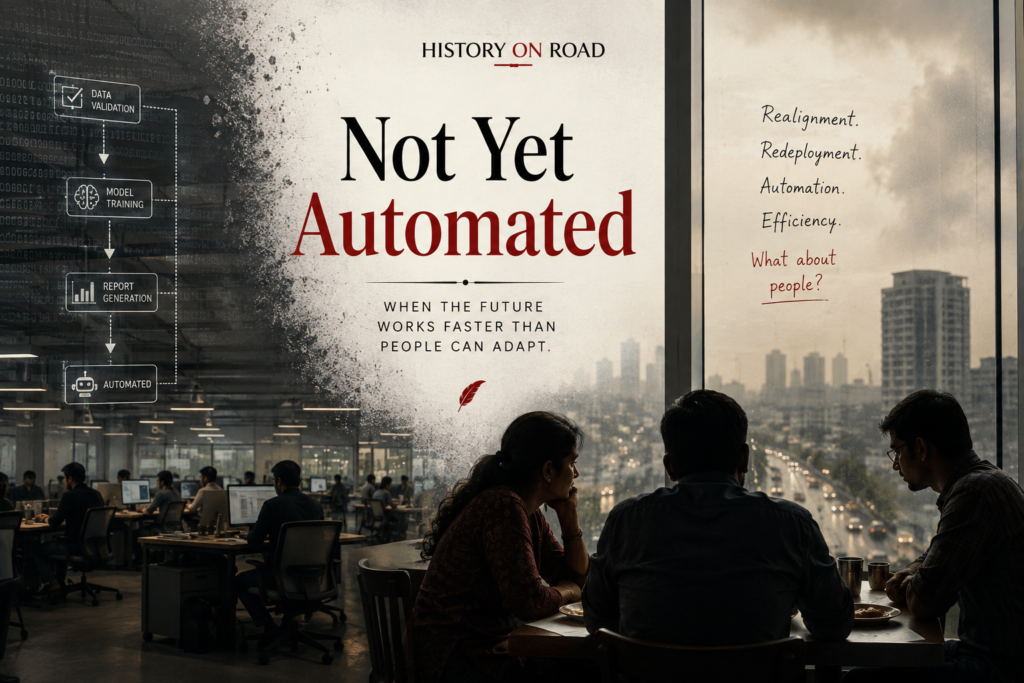
The rain had been threatening Bengaluru all morning, the kind of grey October sky that never quite decided whether to open up or move on. Vijayalaxmi stood at the glass wall of the ninth-floor cafeteria, watching the traffic crawl along Outer Ring Road, a paper cup of filter coffee cooling in her hand. Below her, the city looked the same as it had for the fifteen years she’d worked in it — glass towers, half-finished flyovers, auto-rickshaws weaving between everything. But something in the office behind her felt different this year, and she couldn’t quite name it until Virat sat down across the small round table with his laptop tucked under his arm like a shield.
“Did you see the message from Ganeshan?” he asked, not bothering with hello.
“No. What message?”
“He’s flying back. Early. His onsite got cut short.”
Vijayalaxmi set her cup down carefully, the way she did most things — with a kind of deliberate calm that had made her a good project lead for as long as anyone at the company could remember. “Cut short how? He still had four months on that visa rotation.”
“That’s what I’m saying. Four months, gone, just like that. His manager in the US called it ‘realignment of the client engagement.’ Ganesh called it something else on the phone, but I won’t repeat it in office.”
She almost smiled, despite herself. Ganeshan had always had a temper simmering just under his mild exterior, the kind that surfaced only with people he trusted. She’d known him since their first year out of college, when they’d both joined the same firm in Electronic City as trainees who barely understood what a server rack was. Virat had come a few years later, younger, sharper with the new tools, the one who had actually gone and gotten himself certified in machine learning frameworks while the rest of them were still debugging Java.
“When does he land?” she asked.
“Tomorrow night. He wants to meet. Not in office — he said office feels like a funeral home right now.”
They met instead at the small Udupi place near Vijayalaxmi’s apartment in Indiranagar, a narrow restaurant with steel plates and a ceiling fan that wobbled dangerously but had never actually fallen in the eleven years she’d been eating there. Ganeshan looked thinner than when he’d left for the US eight months earlier, and there were new lines around his eyes that hadn’t been there before, the kind that come less from age and more from too many nights spent reading emails at 2 a.m. because the client was twelve and a half hours away and always, it seemed, awake.
“You look terrible,” Virat said, by way of greeting, and Ganeshan laughed for the first time that evening, a short, tired sound.
“Thanks. Onsite life. You eat badly, sleep worse, and then they tell you the project itself doesn’t need you anymore.”
“What actually happened?” Vijayalaxmi asked, once the dosas had arrived and the initial noise of ordering had settled.
Ganeshan turned his glass of buttermilk in slow circles on the table before answering. “The client is automating half the pipeline we were building manually. Data validation, model retraining schedules, even some of the report generation — all of it’s being handed to an internal AI tool now. Three of us on the team got pulled. Not fired, they were careful to say. ‘Released back to base location for redeployment.’ That’s the phrase. Redeployment.”
“Redeployment to what?” Virat asked.
“That’s the question, isn’t it.” Ganeshan finally looked up. “I called my manager here before I even landed. Asked what bench status looks like. She didn’t say much. Just that things are ‘being reviewed across several accounts.'”
There was a silence at the table then, filled only by the fan’s uneven creak and the clatter of steel plates from the kitchen. Vijayalaxmi thought of the survey Virat had shown her a few days earlier on his phone, some workplace platform’s numbers — a large majority of AI and machine learning employees across the country expecting layoffs or shrinking teams within the next few months. She hadn’t paid much attention to it then. It had felt like one of those statistics that floated past you on a screen, true in the abstract but not yet true of your own kitchen table, your own three friends eating dosas on a Tuesday night.
“I read something the other day,” she said slowly. “About how most people in our kind of work expect their own team to shrink soon. I didn’t think it would mean people I actually know.”
“It’s strange,” Virat said. “We built the thing that’s supposed to replace half our jobs, and now we’re sitting here wondering if it replaced us too.”
“It’s not that simple,” Ganeshan said, though he didn’t sound entirely convinced by his own words. “The automation isn’t wrong, exactly. The model retraining pipeline I helped design last year — it does the job faster than we ever did by hand. I’m not angry that it works. I’m angry that nobody planned for what happens to the people who built it once it does.”
The weeks that followed had a strange texture to them — office life continuing on the surface exactly as it always had, badge swipes and lunch queues and the eternal hum of air conditioning, while underneath it, something quieter and more anxious moved through every team’s WhatsApp group. Someone in another vertical had been “released.” A senior architect in the fintech account had taken a package and left for a smaller startup. Rumors outpaced facts, as they always did, and facts, when they arrived, were usually smaller and stranger than the rumors had promised.
Virat, for his part, threw himself into learning. He signed up for two more certifications, stayed late most evenings poring over papers on model efficiency and deployment architecture, the kind of work that had once felt optional and now felt like the only insurance he had. Vijayalaxmi noticed the shift in him — the easy confidence of a twenty-nine-year-old who had assumed the future belonged to people who understood machine learning, replaced by something more careful, more searching.
“You don’t have to prove anything to me,” she told him one evening, finding him still at his desk long after most of the floor had emptied out, the blue light of his monitor the only thing lit in that section of the office.
“I know,” he said. “I’m not doing it for you. I keep thinking — if the tools are what’s taking the work, then maybe the only way through is to understand the tools better than anyone else does. Or maybe that’s just what I tell myself so I don’t have to sit still and worry.”
She sat down in the empty chair beside him, the one that used to belong to a junior developer named Priya who had left the company two months ago for reasons nobody in the team fully understood, or maybe understood too well to say out loud.
“When I started in this industry,” Vijayalaxmi said, “we were all afraid of outsourcing taking work from other countries to us. Then we were afraid of the recession. Then it was the pandemic, remote work, whether offices would survive at all. There’s always something. I don’t say that to make this feel smaller than it is. I say it because I’ve watched people survive each of those things, not by being the smartest in the room, but by being the ones who kept showing up, kept learning sideways instead of just upward, kept their networks alive instead of hiding in a cubicle waiting to be told what happens next.”
Virat didn’t answer immediately. Outside the window, the city lights blurred into long amber streaks through a light drizzle that had finally arrived, three days late by the forecast’s estimate.
“Do you think Ganesh will be okay?” he asked instead.
“I think Ganesh has weathered worse than this and just doesn’t like to say so,” she said. “He’s been through two recessions and a divorce and he still shows up to work in a pressed shirt every single day. That’s not nothing.”
Ganeshan, redeployed at last to an internal project building tools for exactly the kind of automation that had ended his onsite stint, found an odd peace in the irony of it. He was building the successor to his own displaced role, and instead of resenting it, he decided — somewhere around the third week, over another plate of dosas with Virat and Vijayalaxmi — that there was something almost freeing in understanding the machine from the inside rather than fearing it from the outside.
“I used to think my job was writing the pipeline,” he said. “Now I think my job was always something else — knowing when the pipeline was wrong, catching what the model missed, translating what the client actually needed instead of what they said they needed. Machines are good at the first part. I don’t think they’re anywhere close to the second part yet. Maybe they never will be.”
“That’s optimistic for a man who got sent home early,” Virat said.
“I’ve had three weeks to think about it,” Ganeshan said, shrugging. “What else was I going to do — stay bitter forever? My mother would’ve heard about it by phone within a day and lectured me for two hours.”
They all laughed at that, the kind of laugh that comes easier after weeks of tension, not because the underlying worry had disappeared, but because it had become familiar enough to sit beside rather than to be crushed under.
Outside, the rain had finally cleared, leaving the streets slick and mirrored under the streetlights, the whole city washed briefly clean. None of them knew, sitting there with steel plates and cooling coffee, exactly what their teams would look like in three months or six. The surveys and the whispered numbers in corridors weren’t wrong, not entirely — uncertainty had settled over the industry the way monsoon clouds settle over the city, arriving without much warning and staying longer than anyone would like.
But there was something else too, something the numbers didn’t measure — three people who had known each other across fifteen years of shifting technologies and shifting fears, still choosing to sit at the same table, still finding their way, one dosa and one difficult conversation at a time, toward whatever came next.
Vijayalaxmi paid the bill, as she always insisted on doing when it was her turn, waving off Virat’s protest with the same calm she brought to everything. Outside, they parted ways under a sky finally clearing to stars, three colleagues walking back into an industry that was changing faster than any of them could fully predict, carrying with them the one thing that no algorithm had yet learned to replace — the plain, stubborn habit of showing up for each other.


Borrowed Glory in Kalikapur: The Story of a Village Election