

Marginalia
HISTORY ON ROAD | The Story Behind the Story
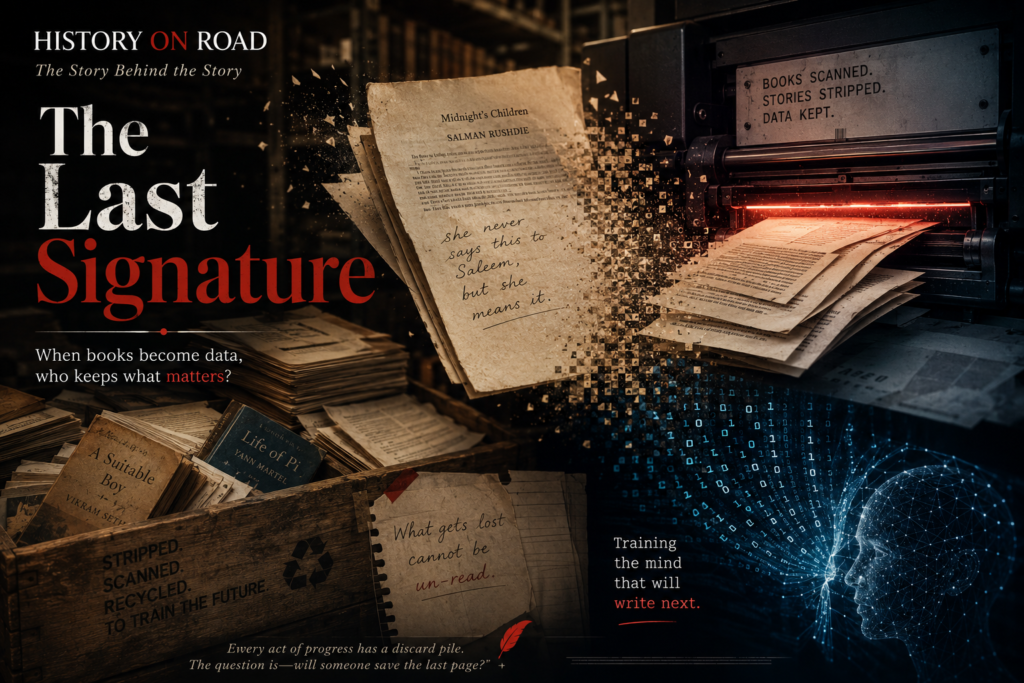
Every act of technological progress has a discard pile. The printing press displaced scribes; early photocopiers made pulping “obsolete” manuscripts routine in libraries clearing shelf space; the digitization booms of the 2000s buried whole newspaper morgues before anyone thought to ask what was being lost in the transfer. What’s happening now — physical books bought in bulk, stripped of their spines, scanned at industrial speed, and recycled to train AI systems on “clean” human writing — is not a new story. It’s the oldest story publishing has, wearing a new machine.
This is a work of fiction. But it’s built on that pattern, and on a real question underneath it: not whether the transfer will happen — it always has — but who notices, and what they choose to keep.
Rucha found the crate first.
It sat outside a raddiwala’s shop in Kothrud, Pune, stacked between broken chairs and a rusted geyser — forty kilos of books, spines slit clean down the middle like something surgical had been done to them. She almost walked past it. Then she saw the title on top: Midnight’s Children, its cover intact, its spine gone.
She picked it up and turned it over in her hands. The pages were loose now, unbound, fluttering slightly in the evening wind like they were trying to fly back to whoever had read them last.
“Ovi,” she said into her phone, still crouched by the crate. “You need to see this.”
Ovi worked two floors above a filter coffee stall in Hyderabad, in an office that smelled permanently of instant noodles and cold AC. He was the kind of engineer who could tell you exactly how a language model learned to write a sentence, and exactly why it still couldn’t feel one. When Rucha sent him the photo, he didn’t answer for four minutes — a long silence, for him.
“That’s not a raddiwala clearance,” he finally wrote. “That’s a scanning job. Someone paid for those books, cut the spines because it’s faster to feed loose pages through a scanner, and once the ink’s been read, the paper’s worthless. It’s not being thrown away. It’s been harvested.”
“Harvested for what?”
“For us, probably. For people like us. Model training. Clean, human-written, long-form text — the internet’s getting too polluted with AI text to train AI on anymore. So they go back to the source. Libraries. Warehouses. Out-of-print backlists nobody’s defending.”
Rucha looked down at the loose pages in her lap. Somewhere in the wind-scatter was a page with a pencil note in the margin — she never says this to Saleem, but she means it — someone’s private conversation with a book, decades old, about to become a data point in a training set that would never know it was reading a person’s memory.
In Bengaluru, Hridhaan heard about it from Urvi, who heard about it from a WhatsApp forward that had already gone through six phones by the time it reached her. She called him at 11 p.m., which she never did.
“They’re shredding books, Hridhaan. Actual libraries. For AI training data.”
“Slow down. Who’s ‘they’?”
“Does it matter? Someone. Everyone. It’s happening in Pune too — Rucha found a crate of them.”
Hridhaan sat up in bed. He and Urvi had met four years ago in the poetry aisle of a secondhand bookstore near Blossom’s, both reaching for the same water-stained copy of Neruda. They still fought — gently, endlessly — about whether a Kindle counted as reading. He worked in cloud infrastructure. He understood, better than most people in that argument, exactly what a server actually was. And still, some part of him had always kept the physical book as a kind of last, stubborn refuge — a place technology hadn’t fully colonized.
“A book isn’t data, Urvi,” he said. “It’s the version of you who read it at seventeen, and the version who reread it at thirty and cried at a different page. You can’t scan that part.”
“Tell that to the machine,” she said. “It doesn’t need the crying. It just needs the words.”
The four of them met that Saturday — Ovi and Rucha taking the early Hyderabad–Pune flight, meeting Hridhaan and Urvi who’d driven up from Bengaluru overnight, all four converging at the same secondhand bookstore where Hridhaan and Urvi had first met. It felt, to all of them, like the only appropriate place to have this argument.
“You’re treating efficiency like it’s a crime,” Ovi said, turning a paperback over in his hands, checking its spine out of old professional habit. “You know why they’re doing this instead of just scraping more websites? Because raw internet text is getting worse — more of it is AI-generated now, feeding on itself, going stale. Books are one of the last clean wells. Long-form, edited, actually thought through. In a strange way, it’s a compliment to what you two love. They need the real thing because the fake thing isn’t good enough anymore.”
He paused, turning the paperback over once more. “And it’s not even new. Medieval monasteries scraped ink off old vellum to reuse the parchment for whatever text the abbot wanted copied next — half of what we lost from antiquity, we lost that way, one ‘more useful’ text erasing a less useful one. Libraries pulped ‘obsolete’ volumes for decades to make room on the shelf, long before anyone was training a model on anything. Every generation decides some old writing is raw material for the next thing. We didn’t invent that instinct. We just automated it.”
“That’s exactly what makes it obscene,” Urvi shot back. “You’re saying the same qualities that make a book precious to a human being — the years someone spent writing it, revising it, meaning it — are the qualities that make it useful to a machine. So instead of protecting that, we’re stripping the spine and running it through a scanner at four hundred pages a minute. The intimacy is the raw material now. That’s not a compliment. That’s extraction.”
Rucha, who had spent three days unable to stop thinking about the loose page with the pencil note, finally spoke. “I build these systems. I’m not going to pretend I don’t understand why they want the data. But nobody in that supply chain — the buyer, the scanner, the recycler — ever has to look at a stranger’s handwriting in the margin and think, someone loved this enough to argue with it. The book becomes a tensor before anyone has to feel that. That’s the part that scares me. Not the technology. The distance.”
Hridhaan had been quiet, running his thumb along a shelf of spines — real ones, still whole. “Maybe that’s the actual question,” he said. “Not whether AI should read books. Whether anything should be allowed to read a book without also being changed by it. A person who finishes a novel walks out of it slightly different. A model just gets slightly better at predicting the next word. Same text. Completely different kind of reading.”
“So what do we do,” Ovi asked, “boycott our own industry? You realize the monasteries didn’t stop scraping vellum because a few monks felt bad about it. The habit outlived every objection to it.”
“Maybe,” Urvi said. “But someone still copied Aristotle out by hand before the version they had was scraped clean. That copy is the only reason we have him at all. Whoever did that didn’t stop the pattern. They just made sure something survived it.” She picked up the water-stained Neruda from the shelf — an eerie echo of four years ago, of the day she and Hridhaan had met over the same book — and held it out to him. “We’re not going to out-argue an industrial process. So we do the smaller thing. We buy every copy in here we can carry. Not to save them from a scanner — plenty more will go through one whether we do this or not. Just to make sure a few of them get read by someone who cries at the right page, one more time, before whatever comes next.”
They left an hour later, arms full, the owner too stunned by the sudden sale to ask questions. Nobody pretended they’d solved anything; the crate in Kothrud would still be there on Monday, and so would a hundred more like it, in warehouses none of them would ever see.
On the drive back, Rucha texted the group a photo of the loose page she still carried in her bag — the pencil note, she never says this to Saleem, but she means it — and wrote:
Kept this one. Not scanning it. Just reading it.
Ovi replied first, three dots blinking for a long time before the message came through:
Good. Someone should. Someone always has.
Editorial note, HISTORY ON ROAD: The pattern in this story — old media consumed as raw material for new — is centuries old and will outlast this particular headline. What changes each time isn’t whether the transfer happens, but whether anyone thought to ask what was in the books before they were emptied out. That question, more than any verdict on the technology itself, is the one worth returning to.
This piece is a work of fiction inspired by real, ongoing debates around AI training data and the treatment of print archives. It dramatizes those tensions through invented characters and events rather than depicting any specific company or real individuals.


Borrowed Glory in Kalikapur: The Story of a Village Election