

A Quiet Announcement That Should Have Been Loud
Some moments in history arrive with fireworks. Others slip in quietly, buried in a science journal, and only later do we realise how much they changed the world.
This is one of those moments.
A team of researchers from Stanford University and the Arc Institute recently ran an experiment that sounds like science fiction. They used artificial intelligence to design the complete genetic blueprint of a virus. Not just a small tweak to an existing virus. Not a copy-paste job. A full genome, written by a machine, from scratch.
Then they did something even bolder. They built some of those AI-designed genomes in the lab and tested whether they actually worked as living viruses.
Some of them did.
Before your mind jumps to killer superbugs and lab leaks, take a breath. The viruses in question were bacteriophages — viruses that infect bacteria, not humans. They are harmless to us and have been used safely in labs and even in medicine for over a century. But the story behind this experiment is not really about one virus. It is about a much bigger shift happening quietly in science: AI is no longer just helping us understand biology. It is starting to help us design it.
Why This Story Needed a Backstory
At historyonroad, we love digging into the “story behind the story” — the chain of events, decisions, and discoveries that lead up to a single headline. This AI-virus experiment did not appear out of nowhere. It sits at the end of a long road that started decades ago.
Let’s walk that road together.
Chapter One: Humans Have Been Editing Life for a Long Time
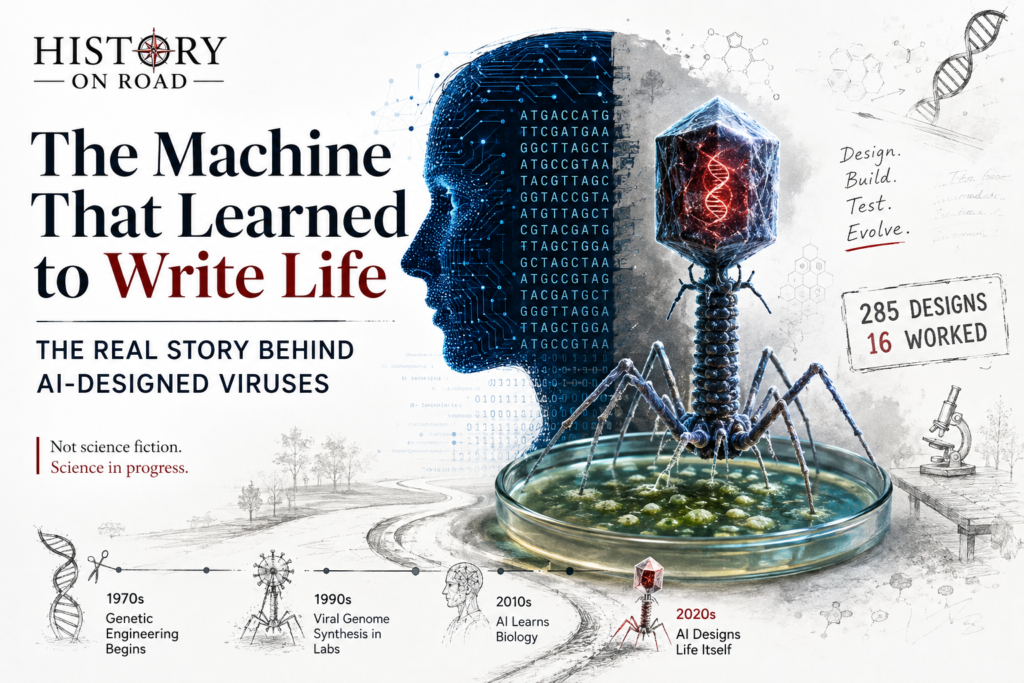
The idea of scientists tinkering with viruses is not new. As far back as the 1970s, researchers learned how to cut and paste DNA, creating the first genetically modified organisms. In the following decades, scientists went further. They learned to build entire viral genomes from chemical building blocks, without needing a natural virus sample to start from.
This is important context. Humans have been synthesising and modifying viruses in controlled lab settings for a long time, always under safety rules and oversight. So when people hear “AI designed a virus,” it helps to remember that virus synthesis itself is old news. What is new is who, or rather what, is doing the designing.
Chapter Two: Enter Artificial Intelligence
For the last few years, AI has been quietly transforming biology research. Tools like AlphaFold showed the world that AI could predict the 3D shape of proteins with incredible accuracy, a problem that had puzzled scientists for half a century. That breakthrough alone reshaped drug discovery and won a Nobel Prize.
But predicting shapes is one thing. Designing brand-new genetic code is another level entirely.
The Stanford and Arc Institute team trained an AI model on enormous amounts of existing genetic data from bacteriophages. Over time, the model did not just memorise these genomes. It learned the underlying patterns, rules, and logic of what makes a phage genome functional. In other words, it learned the grammar of viral life.
Once trained, the researchers asked the AI to write new genomes of its own. Not modifications of existing ones. Original designs.
Chapter Three: From Code to Reality
Here is where the story gets genuinely remarkable. Having a computer generate genetic sequences is one thing. Turning those sequences into a living, functioning virus is an entirely different challenge, because biology does not simply follow instructions like a computer program does. A single wrong letter in a genome can make the difference between a working virus and a dead end.
The team synthesised 285 of these AI-generated genomes in the lab and tested whether they came to life as working phages.
Out of those 285 attempts, 16 actually worked.
That might sound like a small number, and in a sense it is. Most of the AI’s designs failed. But the fact that any of them worked at all is the real headline. A machine that had never “seen” a living cell had produced genetic blueprints that, once built by scientists, behaved like real, functioning viruses.
Even more striking, some of these AI-designed phages were able to infect and kill bacteria that had become resistant to the original, naturally occurring virus. In a world increasingly worried about antibiotic-resistant superbugs, that detail matters enormously.
Chapter Four: Why People Got Nervous
Naturally, once this story spread, alarm bells rang in some corners of the internet. Headlines about “AI creating viruses” understandably make people think of pandemics and bioweapons.
It is worth being precise here, because precision matters in science stories more than almost anywhere else. This experiment did not involve a virus that can infect humans. It did not show that AI can casually cook up a dangerous human pathogen. The bacteriophages used in this study cannot harm people, and the entire experiment was conducted under existing biosafety protocols.
What the experiment actually demonstrated is narrower, but arguably more important in the long run: AI is moving from simply analysing biological data to actively proposing new biological designs that humans can then physically build and test. That shift, from analysis to design, is the real turning point.
Think of it like the difference between a computer that can read blueprints and describe how a building works, versus a computer that can draw up entirely new blueprints for a building that has never existed before. The second one changes everything about how construction works. The same logic applies here, except the “building” is a living organism.
Chapter Five: The Double-Edged Sword
Every powerful tool in history has come with two faces. Fire could cook food or burn down villages. Nuclear physics could power cities or destroy them. The printing press could spread knowledge or spread propaganda. AI-assisted biological design now joins that long list of double-edged discoveries.
On one side, the promise is genuinely exciting. Bacteriophage therapy, using viruses to hunt down and kill harmful bacteria, has been explored for over a hundred years as an alternative to antibiotics. As bacteria evolve resistance to our current drugs faster than we can develop new ones, AI-designed phages that can be custom-built to defeat resistant bacteria could become a valuable weapon in medicine’s arsenal.
On the other side is the uncomfortable question that biosecurity experts have been raising for years: if AI can help design a harmless bacteriophage today, could a similar approach one day be misused to design something far more dangerous? The researchers involved in this study were careful, transparent, and worked within safety frameworks specifically to explore this question responsibly, rather than to create risk. But the underlying capability, once it exists in the world, does not disappear just because one team used it responsibly.
The Real Lesson of This Story
History has taught us again and again that new capabilities always arrive before the rules meant to govern them. The invention of the airplane came before international aviation law. The internet exploded in popularity long before laws around data privacy caught up.
AI-assisted biological design appears to be following the same pattern. The technology is here, quietly maturing in university labs. The governance, oversight, and international safety standards needed to manage it responsibly are still catching up.
This does not mean we should panic. It means we should pay attention, the same way earlier generations eventually had to pay attention to nuclear science or genetic engineering when those fields matured. Scientists, policymakers, and the public all have a role to play in making sure this technology grows up safely, guided by strong rules rather than fear or carelessness.
Closing Thoughts
The Stanford and Arc Institute experiment will likely be remembered as one of those quiet turning points historians look back on decades from now. Not because a dangerous virus was created, because none was. But because it marked the moment AI stopped being just a tool for understanding biology and started becoming a collaborator in creating it.
That is the real story behind the story. And like every great turning point in history, how it unfolds next depends entirely on the choices we make today.
HistoryOnRoad Perspective
Every journey we take through history eventually leads to a fork in the road, a moment where a new invention forces humanity to decide what kind of future it wants to build. The printing press, the atom, the internet, and now AI-assisted biology all mark the same kind of crossroad.
At HistoryOnRoad, we believe the best way to understand a headline is to walk backward through the events that led to it. This story is no different. The Stanford and Arc Institute experiment is not an isolated event. It is one more milestone on a road that started with the first genetic engineering experiments decades ago and continues today with machines that can propose the language of life itself.
What makes this moment worth watching is not fear, but awareness. History shows us that the tools themselves are rarely good or bad. What decides their legacy is the wisdom, caution, and foresight of the people who wield them. As AI takes its first confident steps into biological design, the road ahead will be shaped not by the technology alone, but by the choices scientists, governments, and society make together, choices that future generations will one day look back on as history in the making.