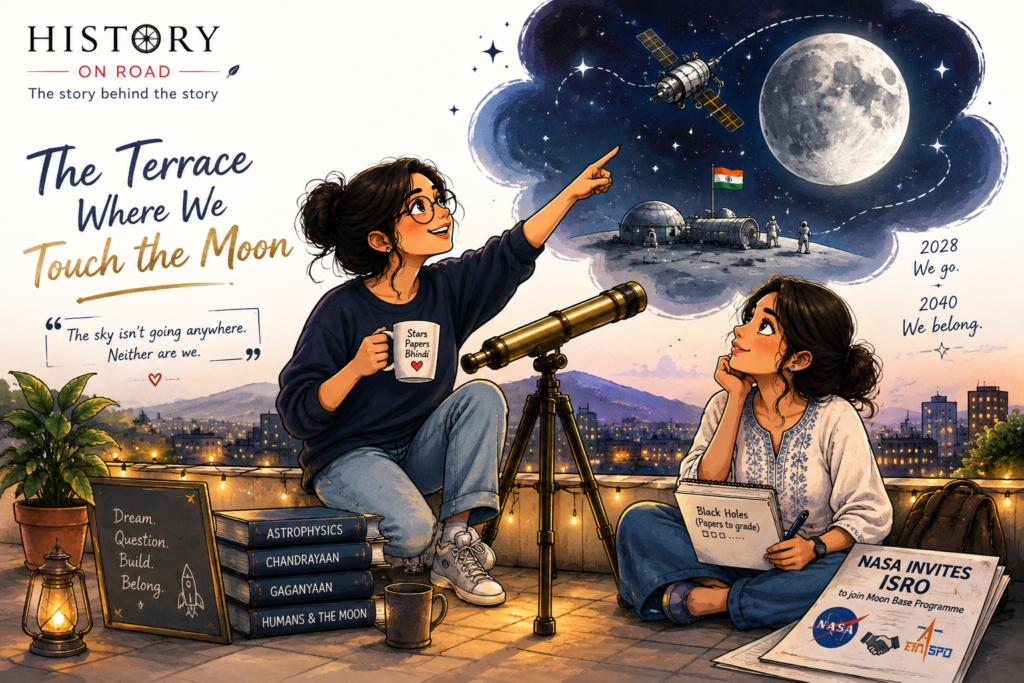

Two Skies, One Dream
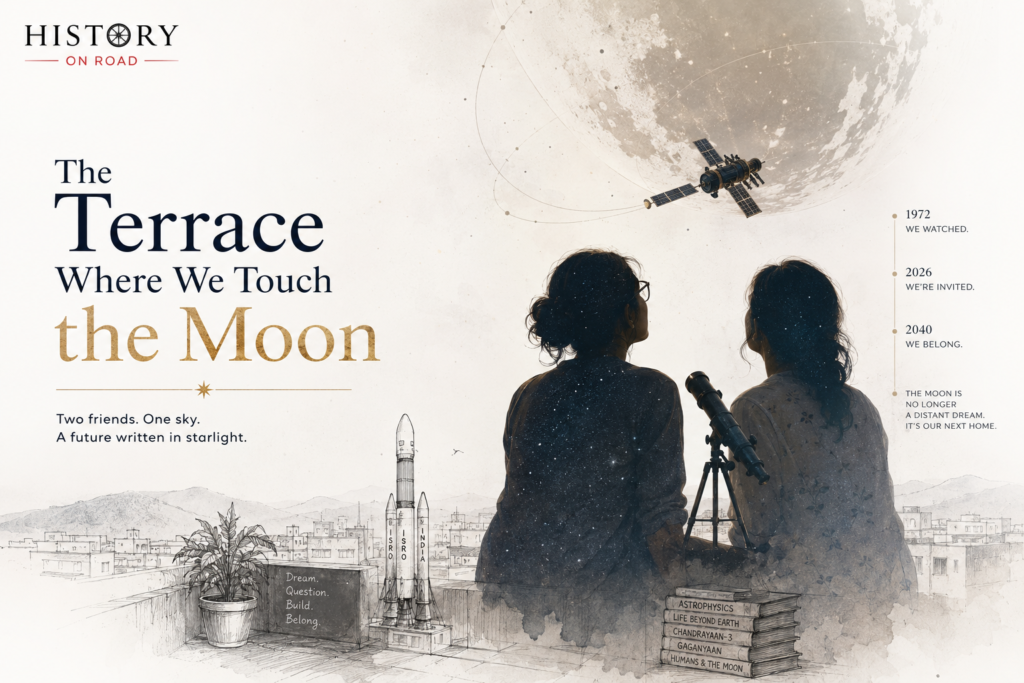
The evening had that particular Pune stillness — the kind that settles in after the monsoon rain has passed but before the streetlights fully take over the sky. On the terrace of an old bungalow near the college, a small brass telescope stood angled toward the east, dew already collecting faintly on its barrel.
Shloka was crouched beside it, one eye shut, adjusting the focus ring with the patience of someone who had done this a thousand evenings before. She heard footsteps on the stairs and didn’t turn around.
“You’re late again,” she called out. “Jupiter’s about to disappear behind the neem tree.”
Aditi stepped onto the terrace, dropping a canvas bag stuffed with ungraded answer sheets by the door. “I have eighty papers on black holes to grade, Shloka. Not everyone gets to spend their afternoon staring at journals and stars.”
“I spent my afternoon arguing with the vegetable vendor about the price of bhindi,” Shloka said, straightening up. “Then I read astrophysics papers. Multitasking.”
Aditi laughed and sat down on the low parapet wall. “Fine. Show me Jupiter before it’s gone.”
Shloka stepped aside and let her look. For a moment, neither of them spoke — that companionable silence that only forms between two people who have spent years talking about the same sky.
“Did you see the news today?” Shloka asked finally, still looking up.
“Which news? There’s always news.”
“NASA has invited ISRO to join its Moon Base programme.”
Aditi pulled her eye away from the telescope so fast she nearly knocked it off balance. “Wait — say that again.”
“You heard me the first time.”
“Shloka. The Moon Base programme? The one where astronauts actually live up there — not just land and leave, but stay, run experiments, build something permanent?”
“That one.” Shloka folded her arms, a small, satisfied smile on her face, the way she always looked when she’d managed to surprise her sharper, more formally trained friend. “Humans haven’t set foot on the Moon since 1972. Fifty-plus years, Aditi. And now there’s an actual plan to go back — and this time, to stay.”
Aditi sat back down slowly, as though the weight of it needed a place to land. “I read that the U.S. wants boots on the ground before 2028, through Artemis. But a permanent base — that’s a different order of ambition altogether.”
“Exactly. And NASA isn’t asking to lead it alone. It’s inviting partner countries. Private companies too.” Shloka paused. “And ISRO is one of the countries on that list now.”
“That’s not a small thing,” Aditi murmured.
“It’s not a given thing either,” Shloka said, more firmly. “That’s what I keep turning over in my head. Nobody hands you a seat at a table like this. You get invited because you’ve already proven you can build the table yourself.”
Aditi looked at her friend properly now, the way she sometimes looked at a student who had just asked a question sharper than the syllabus expected. “Go on. I know that tone. You’ve been thinking about this all day.”
Shloka sat down across from her, elbows on her knees. “Think about it, Aditi. Chandrayaan-3 didn’t land near the lunar south pole because someone lent India the technology. We built that ourselves — on a fraction of the budget any other space agency would call ‘lean.’ Gaganyaan is being built to send Indian astronauts into orbit on Indian rockets, launched from Indian soil. NASA isn’t inviting ISRO because the Moon Base project needs charity partners. It’s inviting ISRO because it needs partners who know how to solve very hard problems efficiently.”
“So you’re saying this is a compliment,” Aditi said, half-smiling.
“I’m saying it’s a result.” Shloka’s voice sharpened, not unkindly. “Results, not compliments, are what get you invited to build a Moon base.”
Aditi was quiet for a moment, turning the thought over. “But there’s a question underneath all of this that worries me a little.”
“Which is?”
“ISRO already has its own roadmap. An Indian astronaut on the Moon by 2040 — that’s our own mission, our own timeline, decided by us, for reasons that matter to us. My worry is—” she hesitated, choosing her words carefully, “—what happens if ‘cooperation’ quietly becomes ‘dependence’? What if helping build someone else’s Moon Base ends up slowing down our own Moon landing, because all the best scientists, all the funding, all the political attention gets pulled toward their deadlines instead of ours?”
Shloka nodded slowly, taking the concern seriously rather than brushing past it. “That’s a fair worry. And I don’t think the answer is simple. But I keep coming back to one idea: cooperation is only worth having if it makes you more yourself, not less. If working alongside NASA on the Moon Base gives ISRO’s engineers hands-on experience with crewed lunar operations — habitat design, radiation shielding, long-duration life support — that’s knowledge ISRO can fold directly into its own 2040 mission. That’s not losing time. That’s compounding it.”
“And if it doesn’t work that way?” Aditi asked. “If it turns into a distraction dressed up as an opportunity?”
“Then ISRO says no to the parts that don’t serve its own goals,” Shloka said simply. “That’s the whole point of being invited as a partner, not absorbed as a subordinate. India signed the Artemis Accords already. It agreed with the U.S. to build a framework for human spaceflight cooperation. Those are choices, Aditi — not obligations. Choices can be renegotiated. Obligations can’t.”
Aditi exhaled, some of the tension leaving her shoulders. “You always do this. You take something that’s been rattling around in my head all day and hand it back to me smaller and clearer.”
“I’ve had longer to think about it,” Shloka said. “You’ve been busy explaining projectile motion to eighteen-year-olds since eight in the morning.”
“True.” Aditi allowed herself a laugh. “Although — imagine explaining this to them instead. Imagine standing in front of that classroom tomorrow and saying, ‘By the time some of you are my age, there may be an Indian astronaut living on the Moon.’ Not visiting. Living. Sleeping in a habitat under earthlight, running experiments no one’s ever been able to run before.”
“Say it,” Shloka said. “They need to hear it from someone who actually believes it.”
“Some of them won’t believe it,” Aditi admitted. “There’s a girl in my second row — brilliant, honestly, one of the sharpest minds I’ve taught in years — who still won’t raise her hand unless she’s absolutely certain she’s right. She thinks physics is ‘for people who already know things,’ not for people who are still learning.”
“Tell her about tonight,” Shloka said quietly.
Aditi looked at her. “What do you mean?”
“Tell her there’s a woman who never finished a science degree, who spends her mornings bargaining over vegetables and her evenings reading papers on lunar regolith, sitting on a terrace with a telescope her father gave her twenty years ago — and she understood exactly what today’s news meant within an hour of reading it. Tell her that not knowing everything yet has never been a reason to stop looking up.”
Aditi didn’t answer right away. She simply looked at Shloka the way you look at something you’ve always known but needed to hear out loud.
“You should have been the one standing in front of that classroom,” she said finally.
“No,” Shloka said, without a trace of bitterness. “I like it better up here. Nobody grades me on attendance.”
They both laughed, and for a while, neither spoke. Above them, the sky had cleared further, the city’s usual haze thinning just enough to reveal a scattering of faint stars that Pune rarely offered so generously. Somewhere in that darkness — unseen, unhurried — a satellite crawled steadily across the horizon, doing its quiet work far above every argument, every ambition, every uncertain headline down below.
“You know what strikes me most about all of this?” Aditi said eventually, her voice softer now. “It isn’t really about America or India, or accords, or timelines. It’s about the fact that fifty years ago, going to the Moon was something that happened to other people, in other countries, on grainy footage we watched from a distance. And now, however this partnership unfolds, it’s genuinely possible that someone born in this country — maybe even someone I’ve taught — could end up living up there.”
“That’s the part worth holding onto,” Shloka agreed. “Not the politics of who invited whom. The fact that the door is open at all — and that it opened because people did the unglamorous work of earning it, one small, careful step at a time. Rockets don’t get built in press conferences, Aditi. They get built in years of testing, failing, adjusting, testing again. Nobody claps for that part. But it’s the only part that actually gets you off the ground.”
Aditi stood up slowly, brushing the dust off her kurta, glancing at her watch. “I should go. Eighty papers on black holes aren’t going to grade themselves.”
“Same time next week?” Shloka asked, already turning the telescope back toward the sky.
“Same time,” Aditi said, pausing at the top of the stairs. “Jupiter should be higher by then.”
“The sky isn’t going anywhere,” Shloka said. “Neither are we.”
Aditi smiled and made her way down into the warm, humming streets of the city, the sound of scooters and distant television sets rising to meet her. But some part of her stayed up on that terrace a little longer than the rest of her — caught between the telescope’s quiet gaze and the vast, patient dark it pointed toward.
She thought about the invitation, about the accords and the arguments still to come, about the girl in the second row who didn’t yet believe physics belonged to her. And she thought, most of all, about two women on a terrace who had needed no permission, no invitation, and no institution to already understand what tomorrow’s headlines were only just beginning to describe: that the Moon, at last, was becoming something India didn’t merely watch from a distance — but something India was finally being asked to help build.