

A HistoryOnRoad Travel Diary — by Ganesh
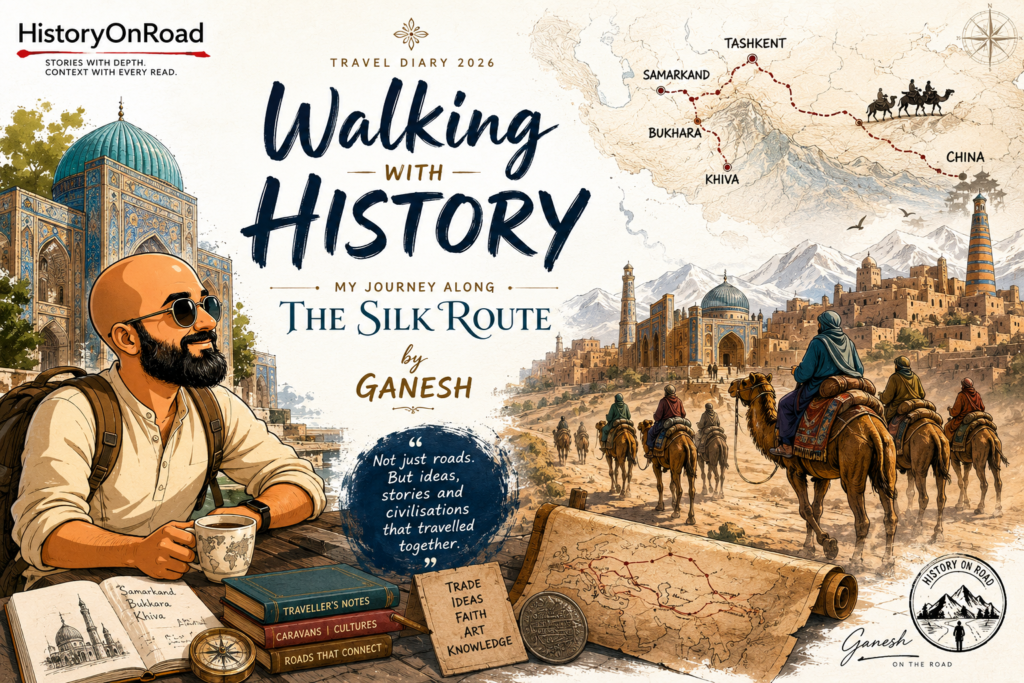
I did not plan this trip to learn history. I planned it to walk somewhere old. But somewhere between Tashkent’s airport lounge and my first cup of green tea in Samarkand, I realised the Silk Route doesn’t let you keep history at a distance. It walks beside you — quietly, at your pace, pointing things out you’d have otherwise missed.
This is that account.
Day 1 — Tashkent: Where the Modern City Still Remembers
Tashkent didn’t feel ancient at first. Wide boulevards, glass buildings, a metro system with stations that look more like art galleries than transit stops. For a moment, I wondered if I’d come looking for the wrong city.
Then I found the old town — Chorsu Bazaar, its blue dome rising over a market that has, in some form, existed on this spot for centuries. Traders once stopped here not because Tashkent was the destination, but because it was the pause — a resting point where northern and southern trade paths met before splitting again toward Persia, India, or China.
Standing under that dome, watching a spice seller weigh dried apricots on a hand scale, I felt history lean in for the first time. This is what never really changed, it seemed to say. Only the currency did.
Day 2 — Samarkand: The City That Refused to Be Forgotten
Nothing prepares you for the Registan.
I’d seen photographs. They lied — not about the colours, but about the scale. Three madrasahs face each other across a square that feels less like architecture and more like a held breath. The turquoise tilework catches the afternoon light differently every hour, and I found myself returning to the same spot three times in one day just to watch it shift.
Samarkand’s real gift to the Silk Route wasn’t just its location — it was its ambition. In the 14th and 15th centuries, this city became a deliberate centre of learning under Ulugh Beg, a ruler more interested in astronomy than conquest. I visited the remains of his observatory on the city’s edge — a curved underground track once used to measure the stars with startling precision for its time.
Here, history didn’t just walk beside me. It sat down. It wanted me to slow down and notice that trade routes carried more than silk and spices — they carried ideas, instruments, and questions people were still asking in the dark, about the sky above them.
Day 3 — Bukhara: A City Built Like a Memory
If Samarkand is grand, Bukhara is intimate. Its old town is walkable in a way few historic cities are — narrow lanes, sun-baked brick, doorways that open unexpectedly into courtyards.
I spent an early morning at the Ark, the old fortress that watched over the city for over a thousand years, and later wandered to the Kalyan Minaret — tall enough, locals told me, that it once served as a landmark for caravans approaching from days away in the desert. I tried to imagine that: a structure built not for defence, not for prayer alone, but partly as a beacon — a promise of rest visible long before you reached it.
By evening, sitting near a centuries-old trading dome now filled with small artisan stalls, I bought nothing but stayed for over an hour. A woodworker showed me a technique passed down, he said, through his family for five generations. I didn’t ask him to prove it. Some things don’t need footnotes.
Day 4 — The Desert Crossing: Where History Goes Quiet
Between Bukhara and Khiva lies a long stretch of desert — hours where the landscape empties out and conversation in the car naturally slows.
This, I think, is where the Silk Route’s real character reveals itself. Not in the cities, but in the distances between them. Caravans didn’t move for weeks at a time because the destinations were far — they moved because survival itself was the daily task. Water, shade, direction — these were the currencies that mattered most out here, long before silk or spice.
I didn’t try to fill this part of the diary with facts. Some stretches of history are better felt as silence.
Day 5 — Khiva: The City That Stopped in Time
Khiva surprised me the most. Its old town, Itchan Kala, is compact enough to walk end to end in under twenty minutes — and yet it holds centuries inside it, preserved almost like a paused frame.
I climbed the unfinished Kalta Minor minaret’s base at sunset, its turquoise tiles glowing against a sky doing something similarly dramatic. Below, the town’s mudbrick walls turned gold, then rust, then grey, in the span of maybe fifteen minutes.
It struck me here, more than anywhere else on this trip, that the Silk Route was never really one road. It was a network — flexible, shifting, rerouted by weather, politics, and opportunity across centuries. Khiva, Bukhara, and Samarkand didn’t all rise at once. They took turns holding the route’s attention, decade by decade, empire by empire.
What History Left Me With
On my last evening, back in Tashkent, I sat with a pot of tea and tried to write down what I’d actually learned — not dates, not dynasties, but something closer to a feeling.
The Silk Route was never really about silk. It was about the willingness to go — merchants, scholars, monks, and travellers who accepted that a long, uncertain road might still be worth walking, if what waited on the other side was knowledge, goods, or simply a story worth telling later.
I came here as a traveller in 2026. But for five days, I moved at the pace of caravans that crossed this same ground centuries before satellites, before highways, before anyone thought to draw these paths on a map. History didn’t just show me old buildings. It reminded me that roads outlive the people who first walked them — and that if you walk slowly enough, they’ll still tell you their story.
This is the first entry in HistoryOnRoad’s ongoing travel diary series. Next stop: the Grand Trunk Road, from Kabul to Kolkata.