
A HistoryOnRoad Travel Diary — by Ganesh
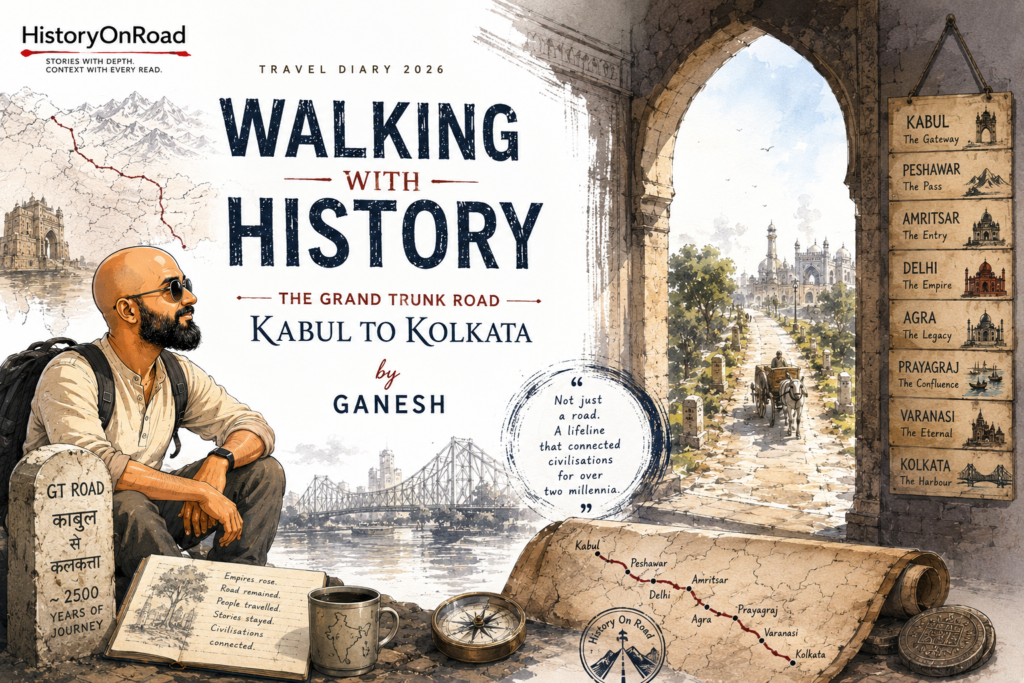
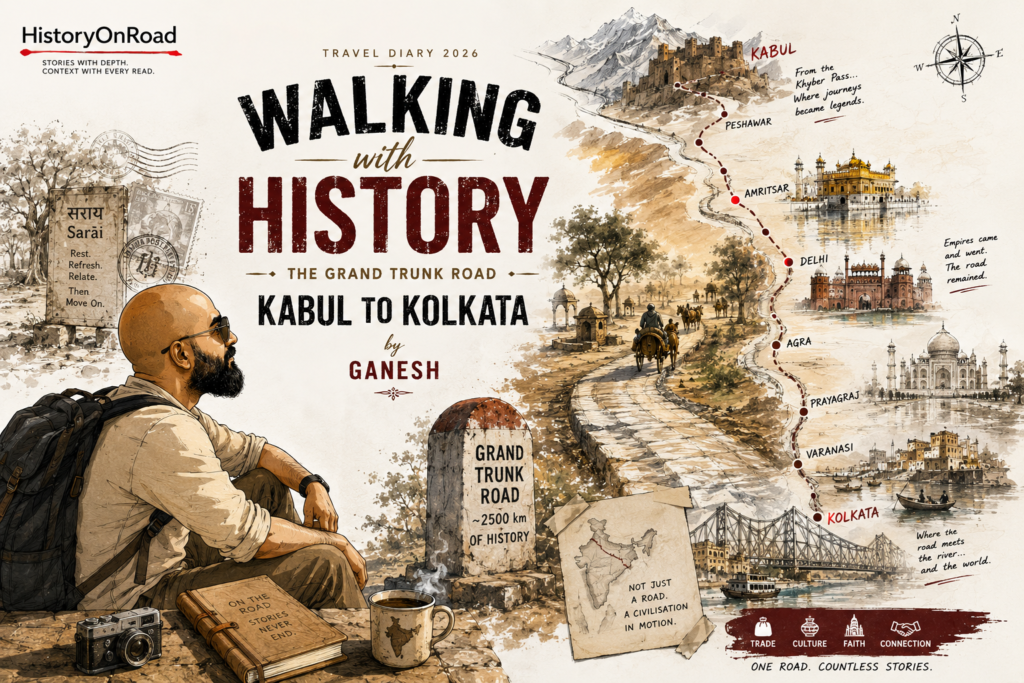
Some roads are older than the countries they now pass through. The Grand Trunk Road is one of them.
Long before it carried that name, it existed as the Uttarapatha — the northern route — connecting the Indo-Gangetic plain to lands far beyond it, used by traders and travellers as early as the Mauryan era, over two thousand years ago. In the 16th century, the ruler Sher Shah Suri rebuilt and extended it into a proper trunk route, planting shade trees, building wells and rest-houses along its length, and setting up a postal relay system that let messages move faster than they ever had before. The British later stretched it further still, until it ran, on paper at least, from Kabul to Kolkata — one of the longest continuously used roads in the world, carrying nearly two and a half thousand years of footsteps, wheels, and stories.
I couldn’t walk all of it. Some stretches, today, aren’t open to a traveller like me. But I could walk enough of it to feel its age — and that’s the account I’ve written here.
Where the Road Begins — In Memory, If Not on My Route
Kabul and Peshawar mark the road’s historic western edge, threaded through the Khyber Pass — a corridor traders, armies, and travellers used for centuries to move between Central and South Asia. Caravans once carried dried fruit, horses, and textiles through that pass, exchanging them for goods moving the other way — spices, cotton, ideas.
My journey this time didn’t take me that far west; present-day travel realities kept that stretch out of reach. But it felt important to acknowledge where the road begins, even if my footsteps picked it up further east. History, I’ve learned, doesn’t mind being remembered from a distance. Some places we visit with our feet. Others, we visit only in the mind — and both, I’ve come to think, count as travel.
Day 1 — Amritsar: The Road Enters India
I picked up the road properly in Amritsar, where the Grand Trunk’s old alignment still runs close to the modern highway. Before visiting the Golden Temple at dawn — its reflection in the sarovar so still it looked painted — I spent an hour simply standing near the old road’s edge, trying to picture it as Sher Shah Suri’s engineers once built it: packed earth, shaded by rows of trees, dotted every few kilometres with a sarai — a rest-house — for travellers to stop, water their animals, and sleep safely before continuing on.
Almost none of those original sarais survive today. A few crumbling foundations remain here and there, half-swallowed by newer construction, easy to miss if you don’t know to look. But the rhythm they created — a road punctuated by rest, not rushed in one stretch — still shapes how this route feels, even now. Modern highways move faster, but they’ve lost that built-in patience. I found myself missing it, oddly, even though I’d never experienced it myself.
Later that morning, over a plate of chhole bhature at a roadside dhaba, an elderly shopkeeper told me his family had run some version of a food stall along this road for three generations. “The road changes,” he said, “but people still need to eat before they keep moving.” It struck me as the simplest possible summary of everything the Grand Trunk Road has ever been.
Day 2 — Delhi: Where Empires Kept Rebuilding the Same Road
Delhi’s relationship with the Grand Trunk Road is less about one moment and more about repetition. Successive rulers — from the Delhi Sultanate through the Mughals to the British — all understood the same thing: control the road, and you control the movement of grain, soldiers, and information across the north.
I walked a stretch near the Red Fort in the late afternoon, watching the traffic move much faster than any caravan ever could, and tried to imagine the same ground centuries earlier — carts, horses, pilgrims, and merchants converging here because every version of the road, no matter which empire redrew it, still passed through Delhi. Some cities earn their place on a map by geography. Delhi earned it by simply being unavoidable.
I spent part of the evening at a quiet stretch near Old Delhi’s spice market, where the smell of dried chillies and cardamom drifted out into the lane. Markets like this one, I was told, have operated in roughly the same location for centuries — outlasting whichever power happened to be governing the city at the time. Empires rose and fell around this road. The road, and the trade it carried, simply continued.
Day 3 — Agra: A Detour the Road Insisted On
Technically, Agra sits slightly off the most direct line of the Grand Trunk Road — but no historical account of this route feels complete without it. The Mughals shifted their capital here in the 16th century, and for a period, trade and travel patterns bent to accommodate the city’s importance.
I visited the Taj Mahal early, before the crowds arrived, and found myself thinking less about the monument itself and more about the road that had to carry the marble here — some of it transported from Rajasthan, some reportedly from further still. Long before the Taj existed, this stretch of road was already carrying resources, ideas, and people. The monument is what most travellers remember. The road is what made it possible.
Walking back through Agra’s older lanes later that day, I passed a small workshop where a craftsman was inlaying stone in the same pietra dura style used on the Taj itself — a skill, he mentioned, taught to him by his father, who’d learned it from his own. Four centuries after the monument was completed, the road that once carried marble to this city is still, in its own quiet way, carrying a craft forward.
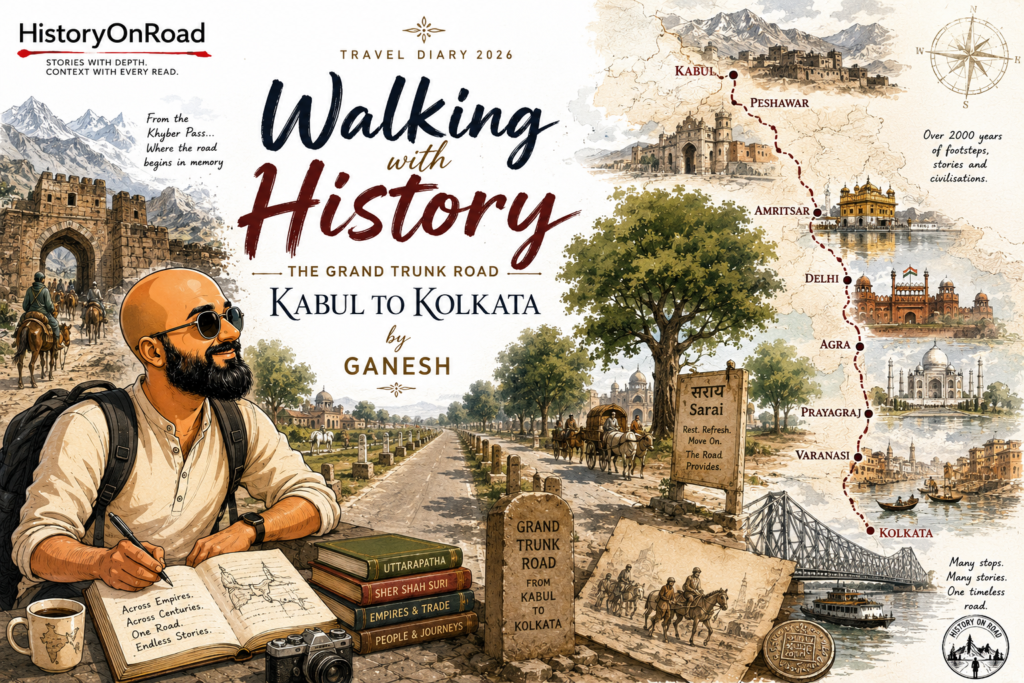
Day 4 — Prayagraj and Varanasi: The Road Meets the River
Further east, the Grand Trunk Road runs close to the Ganga for a long stretch, and here the journey started to feel different — less imperial, more spiritual. In Varanasi, I watched the evening aarti at the ghats, the road just behind me, the river just ahead — two very different kinds of movement, human and sacred, running parallel.
Historically, this stretch of the road carried pilgrims as much as merchants. Trade and faith moved together here, and I found that combination hard to separate even today — a boatman near the ghats spoke about his family’s generations on the river with the same quiet pride a trader might once have used to describe a well-worn trade route. He rowed slowly, pointing out temples along the bank, each one, he said, older than the last person who’d told him its story.
Sitting by the river that night, I realised the Grand Trunk Road doesn’t really end at any single point along here — it simply hands its travellers over to the water, and the water carries them the rest of the way.
Day 5 — Kolkata: Where the Road Meets the Sea
The Grand Trunk Road’s eastern end brought me to Kolkata — a city built by colonial trade, but layered over a much older network of routes that predate British arrival. Walking near the Hooghly River, watching cargo ships move slowly past old warehouses, I thought about how the road’s final stretch wasn’t really an ending at all. It was a handover — from land route to river, from river to sea, connecting inland trade to a wider maritime world.
Near Howrah Bridge, I watched porters carry goods on their heads through the evening crowd, moving with a rhythm that felt, oddly, like an echo of the caravans I’d been imagining all week — different cargo, different century, same essential task: getting something from one place to another, on foot, by will.
It felt fitting that a road built to move goods across a continent would end at a point built to move them across oceans.
What the Road Taught Me
Retracing even part of the Grand Trunk Road left me with one clear impression: this isn’t a single historical achievement belonging to one ruler or one era. It’s a layered project — Mauryan foundations, Sher Shah Suri’s rebuilding, Mughal expansion, British reinforcement — each generation adding to a road too useful to ever fully abandon.
I didn’t walk from Kabul to Kolkata. Almost no one could, not anymore, not in one uninterrupted journey. But standing at different points along its length — Amritsar, Delhi, Agra, Varanasi, Kolkata — I felt something the map alone couldn’t show me: this road was never really about the two endpoints. It was about everything, and everyone, that happened in between — the shopkeepers, the craftsmen, the boatmen, the porters — all still, in their own way, keeping the road’s oldest promise: that if you keep moving, somewhere ahead, rest and exchange will be waiting.
This is the second entry in HistoryOnRoad’s ongoing travel diary series. Next stop: the old Deccan trade routes, from Pune to the Konkan coast.