

A Special Report on Civility, Disruption, and the Quiet Cost of a Democracy That Won’t Sit Down and Talk
Story + Report by HistoryOnRoad
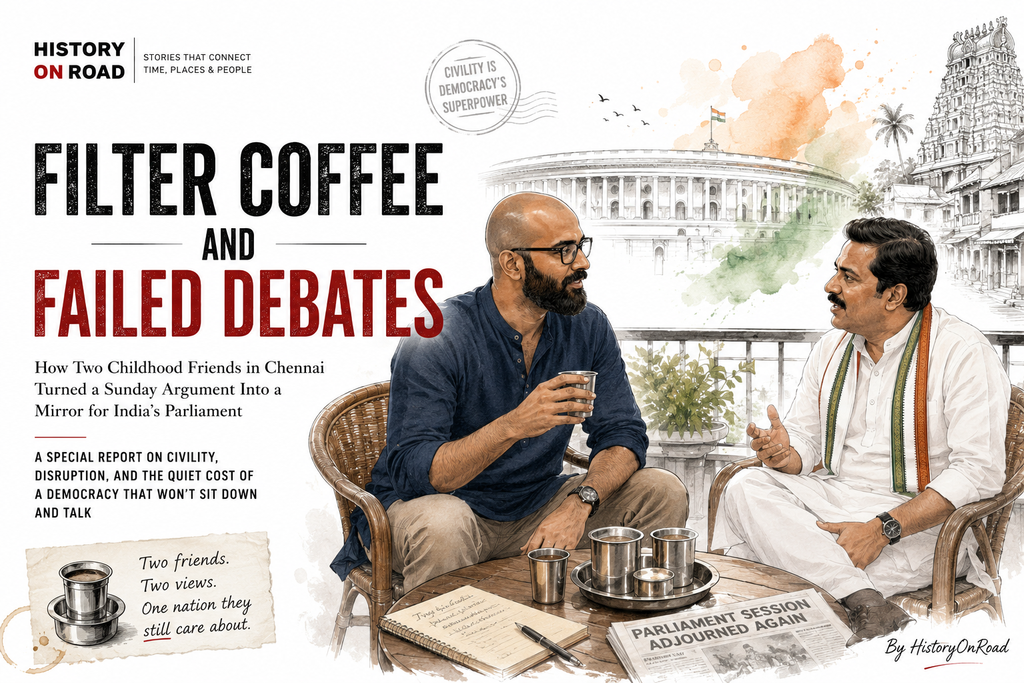
CHENNAI — On the last Sunday of every month, two men sit on a third-floor balcony overlooking a quiet Mylapore lane, and argue about the state of the nation. Neither of them will ever be quoted in a newspaper. Neither of them has ever stood for election, addressed a rally, or been photographed outside a legislature. And yet, in their small, recurring argument over filter coffee, there is something that resembles the exact debate now consuming the country’s institutions — a debate about what happens when the will to be heard collides with the will not to listen.
This is their story. It is also, in a smaller way, a report on a problem far bigger than either of them: the slow erosion of functioning debate in India’s legislatures, and the everyday citizens left paying for it.
Part I: The Argument
Satya Menon had a rule he lived by: never discuss politics before the second cup of filter coffee. It had served him well for eleven years — through three jobs, two apartment shifts, and one particularly bruising performance review at the IT park in Sholinganallur where he now led a team of database engineers. But on the last Sunday of the month, when Ranjit Deshmukh came over with a box of Mysore pak and a mood already spoiling for an argument, the rule rarely survived past the first sip.
“You saw the session, no?” Ranjit said, dropping into the cane chair on Satya’s balcony without waiting for an invitation. “Complete washout. Days of sitting time, and what did we get? Slogans and adjournments.”
Satya poured the coffee slowly, the way his grandmother had taught him, letting the decoction fall in a thin brown thread from the davara into the tumbler. “You’re going to blame the Opposition for that, obviously.”
“Who else? They didn’t let the House function.”
“Because nobody would let them speak,” Satya said. “That’s usually how it goes. Somebody decides an issue is too uncomfortable to discuss, and somebody else decides the only way to be heard is to make sure nothing else gets discussed either.”
Ranjit laughed, but it had an edge. “Careful, Satya. Talk like that and you’ll start sounding like my father.”
That, of course, was the joke that wasn’t really a joke. Ranjit’s father, Vasant Deshmukh, had spent thirty years climbing the unglamorous rungs of local politics in Chennai — first as a ward councillor near Adyar, then a longer stint helping coordinate his party’s local body work across the city, and now a sitting municipal representative known more for solving stormwater-drain complaints before the monsoon than for making speeches. He was not a man who appeared on television debates. He was a man who appeared at 6 a.m. outside ration shops, complaint register in hand, arguing with a supply officer about a delayed sack of rice.
Satya had grown up two doors from the Deshmukhs, back when both families lived in the same modest housing colony off Luz Church Road. He remembered Vasant uncle as the man who fixed the streetlight outside their building three separate times, who once sat with Satya’s father for four hours arguing about a Ranji Trophy match and never once mentioned an election. Politics, in Satya’s childhood memory, had a human face before it had a party symbol.
“I’m not blaming your father,” Satya said. “I’ve never blamed your father for anything except that terrible mimicry of Kishore Kumar he does at every wedding.”
“He thinks he’s very good at it.”
“He is objectively not.”
They both laughed, and for a moment the balcony felt like it always had — two friends who had grown up in the same lane, now grown into men who filed taxes and worried about EMIs and argued about cricket captains, except that one of their fathers now held elected office and the other did not.
But Ranjit wasn’t quite done. “You IT people sit in your glass buildings and complain that Parliament doesn’t function, but you’ve never once stood in a queue outside a government office trying to get a certificate corrected. You don’t know what it costs to be ignored. Sometimes disruption is the only language that gets heard.”
“And you political families,” Satya shot back, though gently, “have forgotten what it costs the rest of us. I pay taxes so that House can sit and work. Every walkout, every adjournment — that’s public money sitting idle, buying nothing. I don’t get to disrupt my sprint planning because I disagree with my manager. I raise the issue, argue it, and if I lose the argument, the work still ships.”
“It’s not the same thing, Satya.”
“I know it’s not the same thing. But tell me honestly — does your father come home happy after a session like the one we just had?”
Ranjit was quiet for a second. “No. He comes home more tired than after ten ward meetings put together. He says the disruptions from his own side embarrass him almost as much as the ones from the other side. He says people used to at least share a cup of tea between sittings. Now, people from opposing parties barely make eye contact in the corridor.”
Part II: The Report — What the Argument Is Really About
Satya and Ranjit’s disagreement is fictional. The condition they are describing is not.
Every legislative session in recent memory, whether in Parliament or in a state assembly, has tended to follow a familiar arc: an issue the Opposition insists must be debated, a government reluctant to open that particular door, a standoff that spills from the floor of the House into repeated adjournments, and a final tally in which sitting days are lost, bills are passed with minimal scrutiny, and citizens are left without the record of debate that a democracy depends on for accountability.
Parliamentary researchers and long-serving officials who track sitting hours have repeatedly noted a pattern: disruption is rarely only about the issue at hand. It is often the last resort of a side that feels structurally shut out of debate — denied time, denied a discussion slot, or denied the assurance that raising an issue will lead anywhere except a scripted, unsatisfying answer. At the same time, treasury benches often treat any concession to the Opposition’s demand for debate as a political defeat rather than a procedural courtesy, hardening a cycle where neither side wants to make the first conciliatory move.
The costs are not abstract. Every hour a legislature does not sit is an hour in which Question Hour goes unused, Zero Hour mentions go unraised, and ordinary constituency matters — a delayed pension, a stalled drainage project, a hospital short of staff — go unspoken on the floor of the House, even though these are often the very issues elected representatives were sent there to raise. Bills, meanwhile, do not stop moving simply because debate has. They are frequently passed anyway, sometimes in minutes, amid the noise — meaning the laws that shape citizens’ lives can clear the legislative process with less scrutiny than a routine office memo.
This is the quiet paradox that both frustrates people like Satya and complicates people like Vasant Deshmukh: disruption as a tool of protest ends up muting the very institution disruption is meant to hold accountable.
Older members of India’s legislatures — across parties, across states — often recall, in interviews and memoirs, a different working culture: one where floor rivalries did not preclude personal courtesy, where political opponents visited each other in hospital, attended family functions, and occasionally worked together informally to get local matters resolved, even while sparring bitterly during debate hours. Whether that memory is fully accurate or gently romanticised by time is itself debated among historians of Indian parliamentary practice. What is not disputed is that today’s environment, shaped by shrinking sitting days, hardened party discipline, and the amplifying effect of round-the-clock media coverage, offers far fewer quiet spaces for that older kind of relationship to form.
Part III: The Argument, Continued
“You know what the worst part is?” Ranjit said finally, back on the balcony, turning his empty tumbler in his hands. “Neither side is entirely wrong. The Opposition has genuine issues that deserve a debate. The government has genuine reasons it doesn’t want to be cornered on some of them. But instead of fighting that out in the House, where it’s supposed to happen, everyone fights it out through disruption and stonewalling, and we — the actual public — get nothing. No debate, no answers, just noise.”
“So what do we do? You and me, sitting on this balcony?”
Ranjit smiled, a little sheepishly. “Nothing dramatic. But maybe I stop assuming that everyone who criticises my father’s party is against him personally. And maybe you stop assuming every disruption is theatre and nothing else.”
“Deal,” Satya said. “Also, deal that you stop humming Kishore Kumar songs off-key in my house.”
“That one I can’t promise.”
Satya set down his tumbler and looked out at the lane below, where a corporation worker was testing a newly repaired streetlight, flicking it on and off, unhurried, unwatched by any camera. “Your father used to tell a story,” he said, “about two ward councillors from our old area — bitter rivals on the floor of the local council, closest friends outside it. One of them fell seriously ill once, and the other cancelled three of his own public meetings just to sit outside the hospital. Nobody made a headline out of it. It was simply what people did.”
“You think that still exists?”
“I think it exists in your father,” Satya said. “I’ve seen him help the family of his rival councillor get a hospital bed during the pandemic. He never mentioned it in a single speech. I only know because your mother told mine.”
Ranjit didn’t answer right away. “He’d be embarrassed you brought that up.”
“That’s exactly why I’m bringing it up. The moment something decent stops being useful for a press release, we’ve decided it doesn’t count as politics anymore. We only notice the shouting.”
They sat in a silence that old friends can afford, filled only by Sunday traffic on the main road below and, three floors down, someone’s television playing a cricket highlights reel.
Part IV: Why It Matters
Democracies are not sustained only by elections, or by the formal machinery of bills and votes. They are sustained, in far less visible ways, by the everyday habits of citizens who continue to argue, disagree, and still show up for each other — across dinner tables, balconies, and old friendships that predate any party affiliation.
Institutional dysfunction at the level of Parliament or a state legislature is real, measurable in lost sitting hours and unanswered questions, and it deserves the scrutiny it receives. But it is worth remembering that the health of a democracy is also quietly renewed at a smaller scale: in whether a taxpayer and a politician’s son can still finish a difficult conversation with a joke instead of a slammed door; in whether rival public servants can still privately help each other’s constituents; in whether disagreement, at the personal level at least, still ends in relationship rather than rupture.
Neither Satya nor Ranjit can fix a stalled legislative session. But their argument — repeated, imperfect, and ultimately unresolved — is itself a small act of civic maintenance, the kind that rarely makes it into any report.
HistoryOnRoad Perspective
History rarely announces itself in the moment. It is rarely a walkout or a headline or a viral clip from the well of the House. More often, it is a streetlight fixed for the third time in a Chennai lane, a rival’s family helped without a press release, two old friends arguing gently over filter coffee about how their country ought to govern itself.
Satya and Ranjit are not real people, and their conversation resolves nothing that India’s actual institutions have not already struggled with for decades. But the impulse behind their argument — the wish to be heard, the wish to be taken seriously, the wish for disagreement to end in decision rather than deadlock — is as old as public life itself. Every generation inherits a Parliament, a legislature, a corporation council, and must decide anew whether disagreement will be a bridge or a wall.
The stories that matter most to HistoryOnRoad are usually not the ones fought in the well of the House. They are the ones fought, and sometimes gently won, on ordinary balconies, between ordinary citizens, over a second cup of filter coffee neither of them really needed. That, too, is history — quieter, slower, and perhaps more durable than anything shouted into a microphone.
— HistoryOnRoad