
A fictional story by HistoryOnRoad
Setting
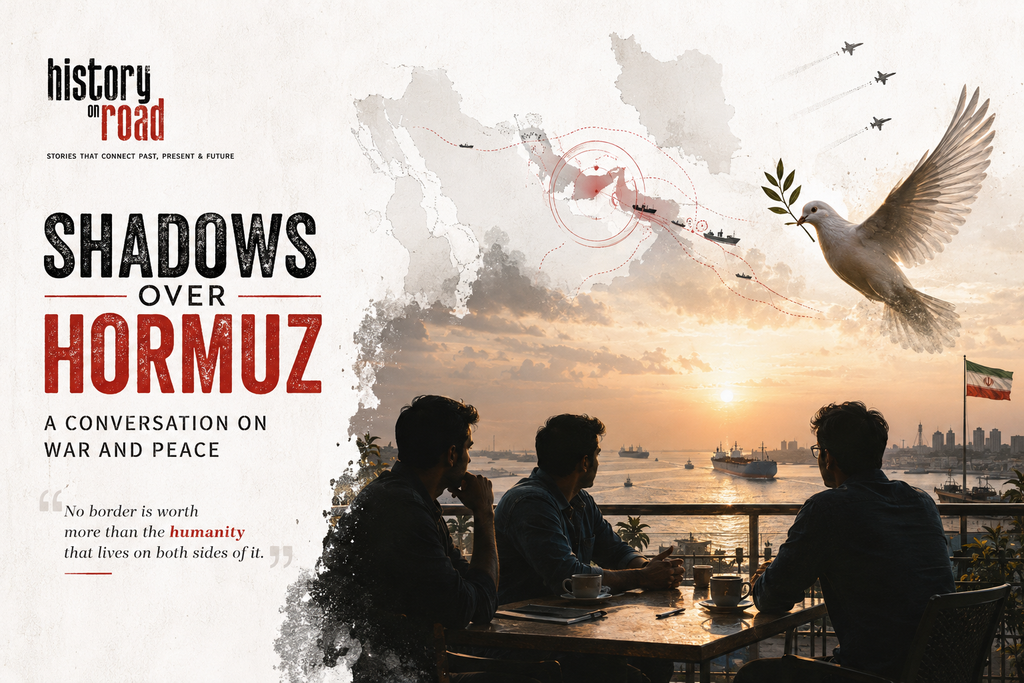
A quiet rooftop cafe in Indiranagar, Bengaluru. The evening traffic hums below, but up here the air feels calmer, almost detached from the noise of the world. Three friends who studied together years ago meet every few months to argue, laugh, and think out loud. Tonight, the television inside is playing breaking news about a new flashpoint in the Strait of Hormuz. Trunal, Vaibhav, and Shiva settle into their usual corner table, coffee cups steaming between them.
The Conversation
Trunal set his phone face down on the table, as if trying to physically distance himself from the headlines. “Another island, another airstrike, another round of retaliation. I keep asking myself the same question every time this happens. What did history teach us that we still refuse to learn?”
Vaibhav leaned back, arms crossed. “History teaches plenty, Trunal. It teaches that deterrence works. A rocket launcher on an island near a shipping lane is not a hypothetical threat, it is a loaded gun pointed at global trade. When someone strikes first, sometimes the only language left is force.”
“Force is never the only language,” Trunal replied gently. “It is simply the loudest one, and loud does not mean wise. Every war we have ever studied began with someone convinced that this time, force would finally settle things once and for all. It never does. It just writes a new chapter of grief for someone else to inherit.”
Shiva, who had been quietly stirring his coffee, finally spoke. “I look at this differently, from where I sit. My work is protecting networks, not battlefields, but modern conflict does not stay inside straits and deserts anymore. The moment missiles fly in the Gulf, power grids get probed, banks get tested, hospitals get targeted by ransomware crews hiding behind flags of convenience. War today has no borders. It leaks into every server room, every fuel pipeline, every family’s electricity bill.”
Vaibhav nodded slowly. “That part is true. But tell me, Shiva, if a nation does not respond to provocation, what message does restraint send to those calculating whether aggression carries a price?”
“A message of strength, not weakness,” Trunal said, “if restraint is paired with diplomacy rather than fear. My old professor used to say something I still repeat to my students: A nation that answers fire with fire may win a battle, but it always loses a generation. I have never forgotten that line, because I have seen it proven true again and again in the histories I teach.”
The Human Cost
The three sat in silence for a moment as a waiter refilled their glasses.
“Let us talk about the people,” Shiva said quietly. “Not the strategy, not the geopolitics. The actual people. Somewhere near that strait tonight, there are fishermen who have no stake in any ideology, dockworkers who just want their shift to end so they can go home to their children. There are families in Jordan near those bases who will not sleep tonight because the walls of their homes are shaking.”
Vaibhav’s voice softened. “You are right that the human cost is always the heaviest currency in any conflict. I study warfare because I want to understand it, not because I glorify it. Every escalation I have ever researched carries the same pattern. Oil prices spike within hours. Shipping insurance triples overnight. Small economies far from the actual fighting, ones that depend on imported fuel or exported goods through that strait, are the first to suffer, long before any general or admiral feels the pinch.”
“That is the part people forget,” Trunal added. “War is marketed as a contest between governments, but its true battlefield is the grocery bill of a mother in Nairobi, the fuel cost for a rickshaw driver in Dhaka, the school fees a father in Cairo can no longer afford because his currency has collapsed. Conflict does not stay where it starts. It travels through economies like smoke through an open window.”
Shiva added, “And it travels through code too. A single strike on infrastructure can trigger cyber retaliation that knocks out a hospital’s systems on the other side of the planet. I have seen simulations of exactly this. The line between a soldier and a civilian, between a battlefield and a bedroom, has nearly disappeared.”
The Weight of Displacement
Trunal turned his cup slowly in his hands, watching the steam rise and vanish. “There is something else history keeps teaching me, something people rarely want to hear in the first days of any conflict. It is never just about the strike or the retaliation. It is about what comes after. Every time a base is hit or a rocket is launched, somewhere a family packs a single bag and walks toward a border they hope will let them in.”
“The humanitarian angle,” Shiva said, nodding. “It never makes the first headline. The first headline is always about the missile, the target, the military calculus. The second headline, weeks later, is about a refugee camp overflowing, about children who have missed a year of school, about a grandmother separated from her son because the roads out were closed the day the strikes began.”
Vaibhav set his cup down harder than he meant to. “I do not dispute that. In every conflict I have studied, displacement follows escalation within days, not months. But I ask you both, what is the alternative when provocation goes unanswered? History also remembers the cost of appeasement, of nations that looked away while threats grew unchecked.”
“There is a difference,” Trunal said carefully, “between appeasement and restraint guided by wisdom. Appeasement is silence born of fear. Restraint is strength that chooses dialogue because it understands the true cost of the alternative. My old professor, the one I quoted earlier, used to say something else too. A border defended by tanks is temporary. A border respected out of trust lasts generations. I did not understand that line when I was twenty. I understand it now.”
Shiva leaned forward. “From where I work, I see the quieter side of this same displacement. It is not just people crossing borders on foot. It is entire digital lives disrupted. Bank accounts frozen because sanctions ripple through payment systems. Families unable to send money home because the financial rails connecting two countries have been cut overnight. A worker in Bengaluru sending remittances to a relative in the Gulf region can wake up one morning and find the transfer simply will not go through. That, too, is a humanitarian crisis, just one without smoke or sirens.”
“That is a good point,” Vaibhav admitted. “We tend to measure war in casualties and territory. We rarely measure it in interrupted lives. A shipment of medicine delayed at a port. A surgery postponed because the specialist could not get a flight. A student’s scholarship abroad cancelled because the university closed its doors to applicants from a country now under scrutiny.”
Trunal nodded. “And underneath all of it is fear, the kind that outlasts any single event. Communities start to view each other through the lens of suspicion long after the fighting stops. Neighbors who had lived side by side for decades suddenly ask silent questions about loyalty and identity. That fracture, once it forms, takes far longer to heal than any physical damage. Buildings can be rebuilt in years. Trust sometimes takes generations.”
Finding Common Ground
Vaibhav exhaled slowly, some of the sharpness leaving his voice. “I will not pretend that deterrence is not necessary in the world as it exists. But maybe deterrence and diplomacy are not opposites. Maybe the strongest nations are the ones disciplined enough to know when to hold back the trigger and open a channel of dialogue instead.”
Trunal smiled for the first time that evening. “That, my friend, is the beginning of wisdom. There is a fictional general in one of the case studies I teach, a character my late mentor invented for classroom debates, who used to tell his officers: Victory without peace is only a longer war wearing a medal. I think about that line every time I read a headline like today’s.”
“I like that,” Shiva said. “In my world, we call it the same principle with different words. A firewall stops an attack, but it does not build trust. Only cooperation between rivals actually reduces the number of attacks in the first place. Technology has taught me that security built on isolation always eventually fails. Security built on shared interest tends to last.”
“There is one more thing worth naming,” Shiva continued. “The speed at which information now travels makes every conflict more dangerous than the ones our parents grew up watching. Within minutes of any strike, unverified videos flood every screen, some real, some manipulated, all designed to provoke a reaction before anyone has time to think. Misinformation has become its own weapon, capable of turning a regional dispute into a global argument overnight.”
“That is exactly why voices like ours matter,” Trunal said. “Not because we can stop a missile or draft a treaty, but because we can choose not to add fuel to that fire. We can choose to ask questions before we share outrage. We can choose to remember that the people on the other side of any border are, more often than not, just as frightened and just as tired of conflict as the people on our own side.”
Vaibhav allowed himself a small, tired smile. “You make it sound almost simple, Trunal.”
“It is not simple,” Trunal replied. “It is just necessary. Simple and necessary are rarely the same thing.”
Vaibhav looked at both of them. “So where does that leave us? Three friends in Bengaluru, far from any strait or border, arguing over coffee while the world burns somewhere else?”
Trunal shook his head. “It leaves us exactly where every meaningful change has ever started, in a conversation. Wars are declared by a handful of decision makers, but they are sustained by the silence of everyone else who decides it is not their problem. Peace begins the moment ordinary people refuse to treat conflict as background noise.”
Closing Thought
The three friends sat quietly as the city lights flickered on below them, the television still murmuring the day’s grim updates from inside the cafe.
“Whatever happens in the Gulf tonight,” Trunal said finally, “let us at least agree on this. No economic gain is worth a child’s fear. No strategic victory is worth a mother’s grief. And no border, however contested, is worth more than the humanity that lives on both sides of it.”
Vaibhav raised his cup in a quiet toast. “To wisdom over war.”
Shiva raised his too. “To bridges over walls.”
Trunal joined them. “To peace, before it becomes a memory instead of a choice.”
The three cups touched gently in the evening air, a small and simple sound, but one that carried, at least for that moment, more weight than any headline below them.
This is a work of fiction. All characters, dialogue, and quotations are original and created for illustrative and educational purposes, intended to promote reflection on the human, social, and economic costs of conflict, and to encourage dialogue and peace.