

A HistoryOnRoad Fiction
The evening sky over Pune had turned the colour of weak tea when the signal near FC Road broke down for the third time that month. Horns rose like an angry choir. Two wheelers climbed onto the footpath. An auto driver tried to squeeze through a gap that did not exist, and for a moment the entire junction froze into a single knot of metal and noise.
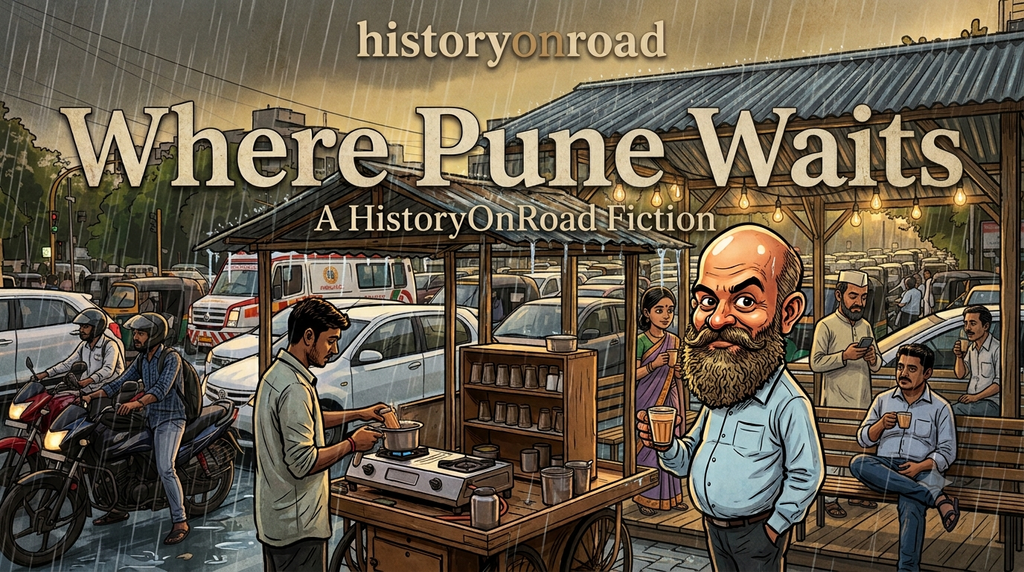
Aakash stood behind his tea stall at the corner, wiping the same glass he had wiped for the last ten minutes, watching the chaos with the tired patience of a man who had seen this a thousand times. His stall was small, just a wooden cart with a gas stove and a shelf of glasses, but it sat at a corner that saw more of the city’s temper than any office ever could.
“Ek chai,” said a voice. It was Ram, his shirt still carrying the cold smell of an office AC, phone in one hand, the other hand rubbing his forehead. He worked in data at an IT company nearby and usually stopped here after work, not for the tea alone, but for the five minutes of stillness before the ride home. In a world of dashboards and numbers, this small corner was the only place that still felt human to him.
“Aaj bhi wahi,” Aakash said, pouring the tea. Same as always.
Ram looked at the signal, dead for the third time that week, and at the ambulance stuck four cars deep with its siren wailing uselessly into a wall of vehicles that refused to move. He watched a young man on a bike lean out to film the scene on his phone instead of making way, and something in his chest tightened.
“Somebody’s father, somebody’s child, waiting in there,” Ram said quietly. “And nobody is willing to lose thirty seconds.”
Kabir arrived just then, parking his car badly because there was no good way to park anything in that mess. He ran a small manufacturing company, the kind that made unglamorous but necessary parts for other people’s machines. He was a regular too, mostly because Aakash’s chai reminded him of his college days in Pune, back when the city still had space to breathe and roads still had room for patience.
“You would think,” Kabir said, sitting on the wooden bench outside the stall, “that people forget an ambulance carries a life, not cargo.”
Aakash placed three cups on the counter, one for himself, which he rarely did, but tonight felt heavier than most nights.
“Sahab,” he said to Kabir, “I sell tea to everyone here. Good men, bad men, all take chai from me the same way. I have seen a boy risk his life to overtake fifteen vehicles just to reach a party ten minutes earlier. I have seen a grandmother trapped in a rickshaw for forty minutes because two cars refused to give way to each other over pride. This road does not care who you are. It only shows who you choose to be when nobody is watching.”
Ram smiled without humour. “It is strange. Everyone complains about the traffic. But when you ask them to be the one who waits, who lets go, who follows the line, suddenly the complaint disappears and the shortcut appears in its place.”
“We are a data heavy world now,” Ram continued, more to himself than to the others. “I look at numbers all day. Do you know what our commute numbers say? Pune loses lakhs of hours every week, sitting in jams that did not need to happen. That is not traffic. That is stolen time. Stolen from families, from sleep, from dinner tables, from a child waiting for a father to come home and read a bedtime story.”
Kabir nodded slowly. “And it costs us more than time. Fuel burnt for nothing pollutes the same air our children breathe. My own factory pays for it twice, once in diesel, once in the workers who arrive late, tired, and angry before the shift even begins. Anger does not stay on the road. It walks into homes, into offices, into every conversation that follows it. A man who spends an hour shouting in traffic rarely comes home gentle.”
Aakash wiped his hands on his apron. He was not a man of degrees or designations, but the road had taught him things no classroom could ever teach.
“You both talk of numbers and factories,” he said gently. “I only see faces. I see the same boy who jumps the signal every evening, who once shouted at an old man for walking too slowly across the street. That old man was somebody’s father too. We forget that behind every number plate sits a person who is loved by someone at home. The road does not know rich or poor, officer or worker. It only knows who waited and who did not.”
For a while none of them spoke. The signal flickered back to life, red first, and cars began to inch forward with the reluctant discipline of people who had no other choice left.
“There is a strange kind of person on our roads,” Kabir said after some time. “The kind who breaks every rule himself, then shouts at others to follow rules. I saw one today. He jumped the divider on his bike, and two minutes later he was screaming at a rickshaw driver for stopping in the wrong lane. He wanted the whole world disciplined except himself.”
Ram laughed softly, though there was no real joy in it. “Aakash uncle has a saying for that, doesn’t he.”
Aakash smiled for the first time that evening. “My father used to tell me, a man who lights a fire and then complains of the smoke has no right to call himself wise.”
Kabir repeated it under his breath, as if testing the weight of the words. “A man who lights a fire and then complains of the smoke has no right to call himself wise.”
“That is us,” Ram said. “All of us, sometimes. We want discipline from the world but not from ourselves. We want the ambulance to move fast, but we do not move aside. We want clean air, but we do not switch off the engine while waiting. We want a fair city, but we take the shortcut the moment nobody is looking.”
The ambulance finally broke free from the jam, its siren fading into the distance, carrying its own small unspoken relief with it. Aakash watched it go and something in his shoulders eased, as though a weight he had carried without knowing had finally been set down.
“You know what I have learned standing at this corner for twenty years,” he said. “Awareness campaigns come with posters and speeches and then they go, like the rain in June, loud for a while, then forgotten by July. But a man’s own conscience, that stays with him even when the poster is torn down and the officer has gone home for the night.”
Kabir looked at the busy road stretching ahead, headlights merging into a long restless river of red and white. “Maybe the answer was never in bigger signals or stronger fines alone. Maybe it starts smaller. In one driver who waits an extra ten seconds for an ambulance. In one father who tells his son that reaching five minutes late is better than not reaching at all. In one young man who chooses to lower his voice instead of raising it.”
Ram finished his tea and set the cup down carefully, as if the small act itself was a kind of promise he was making to himself. “We cannot control the man who jumps the signal beside us. We can only control whether we become like him. That is the only traffic rule that never fails, discipline with yourself, even when nobody else follows it.”
“There is an old line my grandfather used to say about our village roads,” Kabir added. “He said a road is not measured by how wide it is, but by how many people cross it safely because someone chose to wait.”
Aakash nodded, pouring himself a last half cup. “Then let us be the ones who wait, patiently and without anger, so that someone else’s tea is still warm when the road finally lets them home. Let us be the calm in a place that has forgotten what calm feels like.”
The signal turned green. The three of them stood there a moment longer, unhurried, letting the evening traffic move without them, three ordinary men who had, in their own quiet corner of the city, chosen the one road that could never get jammed. Patience.
A young college student who had been standing nearby, waiting for her friend, had overheard most of the conversation while scrolling through her phone. She looked up and asked, almost shyly, “But sir, if everyone else is breaking the rules, why should only a few of us follow them. Does it not feel pointless sometimes.”
Kabir turned to her with the gentle patience of someone answering a question he had once asked himself. “It feels pointless only until you remember that a city is built one person at a time, not all at once. Nobody waited for the whole world to plant trees before planting the first one. Somebody always has to go first, even if it feels lonely in the beginning.”
Ram added, “And you are not really doing it for others. You are doing it so that your own mind stays clean of the anger this road tries to hand out for free. The moment you follow the rule for yourself, not to prove a point to anyone else, it stops feeling pointless and starts feeling like peace.”
The girl smiled, thanked them, and walked off toward her friend, repeating the words softly under her breath as though she wanted to remember them for later.
As the crowd thinned and the noise softened into the ordinary hum of a city settling into night, Ram looked at his two companions and said what felt like the simplest truth of the evening. “Maybe peace on the road begins the same way peace begins anywhere else, one person deciding not to add to the noise.”
Kabir raised his empty cup slightly, as if offering a quiet toast to no one in particular. “To patience then. The cheapest thing anyone can offer this city, and somehow the rarest.”
Aakash smiled and began washing the glasses again, the same slow, steady motion he had repeated for twenty years at that same corner, waiting, as he always did, for the city to someday learn what he had known all along.
HistoryOnRoad, every corner of the city carries a story. This one asks us to slow down, before the road forces us to stop.



Borrowed Glory in Kalikapur: The Story of a Village Election